THEBUSINESSBYTES
BUREAU
BHUBANESWAR,
JANUARY 22, 2026
In a decisive move to safeguard its
agrarian economy against the growing threat of climate variability, the Odisha Government
on Thursday launched the Odisha Agriculture Drought Mitigation Programme
(OADMP), a ₹141.50 crore initiative that marks a
strategic shift from reactive relief measures to a proactive, science-led
resilience framework. Signed under the National Drought Mitigation Project
(NDMP), the programme positions Odisha at the forefront of climate-resilient
agricultural transformation in India.
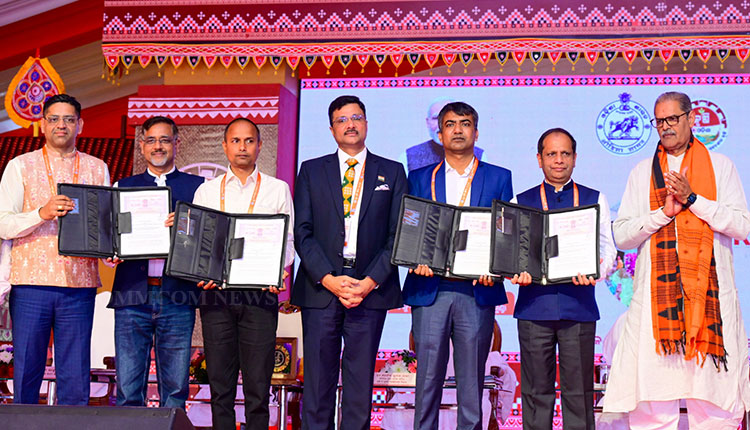
The Memorandum of Agreement (MoA) was
signed by the Department of Agriculture & Farmers’ Empowerment during the
inaugural session of Krushi Odisha 2026, in the presence of Kanak Vardhan Singh
Deo, Deputy Chief Minister and Minister of Agriculture & FE and Energy.
The MoA was signed by Shubham Saxena,
Director of Agriculture & FP, Odisha, along with Dr. Himanshu Pathak,
Director General, ICRISAT; Dr. V. K. Singh, Director, ICAR-CRIDA; and Dr. Swati
Nayak, South Asia Lead, IRRI.
The ambitious programme brings
together a formidable alliance of institutions, including the National Disaster
Management Authority (NDMA), Odisha State Disaster Management Authority
(OSDMA), and leading global research bodies such as ICRISAT, IRRI, and
ICAR-CRIDA, underscoring its strong scientific and institutional foundation.
 Breaking away from conventional
“scheme-wise” interventions, OADMP adopts a “landscape-first” strategy that
integrates water, soil, and crop management across entire village clusters,
ensuring that each intervention strengthens the other. “This project moves
beyond temporary aid. We are building a system where science leads the way—from
the farm to the entire value chain,” said Dr. Arabinda Kumar Padhee, Additional
Chief Secretary, DAFE, highlighting the programme’s long-term vision.
Breaking away from conventional
“scheme-wise” interventions, OADMP adopts a “landscape-first” strategy that
integrates water, soil, and crop management across entire village clusters,
ensuring that each intervention strengthens the other. “This project moves
beyond temporary aid. We are building a system where science leads the way—from
the farm to the entire value chain,” said Dr. Arabinda Kumar Padhee, Additional
Chief Secretary, DAFE, highlighting the programme’s long-term vision.
With total funding of ₹141.50
crore drawn from the National Disaster Mitigation Fund (NDMF) and State
Government resources, the programme will be rolled out immediately in three
highly vulnerable blocks—Komna in Nuapada, Kosagumuda in Nabarangpur, and
Raruan in Mayurbhanj. It is set to directly benefit 24,000 households, while
many more will gain through convergence with existing state and central
schemes. A real-time digital dashboard will monitor key indicators ranging from
soil moisture to household income, ensuring transparency, accountability, and
data-driven scaling.
The initiative aims to stabilise farm
incomes by delivering steadier yields and higher cropping intensity through the
introduction of drought-tolerant seed varieties and community-managed water
recharge systems. It also places strong emphasis on empowering Self-Help Groups
and Farmer Producer Organizations by enhancing access to modern farm
mechanisation and high-value markets, thereby strengthening the entire
agricultural value chain.