Says clean energy transition must become a
people’s movement, creating economic opportunities and household prosperity
THEBUSINESSBYTES BUREAU
NEW DELHI, NOVEMBER 5, 2026
India’s remarkable transformation in the renewable energy sector has
demonstrated that environmental commitments are not a constraint on economic
growth but a powerful catalyst for development, Vice-President C P
Radhakrishnan said on Thursday, asserting that the country's clean energy
journey offers an inspiring model for the Global South. He called for making
the transition to clean energy a people's movement, with active participation
from citizens, farmers, entrepreneurs and institutions to generate economic
opportunities, create livelihoods and enhance household prosperity.
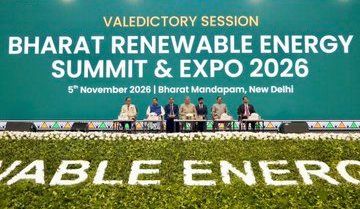
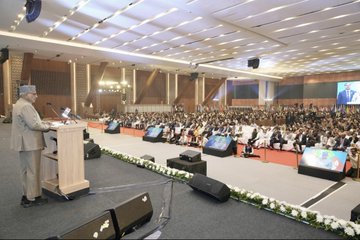
Addressing the valedictory session of the Bharat Renewable Energy
Summit and Expo 2026 at Bharat Mandapam here, Radhakrishnan highlighted
India's significant achievements in renewable energy and said the country had
successfully demonstrated that rapid economic growth and environmental
sustainability could go hand in hand.
 Recalling the scepticism over whether a developing country of India's
size could sustain high economic growth while reducing its dependence on fossil
fuels, the Vice-President said the country's achievements had effectively
answered such doubts.
India's non-fossil fuel-based installed power capacity has crossed 300
GW, while the country achieved 50 per cent of its installed electricity
capacity from non-fossil fuel sources in 2025, five years ahead of its target,
he said.
Highlighting the remarkable expansion of solar energy, Radhakrishnan said
India's solar power capacity had surged from less than 3 GW to over 170 GW in a
decade, reflecting the country's growing commitment to clean and affordable
energy.
He noted that solar power, which was once several times more expensive
than coal-based electricity, had now emerged as one of the cheapest sources of
electricity in the country.
The transformation, he said, was the outcome of sound policy initiatives,
private enterprise and the collective efforts of states and citizens.
Expressing optimism over the emerging hydrogen energy sector, the Vice-President
said encouraging progress was being made in the country and expressed
confidence that advancements in science and technology would make hydrogen
energy increasingly affordable in the coming years.
Describing India's renewable energy journey as an achievement with global
significance, he said the country's experience could serve as an inspiring
example for developing nations, particularly those in the Global South, seeking
to balance economic development with environmental protection.
Radhakrishnan said the progress made over the last decade had vindicated
Prime Minister Narendra Modi's vision that environmental commitments could
become catalysts for economic growth by expanding energy access, lowering
industrial costs, generating employment and reducing dependence on imports.
Emphasising the importance of research and innovation, he called for
stronger collaboration between industry and academic institutions, observing
that the technologies of 2040 would emerge from today's laboratories and start-ups.
"The technologies of 2040 will come from the laboratories and
start-ups of today," he said, underlining the need to nurture innovation,
scientific research and entrepreneurship to strengthen India's clean energy
ecosystem.
Highlighting the people-centric dimension of the renewable energy
transition, the Vice-President said more than 65 lakh households had joined the
solar movement under the PM Surya Ghar Muft Bijli Yojana, gaining access to
affordable clean electricity.
He also noted that nearly 30 lakh farmers had benefited from the PM-KUSUM
scheme, which enables them to reduce diesel expenditure through solar-powered
pumps, earn additional income and become 'Urjadatas' by contributing to energy
generation alongside food production.
Radhakrishnan said initiatives such as PM-JANMAN and the Dharti Aaba
Janjatiya Gram Utkarsh Abhiyan were extending electricity access to remote
tribal habitations where conventional grid connectivity might not be feasible.
Access to electricity, he observed, was transformative as it opened up
new opportunities in education, healthcare, communication and livelihoods,
adding that energy solutions must be designed to address the distinct
requirements of urban centres, rural communities and remote habitations.
Calling the renewable energy transition a 'Jan Andolan', in line with the
Prime Minister's vision, the Vice-President said the movement could not be
driven by the government alone and required the active involvement of teachers,
students, entrepreneurs and citizens.
He stressed that wider public participation would accelerate renewable
energy adoption while generating employment, creating new livelihood
opportunities and strengthening household economies.
Invoking Mission LiFE, Radhakrishnan urged citizens to embrace
energy-efficient practices, mindful consumption and responsible disposal of
resources, noting that a billion small individual actions could contribute as
significantly to sustainability as the establishment of a new power plant.
Looking ahead, he said the coming decade would be crucial for achieving
global climate goals and reiterated India's commitment to the vision of Viksit
Bharat by 2047 and net-zero emissions by 2070.
With India's electricity demand projected to rise nearly seven-fold by
2070, he emphasised the need to ensure that growing energy requirements were
met through clean, reliable and affordable power without compromising
environmental sustainability.
Urging participants to convert the deliberations of the summit into
tangible outcomes, the Vice-President said, "Turn discussions into
projects, and projects into power."
Calling for stronger international cooperation in the renewable energy
sector, he observed, "If the world is to be lit by the Sun, let it be lit
by hands that work together."
On the occasion, Radhakrishnan presented the Excellence in Renewable
Energy Awards and PM Surya Ghar Awards to outstanding-performing states,
government departments, vendors, brand owners and public sector banks.
Union Minister for New and Renewable Energy Pralhad Joshi, Minister of
State for New and Renewable Energy Shripad Yesso Naik, Principal Scientific
Adviser to the Government of India Ajay Kumar Sood and Secretary in the
Ministry of New and Renewable Energy Santosh Kumar Sarangi were among those
present.
Representatives of partner countries, policymakers, investors, industry
leaders, knowledge partners, exhibitors and other delegates also participated
in the summit.