THEBUSINESSBYTES
BUREAU
NEW
DELHI, SEPTEMBER 17, 2026
Prime Minister
Narendra Modi on Thursday said India’s semiconductor ecosystem is expanding
rapidly, opening up new opportunities for innovation, investment and growth, as
he pitched the country as a trusted destination for global chip manufacturing
and called for greater industry participation in research, development and
talent creation.
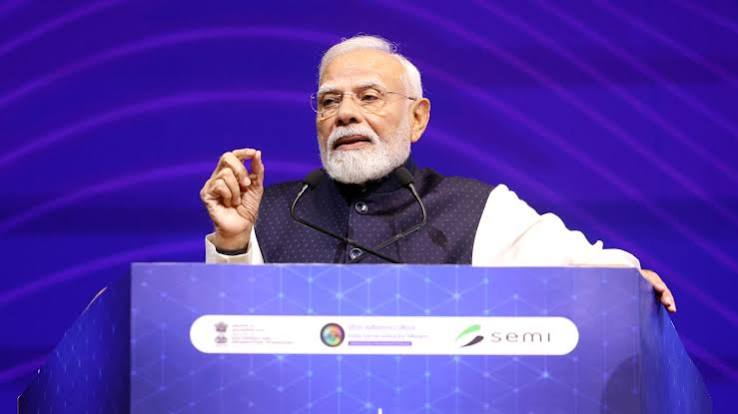
Inaugurating the
fifth edition of SEMICON India 2026 at Yashobhoomi in New Delhi, Modi welcomed
participants from India and abroad and said the event assumes special
significance as the country moves from policy formulation and project planning
to commercial semiconductor production. SEMICON India 2026 is being held from
September 17-19 with the theme “Silicon to Systems: Building the Ecosystem”.
The Prime Minister
drew a parallel between the launch of SEMICON India and Vishwakarma Jayanti,
saying the convergence of India’s centuries-old tradition of creation and
construction with 21st-century technology and vision provides inspiration for a
self-reliant and developed India.
“On one side, our centuries-old tradition of
creation, and on the other side, the technology and vision of the 21st century
— this is our inspiration for self-reliant India, for developed India,” he
said.
Highlighting
developments over the past 15 days, Modi referred to discussions on inclusive
finance at the Global Fintech Fest, the operationalisation of a 3,000-km
Dedicated Freight Corridor and quarterly GDP growth of 7.8 per cent. He also
cited a recent sovereign rating upgrade by a Japanese credit rating agency,
saying these developments reflected both economic expansion and growing
international confidence in India.
“Meaning, on one hand, India’s economy is
growing, and on the other hand, the world’s trust in India is also increasing,”
he said.
Referring to the
recently concluded BRICS Summit hosted by India, Modi said the unanimous
adoption of the New Delhi Declaration demonstrated international consensus and
was another indication of global confidence in the country.
The Prime Minister
traced the evolution of the India Semiconductor Mission since its launch in
2022, noting that the journey had moved from policy discussions and project
planning to pilot lines and commercial production. He said chips manufactured
in India had started reaching customers domestically and globally, while
commercial production had commenced at two new plants in Mohali and Surat.
“Now our chips, coming out of India’s plants,
have started reaching customers in the country and the world,” Modi said.
Acknowledging the complexity
of creating a semiconductor ecosystem, Modi said India had rapidly developed
capabilities across chip design, equipment manufacturing and testing through
collaboration between the government and industry.
He described industry
leaders as “pillars” and partners in India’s semiconductor journey, saying
their participation had helped the country make a rapid technological
transition.
The Prime Minister
said the sector must maintain its momentum and explained the importance of
“tape out” in chip development, while emphasising that the government was
already preparing for the next generation of semiconductor technology.
He announced the
second phase of the Semiconductor Mission with an outlay of USD 13.5 billion
and said regulatory reforms were being undertaken to facilitate greater
collaboration among international companies, startups and design firms. The
Union Cabinet had approved Semicon 2.0 in July 2026 with an outlay of Rs
1,27,500 crore, with the programme focusing on research and development, chip
design, machines and materials, fabs, talent and advanced packaging.
“The Government of India is taking every step
needed for the success of your projects,” Modi said.
Outlining his vision
for a complete domestic semiconductor supply chain, Modi stressed the need to
nurture fabless companies, develop intellectual property and integrate silicon
photonics into AI-enabling infrastructure.
He urged companies
operating in equipment, chemicals, gases and materials to take advantage of the
opportunities emerging from the 12 approved semiconductor projects and the
expanding demand pipeline.
“We want the entire ecosystem to grow
together,” he said.
Modi also highlighted
India’s large pool of engineers and the country’s growing skilling programmes
for chip design. He said the government had set a target of training one lakh
engineering students in semiconductor-related skills, with around 70,000
already trained.
“Such a large talent pool is, in a way,
nothing less than a gold mine for all of you,” he said.
Calling on Indian and
overseas researchers and young technology professionals to contribute to
advanced research in India, the Prime Minister urged industry leaders to
spearhead research and development activities in the country.
He said greater
industry participation in R&D would create benefits for businesses while
strengthening opportunities for India’s youth.
“There is benefit for the industry in this,
and the youth power of India will also get strength from this,” Modi said.
Addressing the
changing requirements of the global semiconductor industry, Modi said the rapid
growth of artificial intelligence was shifting the focus beyond transistor size
towards overall system integration, including memory placement and heat
management.
He said India was preparing
to meet these emerging manufacturing challenges and position itself as a
reliable destination for global companies seeking new production locations.
“The world is looking for new and trusted
manufacturing destinations; India is steadily preparing itself to meet this
need,” he said.
Modi also underlined
the importance of energy security for semiconductor manufacturing and AI
infrastructure, noting the enormous electricity requirements of
high-performance computing and the need for uninterrupted power supplies for
manufacturing plants.
He said India was
rapidly expanding its power-generation capacity, including solar energy, which
has crossed 160 GW, while the government has also opened the nuclear energy
sector to private participation and is working on small modular reactors.
“Therefore, India today is making huge
investments in the power sector as well,” he said.
The Prime Minister
said the expansion of energy infrastructure would provide an important
foundation for the semiconductor ecosystem and reiterated the government’s
commitment to creating conditions conducive to industrial growth.
“India is taking every step that makes us a
preferred destination for the semiconductor industry,” he said.
SEMICON India 2026
brings together global semiconductor and electronics companies, industry
leaders, policymakers, investors, researchers, academia, startups and students.
The three-day event is aimed at strengthening collaboration across the
semiconductor value chain, from design and manufacturing to packaging,
materials, talent and research.
Concluding his address, Modi linked India’s technological ambitions with its democratic traditions and the country’s constitutional legacy, saying that the development of a critical industry in the “Mother of Democracy” would contribute to strengthening global semiconductor supply chains.
“India’s aspirations are before you, and the new opportunities being created in India are ready to welcome you,” he said.