
THEBUSINESSBYTES BUREAU
NEW DELHI, JULY 30, 2026
In a significant step towards positioning India as a global
hub for medical technology, Invest India, the National Investment Promotion and
Facilitation Agency of the Government of India, on Wednesday signed a
Memorandum of Understanding (MoU) with the Asia Pacific Medical Technology
Association (APACMed) to strengthen collaboration between the government and
the global MedTech industry for driving investment, innovation and sustainable
growth.
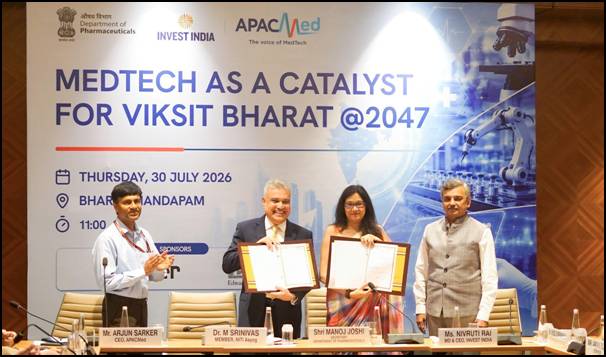
The MoU was signed at Bharat Mandapam in New Delhi in the
presence of Manoj Joshi, Secretary, Department of Pharmaceuticals, Ministry of
Chemicals and Fertilisers, and Dr. M. Srinivas, Member, NITI Aayog.
The strategic partnership establishes a comprehensive
framework for collaboration across key areas, including investment
facilitation, regulatory and policy engagement, research and innovation,
technology transfer, and digital health. It also aims to enhance engagement
with APACMed’s member companies, facilitate investments and business expansion
in India, strengthen domestic manufacturing capabilities, promote local value
addition, improve ease of doing business, and deepen India’s integration into
global MedTech value chains.
Following the signing ceremony, a CEO Roundtable on “MedTech
as a Catalyst for Viksit Bharat @2047” was chaired by Manoj Joshi. The
roundtable brought together 26 senior industry leaders representing global
healthcare and medical technology companies, including Boston Scientific,
FUJIFILM India, Abbott, Johnson & Johnson, Medtronic, GE Healthcare, Bayer
Pharmaceuticals and Stryker.
The discussions centred on strategic priorities for
strengthening India’s MedTech ecosystem and enhancing its global
competitiveness. Participants deliberated on critical policy and regulatory
reforms, investment opportunities, local sourcing, resilient supply chains,
research and development, the expanding role of Global Capability Centres
(GCCs), talent development, workforce enhancement and strategies to boost
India’s participation in global MedTech markets.
Addressing the gathering, Manoj Joshi highlighted the
remarkable progress made by India’s medical devices sector over the past few
years, attributing the growth to rising healthcare demand, expanding healthcare
infrastructure, the Production Linked Incentive (PLI) Scheme and several
supportive government initiatives.
He said the sector must now evolve into a stronger and
better-regulated ecosystem that prioritises quality, patient safety and global
competitiveness.
Outlining the government's long-term roadmap, Joshi said
India aims to significantly strengthen domestic value addition, particularly in
high-end medical devices and imaging equipment, by developing a robust
component manufacturing ecosystem. He said the government intends to increase domestic
value addition from the current level of nearly 25 per cent to between 40 and
45 per cent.
He further stated that the government remains committed to
supporting the sector through enabling policy measures and is actively
exploring the next phase of the PLI Scheme. Greater investments are also being
encouraged in domestic manufacturing of reagents and diagnostics, alongside the
development of a globally competitive component manufacturing industry with
strong export potential.
"Through sustained collaboration between Government and
industry, we aim to build a resilient, innovation-driven and globally
competitive MedTech ecosystem that contributes to the vision of Viksit Bharat
@2047," Joshi said.
Dr. M. Srinivas, Member, NITI Aayog, emphasised that building
a robust MedTech ecosystem is crucial for the future of healthcare in India. He
said the convergence of clinical expertise with technology, research and
digital innovation can significantly strengthen healthcare delivery while
expanding access to quality medical care. He underlined the need for continued
collaboration among the government, industry, academia and innovators to
accelerate research and development, promote adoption of emerging technologies
and create a resilient and globally competitive MedTech sector.
Invest India Managing Director and CEO Nivruti Rai said India's MedTech capabilities are now receiving global recognition. "A device that works here works anywhere because it has been tested against a diverse population. Invest India will work with companies, not around them," she remarked, reaffirming the agency’s commitment to supporting investors and innovators.
APACMed Chief Executive Officer Arjun Sarker described the MoU as a landmark initiative reflecting the shared commitment of APACMed and Invest India to advance India's MedTech ecosystem through stronger collaboration between industry and government. He expressed confidence that the partnership would help unlock new opportunities for innovation, investment and sustainable growth while reinforcing India's position as a preferred global destination for medical technology manufacturing and innovation.