THEBUSINESSBYTES
BUREAU
NEW
DELHI, SEPTEMBER 12, 2026
Jindal Steel Ltd has
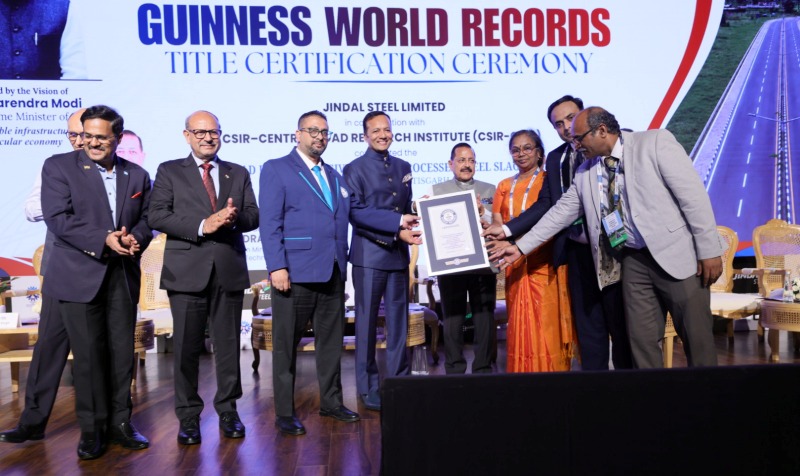
set a global benchmark in sustainable infrastructure by building the world’s
longest road made exclusively with processed steel slag aggregates, earning a
Guinness World Records title for the 1.85-km project at Raigarh in
Chhattisgarh. The four-lane divided road, built using around 2 lakh tonnes of
processed electric arc furnace (EAF) slag, demonstrates how an industrial
by-product can be converted into a high-value construction material while
reducing the use of natural stone and dependence on quarrying.
Built in
collaboration with the CSIR-Central Road Research Institute (CSIR-CRRI), the
road is designed to withstand heavy commercial traffic and has a loading
capacity of 65 million standard axle repetitions.
The project
represents a significant application of circular-economy principles in the
infrastructure sector, with processed steel slag replacing natural aggregates
across the entire pavement structure.
The steel slag
undergoes controlled ageing and stabilisation, followed by recovery of
entrapped metal, crushing, screening, grading and quality checks to convert it
into engineered road aggregates.
Before deployment,
the processed material was subjected to physical, mechanical, geotechnical and
environmental testing. It was subsequently used across the full pavement depth,
including the formation, granular and bituminous layers.
According to Jindal
Steel, the technology enabled 100 per cent replacement of natural aggregates in
the road, saving approximately 2 lakh tonnes of virgin stone and reducing
dependence on quarrying, along with the extraction, processing and
transportation associated with conventional road aggregates.
The pavement is also
approximately 35 per cent thinner than conventional designs, while the project
has estimated construction cost savings of up to 40 per cent, the company said.
 “This achievement shows how science,
technology and industry can transform industrial co-products into valuable
resources for nation-building. It is a strong example of the circular economy
in action,” Naveen Jindal, Chairman, Jindal Steel Ltd, said.
“This achievement shows how science,
technology and industry can transform industrial co-products into valuable
resources for nation-building. It is a strong example of the circular economy
in action,” Naveen Jindal, Chairman, Jindal Steel Ltd, said.
He said India's
growth must be powered by innovation that creates economic value while
protecting the environment.
Union Minister for
Science and Technology Jitendra Singh said the Raigarh road demonstrates
India's ability to translate scientific innovation into practical
infrastructure solutions.
“By transforming steel slag into a high-value
resource for road construction, the project reflects the vision of ‘Waste to
Wealth’ and showcases the potential of indigenous technology to address
real-world challenges,” Singh said.
He expressed
confidence that the technology would find wider application across the country.
The processed slag
was tested for environmental suitability under prescribed methods and cleared
for use in road construction, the company said.
As part of its effort
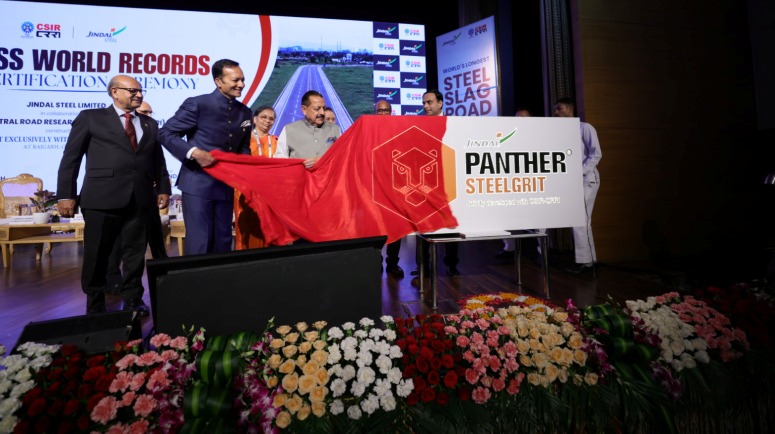
to promote wider commercial adoption of the technology, Jindal Steel also
launched SteelGrit, its brand of processed steel slag aggregates, positioning
it as an engineered construction material.
Jindal Steel and
CSIR-CRRI have also signed a technology transfer agreement aimed at
facilitating the adoption of the technology beyond Raigarh.
The development comes at a time when the growing demand for infrastructure is increasing the requirement for construction aggregates, while industries are under increasing pressure to reduce waste and their dependence on natural resources.
The Raigarh project provides a potential model for addressing both challenges by converting steel slag into a usable infrastructure input and reducing the consumption of virgin aggregates.