From
zero subscribers in August 2016 to more than 1.85 crore mobile users and 8 lakh
home broadband customers, Jio’s decade in Odisha mirrors the State’s rapid
digital transformation
PRIYABRAT
BISWAL
BHUBANESWAR,
SEPTEMBER 4, 2026
Ten
years ago, when Reliance Jio entered Odisha, the State’s telecom market was a
very different proposition. Mobile data was expensive, 4G access was limited,
smartphones remained beyond the reach of a large section of consumers and rural
internet penetration was still at an early stage. A decade later, Jio has not
merely built the largest telecom subscriber base in Odisha; it has helped
reshape the economics of connectivity and, in the process, become a significant
enabler of the State’s digital economy.
Jio
commercially launched its services in Odisha on September 5, 2016, alongside
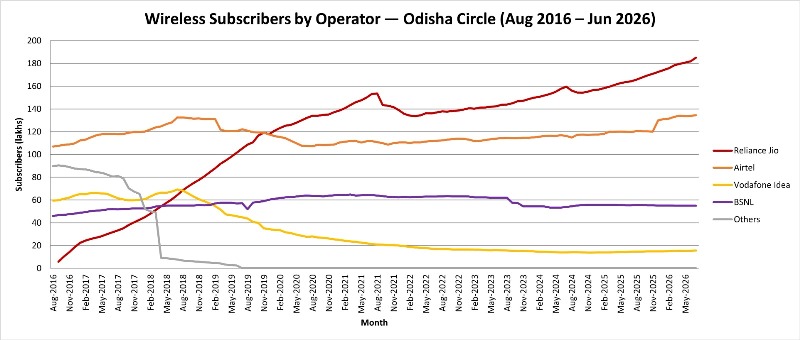
its national rollout. From virtually zero subscribers at the time of entry, the
operator acquired 5.8 lakh customers in the State in its first month. By July
2026, its subscriber base had crossed 1.85 crore, making it the largest telecom
operator in Odisha by both subscriber base and revenue.
The
scale of its market leadership is evident from the latest Telecom Regulatory
Authority of India (TRAI) numbers. Of the nearly 3.9 crore mobile subscribers
in Odisha, Jio commands a 47.4 per cent subscriber market share. Its share of
gross revenue is even higher, at around 52 per cent, highlighting the
operator’s dominant position in what has become one of India’s fastest-changing
consumer markets.
 The
numbers, however, tell only one part of the story.
The
numbers, however, tell only one part of the story.
The
more significant business transformation lies in what happened to data
consumption and internet adoption after affordable high-speed connectivity
became widely available. Jio’s aggressive expansion of its 4G and later 5G
network, coupled with affordable data and voice offerings, accelerated the
transition of the internet from an urban-centric service into a mass-market
utility.
According
to TRAI data, Odisha had around 90 lakh internet users in September 2016. By
the end of March 2026, that number had risen to more than 3 crore. In less than
a decade, therefore, the State’s internet user base has more than tripled.
The
transformation has been particularly striking in rural Odisha. Internet users
in rural areas have risen from around 38 lakh in September 2016 to over 1.87
crore by March 2026.
This
rural expansion is significant from a business perspective because it
represents the opening up of an entirely new digital consumption market. As
connectivity has penetrated deeper into the State, consumers in smaller towns
and villages have gained access to digital payments, online education, OTT
entertainment, e-commerce, social media, digital banking and a host of other
services.
The
increase in internet users per 100 people underlines the scale of the change.
In Odisha, the number rose from 21.21 in September 2016 to 64.79 by the end of
March 2026, almost a threefold increase.
The
rural numbers are even more striking. Internet users per 100 people in rural
Odisha increased more than fourfold, from 11.06 in September 2016 to 49.30 by
March 2026.
Jio’s
extensive 4G and 5G network footprint, along with its efforts to extend
high-speed connectivity to remote parts of the State, has been an important
component of this digital expansion.
The
company’s next major growth opportunity in Odisha came from the home broadband
market. The launch of JioFiber in September 2019 marked its entry into
fixed-line high-speed broadband, while JioAirFiber, launched in September 2023,
brought a wireless alternative to households and businesses that could not
easily be served by traditional fibre infrastructure.
The
result has been a rapid expansion of Jio’s presence beyond the mobile handset.
 By
the end of July 2026, Jio had more than 8 lakh home broadband subscribers in
Odisha. The company now accounts for more than 60 per cent of the State’s home
broadband subscriber market and more than 82 per cent of the Fixed Wireless
Access (FWA), or AirFiber, segment.
By
the end of July 2026, Jio had more than 8 lakh home broadband subscribers in
Odisha. The company now accounts for more than 60 per cent of the State’s home
broadband subscriber market and more than 82 per cent of the Fixed Wireless
Access (FWA), or AirFiber, segment.
For
Jio, this represents an important evolution in its business model. The
company’s proposition is no longer confined to mobile connectivity. High-speed
internet, Wi-Fi, home entertainment and OTT services have increasingly become
part of a broader digital-services ecosystem.
For
consumers, the implications are equally significant. Reliable home broadband
has become an essential enabler for working professionals operating from home,
students attending online classes, entrepreneurs building digital businesses
and small and large enterprises adopting cloud-based applications and digital
workflows.
Jio’s
decade-long expansion in Odisha has been accompanied by a steady stream of
products and technology upgrades designed to widen the addressable market.
The
company began with commercial 4G mobile services in September 2016. In August
2017, it launched JioPhone, an affordable 4G feature phone aimed at consumers
who wanted access to modern mobile services without the cost of a conventional
smartphone.
JioFi,
its Wi-Fi device, followed in March 2018. By 2018-19, Jio had become Odisha’s
No. 1 digital service provider in terms of both subscriber base and revenue.
The
launch of JioFiber in September 2019 expanded its presence into the home
broadband segment. In November 2021, the company introduced JioPhone Next, an
affordable 4G smartphone aimed at further reducing the cost barrier to smartphone
adoption.
Odisha
subsequently became an important part of Jio’s 5G journey. In October 2022, the
company demonstrated the State’s first live 5G service at Pahadpur village in
Mayurbhanj district. The official launch of 5G services in Odisha followed in
January 2023.
The
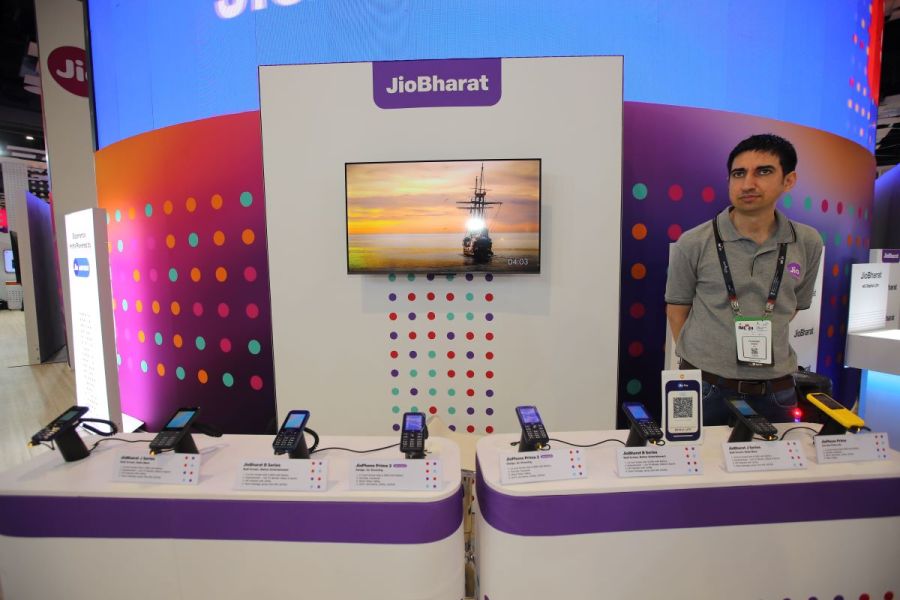
company continued to broaden its device and connectivity portfolio with the
launch of the affordable 4G feature phone JioBharat in July 2023 and
JioAirFiber in September 2023.
 These
launches reflect a strategy that has remained consistent since 2016: reduce the
cost of access, expand the addressable market and increase the amount of
digital activity that can be conducted over the network.
These
launches reflect a strategy that has remained consistent since 2016: reduce the
cost of access, expand the addressable market and increase the amount of
digital activity that can be conducted over the network.
Perhaps
the most disruptive element of that strategy was the introduction of free voice
calls across networks and inexpensive mobile data. For consumers, the immediate
benefit was lower communication costs. For the telecom industry, it represented
a fundamental change in the competitive landscape.
Jio’s
free outgoing calls put pressure on other operators, forcing them to reassess
their tariffs and business strategies. At the same time, the sharp reduction in
data prices triggered a dramatic increase in consumption across the country.
The
contrast between 2016 and 2026 illustrates the scale of that disruption.
In
2016, average monthly mobile data consumption in India was below 0.2 GB per
subscriber. A gigabyte of data cost around ₹228. At the time, fewer than 1 crore Indians had access
to 4G networks
and average download speeds were around 2.5 Mbps.
A
decade later, a gigabyte of mobile data costs roughly ₹7.9 — a decline of about 97
per cent from the 2016 level.
Active
4G and 5G subscribers across the country have climbed to around 93.8 crore. On
Jio’s network alone, average monthly data consumption per subscriber has
reached 42.3 GB.
The
company has also completed the rollout of its pan-India 5G network in about 15
months and has acquired around 26.8 crore 5G users in 42 months.
The
significance of these numbers extends well beyond the telecom sector.
Jio
has increasingly become part of the underlying infrastructure of India’s
digital economy. Affordable connectivity has helped create the conditions for
the rapid expansion of digital payments, OTT entertainment, e-commerce and
other internet-led businesses.
The
growth of the Unified Payments Interface, or UPI, provides perhaps the clearest
illustration.
According
to Government of India data, UPI transactions in financial year 2016-17 — the
year Jio launched its services — were worth only around ₹7,000 crore. By financial year
2025-26, the value had risen more than 4,000 times to ₹314 lakh crore.
The
OTT industry has undergone a similarly dramatic expansion. The number of OTT
viewers has increased from around 3 crore to about 60 crore.
The
common denominator behind these developments is connectivity.
The
number of internet users in India has risen from around 36 crore in September
2016 to more than 109 crore by the end of March 2026. As data became cheaper
and networks expanded, digital services acquired a mass-market audience that
would have been difficult to build on the economics of the pre-Jio era.
The
device ecosystem has played an equally important role.
Before
the transition to affordable 4G devices, around 50 crore people in India were
using 2G technology. Many remained on 2G because they could not afford a
smartphone capable of running on 4G networks, while others preferred the
simplicity and familiarity of a button phone.
Jio
sought to address both barriers with affordable 4G devices. JioPhone and
subsequently JioBharat provided consumers with low-cost routes into the 4G
ecosystem, potentially bringing millions of users into the digital economy
without requiring them to make the financial leap to premium smartphones.
In
Odisha, this national transformation has had a particularly visible rural
dimension.
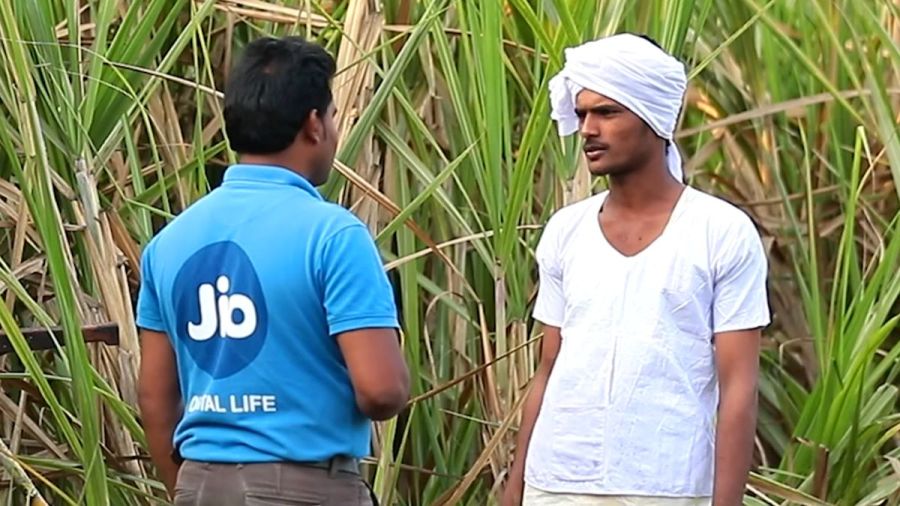 The
growth in rural internet users from around 38 lakh in September 2016 to over
1.87 crore by March 2026 suggests that digital connectivity is no longer
concentrated in Bhubaneswar, Cuttack and other major urban centres. The
expansion of networks into smaller towns and villages has created a much wider
market for digital services and is changing the way consumers, businesses and
institutions interact.
The
growth in rural internet users from around 38 lakh in September 2016 to over
1.87 crore by March 2026 suggests that digital connectivity is no longer
concentrated in Bhubaneswar, Cuttack and other major urban centres. The
expansion of networks into smaller towns and villages has created a much wider
market for digital services and is changing the way consumers, businesses and
institutions interact.
For
businesses, the implications are substantial. A larger connected population
means a larger potential customer base for digital payments, online commerce,
entertainment, financial services and technology-enabled products. For
entrepreneurs, connectivity lowers some of the geographical barriers to
reaching customers and markets. For educational institutions and students,
high-speed internet expands access to digital learning resources. For
professionals, broadband connectivity enables remote and hybrid working models.
This
is where Jio’s decade in Odisha acquires significance beyond the company’s own
balance sheet.
The
operator’s market leadership — with more than 1.85 crore mobile subscribers,
around 47.4 per cent mobile subscriber share, roughly 52 per cent gross revenue
share and more than 8 lakh home broadband users — reflects the commercial
success of its strategy.
But
the broader impact is the creation of a much larger digital addressable market.
From
its launch in September 2016, Jio has moved through several distinct phases in
Odisha: establishing a nationwide 4G network, driving down the cost of data and
voice, expanding into affordable devices, moving into fibre broadband,
extending 5G connectivity and subsequently building a wireless home broadband
proposition.
The
company’s trajectory also mirrors the evolution of India’s telecom sector from
a voice-led business into a data-centric digital infrastructure industry.
A
decade ago, mobile connectivity was primarily about calls and messages, with
mobile internet still an expensive and relatively limited proposition. Today,
the smartphone is a bank, classroom, entertainment platform, workplace,
marketplace and communications device rolled into one.
For
Odisha, the transformation has been especially consequential because the
State’s large rural population means that expanding affordable connectivity can
have effects far beyond traditional telecom consumption.
As
the State’s economy becomes increasingly digital, the availability of reliable
high-speed networks is likely to assume an even greater role in business
formation, employment, education and consumption.
The
next phase of competition, therefore, may not be determined only by the number
of mobile subscribers an operator can acquire. It could increasingly depend on
how effectively telecom networks become integrated with homes, businesses,
devices, entertainment, payments and other digital services.
 Jio
enters its second decade in Odisha from a position of considerable strength. It
is the State’s largest mobile operator by subscriber base and revenue, commands
a dominant position in home broadband and has an overwhelming share of the
emerging FWA market.
Jio
enters its second decade in Odisha from a position of considerable strength. It
is the State’s largest mobile operator by subscriber base and revenue, commands
a dominant position in home broadband and has an overwhelming share of the
emerging FWA market.
Yet
the larger story is not simply one of market share.
It
is the story of a telecom entrant that helped change the price of connectivity,
a network that expanded the boundaries of the internet and a decade in which
Odisha moved from having around 90 lakh internet users to more than 3 crore.
From
5.8 lakh subscribers in its first month of operations to more than 1.85 crore a
decade later, Jio’s Odisha journey has been one of scale, disruption and
digital expansion.
The
State’s digital transformation is far from complete. But if the first decade
was about putting affordable connectivity within reach of millions, the next
could be about what those millions do with it — and how deeply the resulting
digital economy becomes embedded in Odisha’s businesses, homes and everyday
life.