
THEBUSINESSBYTES BUREAU
BHUBANESWAR, FEBRUARY 12, 2026
KIIT is
poised to assume a pivotal role in safeguarding Asia’s vast and largely
unprotected Buddhist heritage. At a time when leading scholars and conservation
experts from India, China, Korea and Japan have voiced serious concerns that
more than 90 per cent of Buddhist heritage sites — particularly those located
in remote and rural regions — remain outside formal protection frameworks, KIIT
and KISS have stepped forward with a timely and forward-looking response. An
International Academy for the Preservation and Management of Unprotected
Buddhist Heritage and Sites in Rural Areas is being established by the Indian
Trust for Rural Heritage and Development, with Professor Dr. Amareswar Galla,
Pro-Chancellor and Professor at KIIT & KISS, providing intellectual vision
and strategic leadership to the ambitious initiative.
 Prof. Galla,
a distinguished scholar of Indigeneity and Inclusive Museum & Heritage
Studies at both KIIT and KISS, is now collaborating closely with the KIIT
School of Law to conceptualise and design a specialised academic programme in
UNESCO International Heritage Law. Once introduced, the programme will be the
first of its kind in South Asia, positioning KIIT at the forefront of heritage
governance, cultural diplomacy and international legal studies related to
heritage conservation.
Prof. Galla,
a distinguished scholar of Indigeneity and Inclusive Museum & Heritage
Studies at both KIIT and KISS, is now collaborating closely with the KIIT
School of Law to conceptualise and design a specialised academic programme in
UNESCO International Heritage Law. Once introduced, the programme will be the
first of its kind in South Asia, positioning KIIT at the forefront of heritage
governance, cultural diplomacy and international legal studies related to
heritage conservation.
Prof. Galla
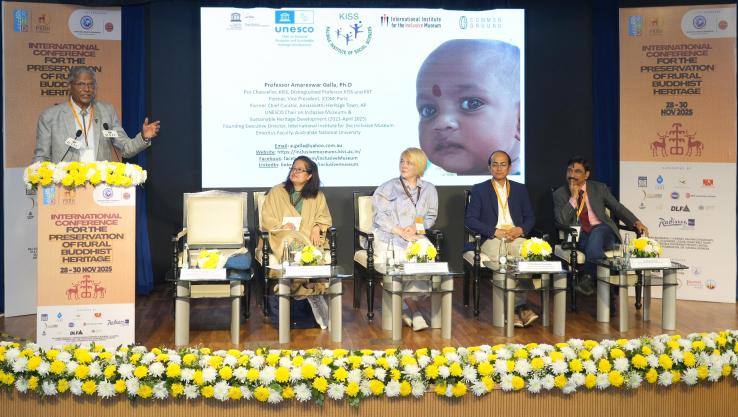
had earlier endorsed and advanced the proposal for the Academy during a major
international conference held late last year, drawing wide support from global
experts. Building on that momentum, a core group of eminent scholars, heritage
practitioners and policy specialists convened in New Delhi on 7 February 2026
to deliberate on the Academy’s structure, academic framework, curriculum design
and long-term strategic roadmap.
Speaking on
the sidelines of the deliberations, Prof. Galla emphasised the urgent need for
integrated and interdisciplinary models that bring together robust legal
frameworks, community participation, ethical stewardship and sustainable
management practices to protect vulnerable Buddhist heritage sites situated
across rural landscapes. He highlighted that without coordinated legal and
institutional mechanisms, many culturally significant sites risk irreversible
neglect and degradation.
The
initiative carries particular significance for Odisha, a state with a rich and
globally recognised Buddhist legacy. Recently, UNESCO included Odisha’s famed
Buddhist Golden Triangle — Ratnagiri, Udayagiri and Lalitgiri — on India’s Tentative
List for World Heritage status through a serial nomination. The proposed
academic programme and the establishment of the International Academy are
expected to significantly strengthen Odisha’s institutional capacity to manage,
conserve and legally safeguard these historic sites, while also enhancing
research, policy advocacy and international collaboration in heritage
protection across South Asia.