THEBUSINESSBYTES
BUREAU
ROURKELA,
SEPTEMBER 3, 2026
Researchers at the
National Institute of Technology (NIT), Rourkela have developed a hybrid energy
storage system aimed at improving the efficiency and extending the lifespan of
batteries used in electric vehicles, an innovation that could help address key
challenges associated with the country's rapidly growing EV ecosystem.
The technology has
been developed by Professor Monalisa Pattnaik, Associate Professor in the
Department of Electrical Engineering, along with her research team comprising
Dr Pradyumna Kumar Behera and Karan Gupta.
The NIT-Rourkela team
has secured a patent for the technology and is open to collaboration with
electric vehicle original equipment manufacturers (OEMs), powertrain system
integrators, fleet operators and EV retrofit start-ups.
India, one of the
world's largest automobile markets, has witnessed rapid growth in electric
mobility, driven by concerns over dwindling petroleum reserves and government
initiatives including the National Electric Mobility Mission Plan and the FAME
schemes. Electric vehicle sales in the country crossed the one-million mark in
2022, reflecting the accelerating electrification of the domestic vehicle
fleet.
EVs rely on battery
packs, which comprise thousands of individual rechargeable cells. However,
conventional battery packs can suffer from limited power density, restricted
cycle life and increased thermal stress when subjected to rapid current
fluctuations.
These challenges
become particularly pronounced in urban driving conditions, where frequent
starting and stopping, sudden acceleration and deceleration, and regenerative
braking expose batteries to repeated high-rate current demands, potentially
accelerating cell degradation.
To address these
limitations, the researchers have developed a hybrid energy storage system
(HESS) that combines a battery pack with a high-power-density supercapacitor.
Supercapacitors store
energy electrostatically at the electrode-electrolyte interface and can charge
and discharge within seconds. Their specific power can be an order of magnitude
higher than that of conventional batteries, while their cycle life typically
exceeds one million charge-discharge cycles with negligible degradation.
In the proposed
system, the supercapacitor absorbs and supplies transient power during sudden
acceleration, deceleration and regenerative braking, reducing the high-rate
current stress on the battery and potentially extending its service life.
Battery and
supercapacitor systems are generally connected through passive, semi-active or
active configurations. In a passive configuration, the two energy storage
devices are directly connected, limiting the ability of the supercapacitor to
respond rapidly to changing power demands.
Active
configurations, on the other hand, use separate electronic converters to manage
the battery and supercapacitor independently. While this provides greater
control, it also increases the number of components, system complexity and
associated losses.
The NIT-Rourkela
researchers have sought to overcome these limitations through a hybrid energy
storage architecture that protects the battery from sudden power surges, makes
efficient use of supercapacitor energy and reduces the number of components
required.
“Our architecture contains three main
components, one converter to connect both battery and supercapacitor to the
vehicle’s electrical system, an inductor that is placed in the electrical path,
and a single control system to handle the power flow,” Prof Pattnaik said.
The single converter
serves both the battery and supercapacitor, reducing the number of switches and
control components and thereby simplifying the system. The inductor helps
protect the battery against sudden current surges, while the single control
system manages power flow during both acceleration and deceleration, reducing
hardware requirements.
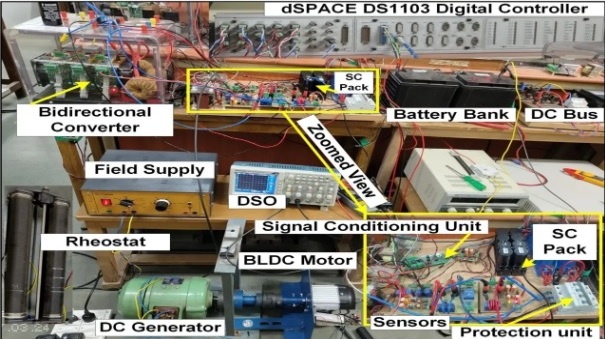
The researchers
tested the system under demanding operating conditions involving sudden
braking, rapid acceleration and deceleration. The tests showed that the system
maintained a stable 48-volt output, enabled smoother changes in battery current
and allowed the supercapacitor to efficiently handle sudden variations in power
demand.
“Our design is highly optimized for
low-voltage EV platforms operating in the 24 V to 60 V DC range. This includes
urban light electric vehicles such as electric scooters, electric motorcycles,
electric rickshaws (e-rickshaws), cargo tricycles, and campus/industrial
utility vehicles,” Prof Pattnaik said.
Beyond electric vehicles, the technology has potential applications in automated guided vehicles (AGVs), warehouse carts, DC microgrids and renewable-energy charging stations, the researchers said.
The patented technology could therefore offer a compact and relatively less complex approach to managing transient power demands while reducing stress on batteries, an important consideration as India expands its electric mobility infrastructure and the demand for longer-lasting, efficient energy storage systems grows.