
THEBUSINESSBYTES BUREAU
NEW DELHI/BHUBANESWAR, MAY 29, 2026
“Odisha has emerged as a frontline
agrarian powerhouse on the national stage,” as the state showcased its
ambitious agricultural roadmap and farmer-centric reforms during the National
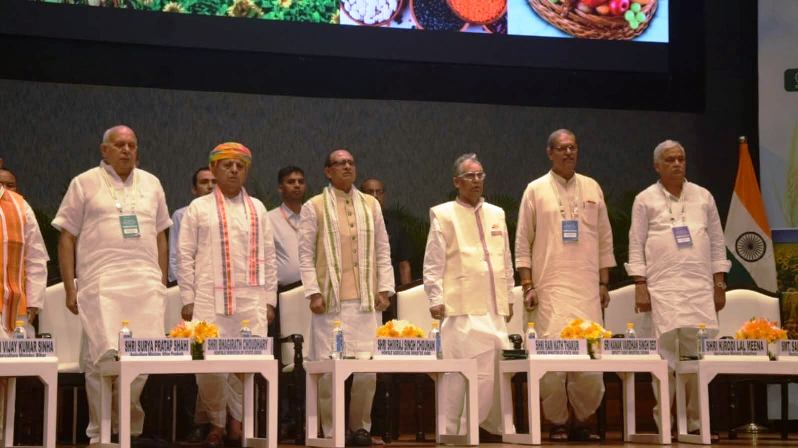
Conference on Kharif held in New Delhi on Friday.
Led by Deputy Chief Minister Kanak Vardhan Singh Deo, the Odisha
delegation presented a comprehensive strategy for the upcoming Kharif 2026
season while highlighting the state’s remarkable agricultural growth and
long-term vision for sustainable rural prosperity.
Participating in the high-level national conference organized ahead of
the Kharif cultivation season, Odisha announced that its agricultural sector is
projected to grow at an impressive estimated rate of 5.3 percent during the
2025-26 fiscal year, significantly higher than the national average of 3.1
percent. The achievement comes on the back of a historic 2024-25 agricultural
season during which the state recorded production of more than 150 lakh metric
tonnes of food grains and 156 lakh metric tonnes of horticulture produce.
Driven by the Central Government’s “Purvodaya” vision and Odisha’s own
“Vikashit Odisha @ 2036” developmental framework, the state government has
intensified efforts to strengthen rural infrastructure, enhance farmers’
income, and build a climate-resilient agricultural ecosystem. Deputy Chief
Minister Kanak Vardhan Singh Deo, while participating in the conference,
aligned Odisha’s priorities with national agricultural strategies and shared
the state’s preparations for the Kharif 2026 season, targeting cultivation
across 57.40 lakh hectares.
To ensure timely and quality agricultural inputs for farmers, Odisha has
established a Rs. 100 crore corpus fund for supplying 4 lakh quintals of
certified seeds. In addition, the state has created a Rs. 240 crore corpus fund
to facilitate the prepositioning of 11.43 lakh metric tonnes of fertilizers
ahead of the cultivation season. Reinforcing its commitment to farmer welfare,
the state’s flagship “Samrudha Krushak Yojana” continues to provide enhanced
financial support to farmers by ensuring paddy procurement at Rs. 3,100 per
quintal through additional input assistance over the Minimum Support Price
(MSP).
Odisha also highlighted its ongoing Digital Agriculture Mission aimed at
transforming agricultural governance and service delivery through technology
integration. The mission includes a comprehensive Farmer Registry, Digital Crop
Survey, and AgriStack integration to streamline data-driven agricultural
planning and benefits distribution.
During the conference, Odisha submitted a detailed memorandum to the
Government of India seeking targeted policy interventions and revisions to
accelerate agricultural growth and remove operational bottlenecks. Under the
“Mission for Atmanirvarata in Pulses,” the state proposed a major enhancement
in allocation for pulse demonstration programmes from the existing Rs. 24.74
crore covering 24,740 hectares to Rs. 200 crore for coverage of 2,00,000
hectares.
The state further urged the Ministry of Agriculture to fully approve its
Rs. 80.50 crore annual action plan for the Digital Crop Survey, against which
Rs. 42.75 crore has already been sanctioned. Odisha also proposed reforms under
the Price Support Scheme (PSS) to streamline payments to farmers by conducting
quality checks only once at procurement centres. This, the state argued, would
enable the State Level Supporting Agency, MARKFED, to release payments
immediately to farmers without duplication of inspections at warehouses.
Showcasing its focus on ecological sustainability and cultural heritage,
Odisha highlighted several pioneering agricultural initiatives including the
upcoming “Balabhadra Jaibika Chasa Mission,” a five-year natural farming
programme that will cover 16,600 hectares across the state. The government also
emphasized the historic “Amruta Anna” initiative aimed at cultivating aromatic
organic rice for the Mahaprasad of the Shree Jagannath Temple.
The state further drew attention to its ambitious 10-year plan for the
plantation of organic high-altitude Koraput Coffee across one lakh acres, a
project designed to economically empower tribal women while promoting Odisha’s
specialty coffee globally. The initiative has also received appreciation from
Prime Minister Narendra Modi in recent months.
For the expansion of horticulture and oil palm cultivation, Odisha sought
several specific interventions from the Centre, including support for expanding
high-density cotton systems, increasing the borewell subsidy ceiling to Rs. 1
lakh, allowing provisions for barbed wire fencing to protect crops from
elephant menace, and enhancing cost norms for rhizomatic spices such as ginger
and turmeric to Rs. 1.50 lakh per hectare.
The conference witnessed participation from senior officials including
Commissioner-cum-Secretary of the Department of Agriculture and Farmers’
Empowerment Sachin Ramchandra Jadhav, Director of Agriculture Shubham Saxena,
and other senior officers, all reaffirming Odisha’s commitment to ensuring
long-term food security, agricultural innovation, and farmer prosperity.