THEBUSINESSBYTES
BUREAU
NEW
DELHI/BHUBANESWAR, SEPTEMBER 18, 2026
Odisha is stepping up
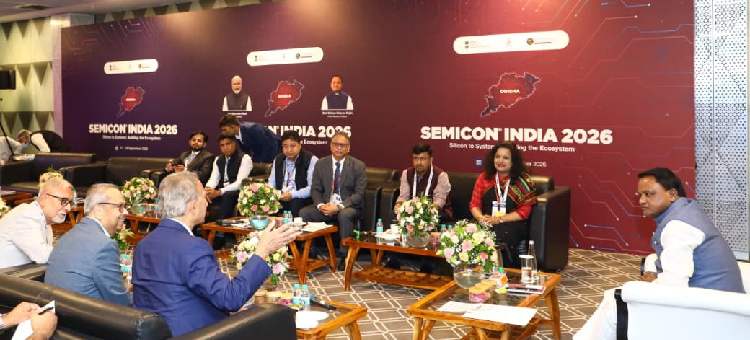
efforts to emerge as a major semiconductor and electronics hub, with Chief
Minister Mohan Charan Majhi holding a series of high-level meetings with global
and domestic technology companies and international delegations at SEMICON
India 2026.
The state government
received investment proposals worth approximately ₹23,600 crore, with the potential to
generate around 6,100 employment opportunities, as Odisha sought to build on
its growing investment pipeline and attract projects across the semiconductor
value chain.
Majhi held
discussions with representatives of companies including Lam Research, Applied
Materials, SiCSem, 3D Glass Solutions, Cyient, Linde and HORIBA India, besides
interacting with delegations from Japan, Sweden and Taiwan.
The engagements also
resulted in the signing of a Letter of Intent with QuadQuantum for setting up a
semiconductor facility for manufacturing silicon carbide (SiC) substrate
wafers. The development is expected to further strengthen Odisha's engagement
with the semiconductor and advanced technology ecosystem.
The state is also
seeking to move beyond individual projects and develop an integrated
semiconductor ecosystem under the broader vision of Semicon 2.0.
As part of the
initiative, Majhi announced the development of the Odisha Silicon Valley over
870 acres at Naraj near Cuttack. The proposed hub will host major
semiconductor, electronics and information technology projects.
The Naraj site is
strategically located along the Cuttack-Bhubaneswar urban corridor and offers
access to major ports, including Paradip and Dhamra, as well as key national
highways. The state government has positioned the location as a potential hub
for semiconductor supply chains, logistics and allied industries.
Its proximity to the
Mahanadi River is also being highlighted as an advantage for industries such as
semiconductor fabrication and assembly that require substantial quantities of
water, besides access to industrial infrastructure and power.
“Odisha’s semiconductor journey is moving
rapidly from intent to implementation. We have been able to attract investments
across critical areas of the semiconductor value chain and, importantly, move
key projects towards execution,” Majhi said at SEMICON India 2026.
“At SEMICON India 2026, our discussions with
industry leaders are focused on taking this momentum forward and bringing the
next set of semiconductor investments to Odisha. We want to build an ecosystem
where global and Indian technology companies can manufacture, innovate and grow,”
he said.
The Odisha Pavilion
at the event showcased the progress of projects involving RIR Power, SiCSem, 3D
Glass Solutions and ARF Design, along with semiconductor-related initiatives by
educational institutions such as NIT Rourkela and PMEC Brahmapur, which are
working on the first batch of Made-in-India chips.
A key attraction at
the pavilion is the “Sand to Silicon” installation, which presents Odisha’s
semiconductor ambitions through a distinctly state-specific theme. The
initiative connects Odisha’s mineral and industrial identity with its
aspirations in silicon and advanced technology, reflecting its larger vision of
transitioning from a “Mine Economy” to a “Mind Economy”.
The state has also
been widening its policy support to attract investments across the
semiconductor value chain. Odisha was among the early states to align its
semiconductor policy with the evolving India Semiconductor Mission 2.0, with
its recent Third Policy Amendment expanding incentives for critical segments.
Under the amended
policy, ISM-approved projects in semiconductor equipment manufacturing,
semiconductor-grade gases, raw materials and supply-chain segments are eligible
for an additional 25 per cent fiscal support. The policy framework also
provides assistance for engineer relocation, manpower skilling, internships,
international patents and research and development.
Dr Mukesh Mahaling,
Minister for Electronics and Information Technology, Odisha, said the state's
approach was to build the ecosystem around semiconductor investments rather
than view projects in isolation.
“Odisha has been an early mover in aligning its policy framework with ISM 2.0, while widening support to areas such as equipment, materials, gases and the supply chain. Alongside this, we are investing in specialised talent and creating the conditions that companies need to set up and scale their operations in the state,” Mahaling said.
With investment proposals, policy incentives, infrastructure development and industry engagements being pursued simultaneously, Odisha is seeking to position itself as a destination for semiconductor manufacturing, electronics production, research and allied supply-chain activities, with the broader objective of contributing to the vision of a developed India.