
THEBUSINESSBYTES
BUREAU
BHUBANESWAR,
AUGUST 28, 2026
Odisha’s telecom
market is showing strong signs of continued expansion, with the state adding
more than 4.12 lakh mobile subscribers in July, pushing its mobile tele-density
above the 85 per cent mark and underscoring the growing depth of digital
connectivity across the state.
Data cited from the
latest TRAI subscriber report shows that Odisha added 4,12,399 mobile users
during July 2026, taking its total mobile subscriber base to 3,90,14,287. The
monthly increase of 1.07 per cent placed Odisha among the fastest-growing
telecom markets in the country, ranking second in subscriber growth, behind
Jammu & Kashmir (1.84 per cent).
The most striking
indicator is Odisha’s 85.43 per cent tele-density. The development signals
continued demand for mobile connectivity, data services and digital
applications across both urban and rural markets.
The July numbers also
highlight an intense competitive battle among telecom operators.
Reliance Jio was the
clear growth leader in Odisha, adding 3.27 lakh customers in the month. Its
subscriber base climbed to 1,85,04,489 strengthening its position in the state.
Bharti Airtel
followed with 80,405 new subscribers, taking its Odisha customer base to 1.346
crore. Vodafone Idea added 9,667 users, bringing its subscriber base to 15.54
lakh.
In contrast, BSNL
lost 4,707 subscribers, with its mobile customer base declining to 54.91 lakh.
The state-owned operator was the only major telecom player in Odisha to see a
contraction during the month.
Odisha’s performance
comes against the backdrop of a broader expansion in India’s wireless market.
Nationally, the mobile subscriber base grew by 55.38 lakh in July, reaching
128.79 crore, up from 128.23 crore in June.
Airtel led national
additions with 26.8 lakh new users, followed by Jio with 24.4 lakh. Vi added
2.4 lakh, while BSNL increased its subscriber base by 1.68 lakh.
The wireless (mobile)
tele-density in India increased from 89.71 per cent at the end of June 2026 to
90.04 per cent at the end of July 2026. The urban wireless (mobile)
tele-density increased from 143.24 per cent at the end of June 2026 to 143.86 per
cent at the end of July 2026 and rural wireless (mobile) tele-density increased
from 59.46 per cent to 59.59 per cent during the same period.
The overall
tele-density in India increased from 94.31 per cent at the end of June 2026 to
94.68 per cent at the end of July 2026. The urban tele-density increased from
153.43 per cent at the end of June 2026 to 154.12 per cent at the end of July
2026 and rural tele-density also increased from 60.89 per cent to 61.05 per
cent during the same period.
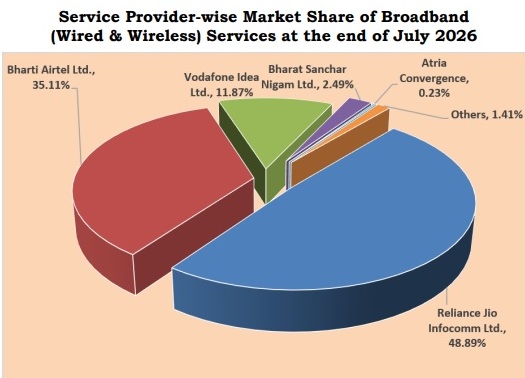
Broadband adoption is
also accelerating. India’s broadband subscriber base rose from 108.75 crore to
109.44 crore over the month, indicating that the telecom growth story is
increasingly being driven not just by voice connectivity but by sustained
demand for mobile data and digital services.
For Odisha, the rise
in tele-density has significance beyond the telecom industry. Higher mobile
penetration creates a larger addressable market for digital payments,
e-commerce, online education, fintech, entertainment, cloud-based services and
app-driven businesses.
The state’s strong
subscriber growth also indicates that telecom operators continue to see room for
expansion despite already-high penetration levels. The next phase of
competition is therefore, likely to shift increasingly toward 5G quality, data
consumption, network coverage, customer retention and digital-service
monetisation rather than simply acquiring first-time mobile users.
With 3.90 crore
mobile subscribers and 85.21 per cent tele-density, Odisha is emerging as a
sizeable and increasingly competitive telecom market in eastern India.