
THEBUSINESSBYTES
BUREAU
PARADIP,
SEPTEMBER 6, 2026
Paradip Port
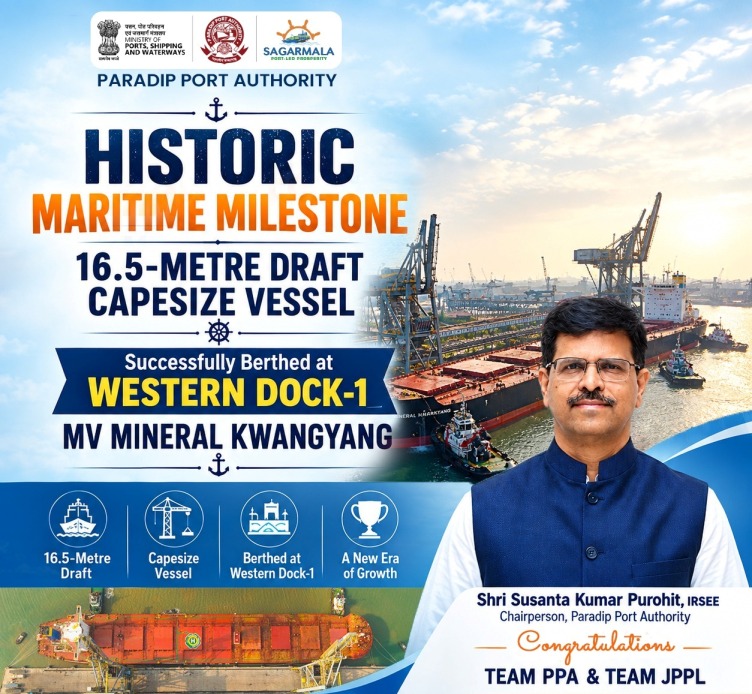
Authority (PPA) has achieved a significant maritime milestone by successfully
berthing its first-ever Capesize vessel with a 16.5-metre draft at Western
Dock-1 (WD-1), reinforcing the Odisha port’s growing ability to handle larger
and higher-capacity bulk carriers.
The landmark
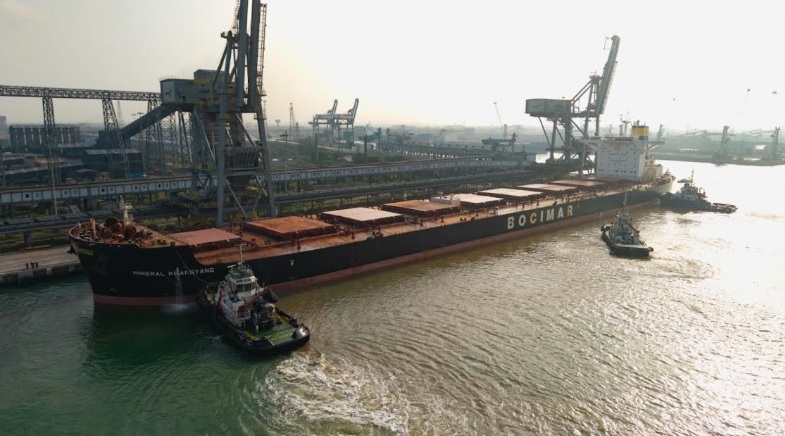
operation was completed on September 6 with the berthing of MV Mineral
Kwangyang, a 292-metre-long and 45-metre-wide Capesize vessel carrying 152,702
metric tonnes of coking coal. The vessel, which arrived at Paradip on September
5, was berthed at WD-1 at 6 am on Sunday with a draft of 16.50 metres.
The cargo, loaded at
Hay Point in Australia, was carried in nine holds, underlining the scale of the
vessel and the port’s enhanced capability to handle deep-draft bulk carriers.
 The successful
berthing marks another step in Paradip Port’s efforts to strengthen its
infrastructure and operational capabilities for handling increasingly large
vessels. The ability to accommodate a Capesize vessel of this draft at WD-1 is
expected to improve logistics efficiency and potentially reduce vessel
turnaround time for major industrial and cargo-handling partners.
The successful
berthing marks another step in Paradip Port’s efforts to strengthen its
infrastructure and operational capabilities for handling increasingly large
vessels. The ability to accommodate a Capesize vessel of this draft at WD-1 is
expected to improve logistics efficiency and potentially reduce vessel
turnaround time for major industrial and cargo-handling partners.
The milestone also
highlights the growing operational coordination between Paradip Port Authority
and Jindal Paradip Port Ltd. (JPPL). The occasion was marked by an exchange of
pleasantries between Rajendra Kumar, Traffic Manager, Paradip Port Authority,
and Sandeep Jaiswal, Deputy CEO, JPPL.
Paradip Port
Authority Chairman Susanta Kumar Purohit congratulated the teams of PPA and
JPPL for the achievement and appreciated their coordinated efforts in
successfully handling the deep-draft vessel.
The latest development strengthens Paradip Port’s position as a key maritime gateway for bulk cargo and industrial supply chains, while signalling its readiness to meet the evolving requirements of the maritime and industrial sectors.
With the successful handling of the 16.5-metre-draft Capesize vessel, Paradip Port Authority has further demonstrated its commitment to building efficient, reliable and world-class port infrastructure capable of supporting larger vessels, higher cargo volumes and more efficient trade flows.