THEBUSINESSBYTES BUREAU
NEW DELHI, AUGUST 14, 2026
Partition was not merely a line drawn across a map but a
rupture that tore through lives, families and a civilisational landscape,
Vice-President C. P. Radhakrishnan said on Thursday, as he called upon the
nation to remember the horrors of 1947 not with bitterness but with a renewed
resolve to preserve unity, harmony and peace.
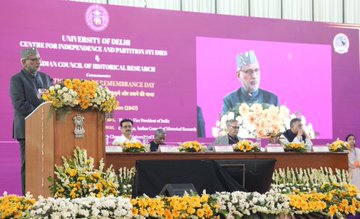
Addressing a National Seminar on the occasion of Partition
Horrors Remembrance Day, organised by the Centre for Independence and Partition
Studies, University of Delhi, in association with the Indian Council of
Historical Research (ICHR), Radhakrishnan said Independence brought freedom
from colonial rule but was accompanied by “one of the most tragic and
dehumanising chapters” in India's history and one of the largest mass
migrations in human history.
The seminar, held on the theme ‘The Partition of India - A
Saga of Displacement, Separation and Resettlement’, focused on the story of
India's Partition and brought together academics, scholars, students and
survivors to reflect on the immense human cost of the division.
Paying his deep respects to the Partition survivors present
at the event, the Vice-President said the occasion was not meant to reopen old
wounds or perpetuate bitterness, but to draw lessons from the past and
strengthen the bonds of national unity.
“As Bharat prepares to
celebrate Independence Day, we must pause to remember the sacrifices and
suffering of those who lived through Partition,” he said, stressing that the
scale of the tragedy remains a stark warning about the devastating consequences
of division and hatred.
Radhakrishnan lauded the University of Delhi for establishing
the Centre for Independence and Partition Studies in 2023 for preserving and
studying the history of Partition. He noted that within a short period, the
Centre had recorded oral testimonies of more than a hundred Partition survivors
and was engaging young students through lectures, archives and public events.
“Our children deserve
to know the truth of Partition,” he said, emphasising that a catastrophe of
such magnitude could not be reduced to a few lines in a textbook. He recalled
the enduring lesson that societies that fail to remember their past risk
repeating its tragedies.
Referring to the continuing ramifications of Partition,
Radhakrishnan said the hurried redrawing of borders had created disputes whose
implications were still felt today. Partition, he noted, had left a lasting
imprint on India's defence policy, national security and relations with
neighbouring countries.
Reflecting on the importance of leadership during times of
crisis, the Vice-President said the will and determination of political
leadership were critical when difficult decisions had to be taken in the larger
national interest. Recalling the circumstances surrounding Partition, he
underlined the importance of preparedness and responsible decision-making,
particularly when choices could affect the safety and security of people.
“Safety and security
of everyone must always remain a paramount consideration,” he said, stressing
that decisions with far-reaching consequences for people's lives should be
taken with adequate advance notice.
The Vice-President also underscored that Partition went far
beyond the redrawing of political boundaries, saying it divided a
civilisational landscape that had remained interconnected for thousands of
years. He referred to the disruption of access to several important
civilisational, cultural and spiritual sites, including the Sindhu river,
Kartarpur Sahib, Nankana Sahib and ancient Shaktipeeths, besides the
archaeological heritage associated with Harappa, Mohenjodaro and Takshashila.
Urging citizens to place the nation above narrower
identities, Radhakrishnan said no caste, religion or region could be more
important than the nation. Every Indian, he said, should take pride in being
Indian and remain conscious of the shared civilisational heritage and national
identity that bind the country together.
During the programme, the Vice-President felicitated 15
Partition survivors in recognition of their courage, resilience and
contribution to preserving the memories and lived experiences of one of the
most traumatic episodes in the subcontinent's history.
He also administered the ‘No Drugs’ pledge to students and
urged the younger generation to stay away from drugs and make healthy,
responsible and constructive choices for their future.
Concluding his address, Radhakrishnan said Partition Horrors
Remembrance Day should serve as a reminder that freedom is precious, unity is
essential and peace can never be taken for granted.
The Vice-President also visited an exhibition organised by the ICHR and the University of Delhi on the occasion and said the exhibits offered a powerful reminder of the enormous human cost of Partition.
The seminar was attended by University of Delhi Vice-Chancellor Prof Yogesh Singh, ICHR Chairman Prof Raghuvendra Tanwar, Dean of Colleges Prof Balram Pani and Registrar Dr Vikas Gupta, besides academics, scholars, students and Partition survivors.