THEBUSINESSBYTES
BUREAU
NEW
DELHI, MAY 4, 2026
From the symbolism of
Earth Day to the urgency of daily action, Climate Asia’s Annual Conference 2026
at India Habitat Centre delivered a clear message: India’s climate response
must move beyond fragmented interventions to a deeply connected, people-first
agenda that places livelihoods, health, gender, and economic resilience at its
core.
Convening nearly 350
participants over two days, the conference — organised by Climate Asia — brought
together close to 100 speakers across six closed-door roundtables and 11 panel
discussions. With the theme “Building India’s Climate Ecosystem: Innovation,
Talent, Leadership,” the gathering marked a decisive shift in discourse,
emphasising that climate change is no longer an abstract environmental concern
but a lived human crisis unfolding in real time.
Opening the dialogue,
Climate Asia’s Satyam Vyas reframed the narrative by underscoring the human
dimension of climate impacts. He pointed out that beyond data and temperature
targets, climate change manifests in everyday decisions — whether a farmer
chooses to sow crops amid uncertain rainfall, or a worker risks health in extreme
heat to sustain income. His remarks set the tone for a conference that
consistently returned to the idea that solutions must begin with people, not
projections.
Echoing the need for
systemic thinking, Shrashtant Patara of Development Alternatives highlighted
the importance of integrating people, planet, and prosperity. He stressed that
sustainable livelihoods lie at the intersection of climate action, job
creation, and resource management, and called for collaborative platforms that
harness entrepreneurship, institutional capacity, and technology to deliver
scalable change.
The conference’s
first panel on resilient livelihoods, co-curated with Development Alternatives,
focused on bridging fragmented approaches and building long-term economic
security for vulnerable communities. Sameer Shisodia of Rainmatter Foundation
emphasised that interventions must respect the complexity of community life,
where water, health, education, and culture are intertwined. He noted that
while philanthropic capital can support systems, the real drivers of resilience
are the people themselves—their knowledge, innovation, and agency.
Delivering a keynote,
Deepali Khanna of The Rockefeller Foundation positioned climate change as both
an economic and social disruption, urging stakeholders to treat it as a core
development strategy. She pointed to India’s expanding renewable energy
landscape and the transformative role of decentralised solar solutions in
empowering women, particularly in rural regions. Khanna outlined three critical
shifts: integrating climate into economic planning, connecting sectors into
cohesive systems, and scaling proven solutions rapidly.
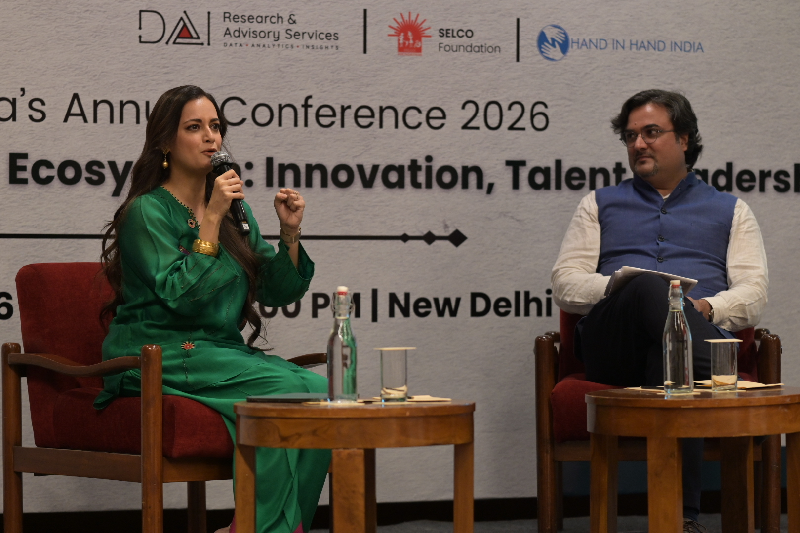
Actor and global
advocate Dia Mirza brought a powerful human perspective, describing the crisis
through lived experiences of rising heat, ecological degradation, and unequal
exposure across communities. In a fireside conversation, she stressed the
importance of storytelling in climate communication and called for stronger
institutional support for grassroots and women-led initiatives, noting that the
climate crisis is no longer a distant warning but an immediate reality
demanding action.
The “Voices from the
Ground” segment grounded these discussions in lived experience. Sarika Santosh
Pawar, a rural entrepreneur from Maharashtra, shared how access to clean energy
and sustainable farming practices transformed her livelihood into a mission to
empower over a thousand women. Her story reflected the broader theme that
community-led solutions are not only viable but essential for scalable impact.
A dedicated panel on
women-led climate resilience, co-curated by PRADAN, explored pathways to scale
grassroots innovations. Deeksha Supyaal Bisht from the Ministry of Rural
Development highlighted the significant participation of women in MGNREGA,
noting its role in strengthening economic independence and resilience. She
emphasised that institutional frameworks already exist but require deeper
community engagement to unlock their full potential.
Discussions on
financial resilience, led in collaboration with the Migrants Resilience
Collaborative, examined parametric insurance as a tool to protect informal
workers from climate shocks. As extreme weather events intensify, participants
stressed the need for accessible financial instruments tailored to the
realities of vulnerable labour markets.
Energy transition
also featured prominently, with sessions highlighting the interconnectedness of
climate and energy policy. Experts called for stronger state-level
implementation, integrated planning across sectors, and a just transition
focused on jobs, skills, and community participation. The emphasis was clear:
India’s energy future must balance sustainability with social equity.
The conference
concluded with a reflective session on scaling climate solutions without losing
local relevance. Speakers underscored the importance of community consultations
and flexible programme design, warning that top-down approaches risk
overlooking the nuanced needs of small and marginal communities.
Across its sessions, Climate Asia’s Annual Conference 2026 reinforced a unifying message: the foundations of effective climate action already exist—in grassroots innovation, local leadership, and community knowledge systems. The challenge now lies in connecting these elements with urgency, alignment, and accountability to transform intent into impact.
As the world moves beyond symbolic observances, the call from New Delhi was unequivocal — climate action must no longer be confined to a day. It must become an everyday commitment anchored in people, powered by collaboration, and driven by the realities on the ground.