
THEBUSINESSBYTES
BUREAU
NEW
DELHI, MAY 4, 2026
In a dramatic
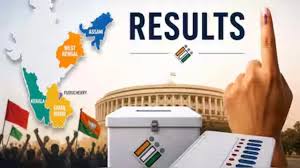
reshaping of India’s political landscape, the 2026 Assembly elections delivered
a sweeping mandate across key states, with the Bharatiya Janata Party (BJP)
scripting history in West Bengal and consolidating power in Assam, while
actor-turned-politician Vijay emerged as a formidable disruptor in Tamil Nadu
with his party’s stunning debut.
According to trends
released by the Election Commission of India, the BJP crossed the 200-mark in
West Bengal, securing 206 seats in the 294-member Assembly and ending the
long-standing dominance of the Trinamool Congress. The emphatic verdict signals
a historic first for the saffron party in the state, unseating Chief Minister
Mamata Banerjee, who also suffered a high-profile defeat to BJP leader Suvendu
Adhikari in the Bhabanipur constituency.
The scale of the
BJP’s victory in Bengal underscores a decisive political shift, with the TMC
trailing far behind at 81 seats. The outcome not only ends a 15-year rule but
also marks one of the most significant electoral upsets in recent state
politics.
In Assam, Chief
Minister Himanta Biswa Sarma led the BJP to a third consecutive term, winning
82 of the 126 seats and reinforcing the party’s dominance in the Northeast. The
Indian National Congress lagged with just 19 seats, with state unit chief
Gaurav Gogoi facing a setback in Jorhat, marking a significant blow to the
party’s regional prospects.
While the BJP’s twin
victories defined the saffron surge narrative, Tamil Nadu delivered an equally
compelling storyline. Vijay’s Tamilaga Vettri Kazhagam (TVK) stunned observers
by emerging as the single-largest party with 107 seats in the 234-member
Assembly. The unprecedented debut disrupted the entrenched Dravidian political
order, pushing both the Dravida Munnetra Kazhagam (DMK) and the All India Anna
Dravida Munnetra Kazhagam (AIADMK) to the margins, with 60 and 47 seats
respectively.
The result signals
the political arrival of Vijay as a mass leader capable of converting cinematic
popularity into electoral success, despite earlier controversies surrounding a
tragic rally incident in 2025. His party’s performance has not only altered Tamil
Nadu’s electoral arithmetic but also positioned TVK as a potential kingmaker in
future national alignments.
In Kerala, the
elections marked the end of the Left’s stronghold, with the Communist Party of
India (Marxist)-led front suffering a near-total rout. Chief Minister Pinarayi
Vijayan is headed for an exit, while the Congress managed to secure just a
solitary seat, highlighting its continued electoral decline in the state.
Meanwhile, in the
Union Territory of Puducherry, the All India NR Congress led the charts with 12
seats in the 30-member Assembly. The DMK secured five seats, the BJP four, and
the TVK made its presence felt with two seats, indicating a fragmented mandate.
Taken together, the
results of Elections 2026 reflect a profound churn in India’s regional politics
— a saffron wave sweeping the east and northeast, a cinematic insurgency
rewriting southern equations, and a continued struggle for relevance by legacy
parties. As new power centres emerge and old bastions crumble, the electoral verdict
signals not just a change in governments, but a redefinition of political
narratives across the country.