THEBUSINESSBYTES
BUREAU
NEW
DELHI, SEPTEMBER 2, 2026
Commerce and Industry
Minister Piyush Goyal on Wednesday called upon the auto component industry to
transform local businesses into global enterprises, expand manufacturing
footprints in developed markets and move up the value chain as India seeks
deeper integration with the global economy.
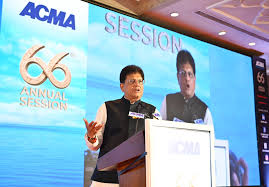
Addressing the 66th
Annual Session of the Automotive Component Manufacturers Association (ACMA)
here, Goyal said the industry's international trade was currently close to USD
50 billion, evenly divided between imports and exports, and stressed the need
for greater international investment and more Indian businesses emerging as
global players.
"Business
prospers when it looks globally," Goyal said, while noting that imports
can also contribute to a country's economic progress, though this should not be
construed as an encouragement to increase imports.
He said there was a
commitment to widen the gap between India's imports and exports, but that process
had not yet begun, and called for significantly greater international
investment and global business expansion by ACMA members.
"The industry
has to now expand its manufacturing footprint across the world and establish a
presence in developed countries," he said.
Goyal said the Indian
auto component industry had benefited from collaborations over the years and
had developed the capability to manufacture quality products at globally
competitive price points.
He highlighted
India's expanding market access through nine trade agreements finalised over
the last four to five years, covering 38 developed countries and economies
representing a combined GDP of USD 60 trillion.
In contrast, the free
trade agreements concluded before 2014 collectively represented economies
accounting for about USD 10 trillion in GDP at today's value, he said.
The minister said the
new agreements provide two-way market access to prosperous economies with high
GDP and per capita income, offering Indian industry greater complementarity and
relatively lower competitive pressures.
Goyal also credited
ACMA with playing an important role in India's FTA negotiations, saying the
industry body had consistently sought zero-duty access for Indian auto
components while also supporting reciprocal opening of the domestic market.
"The industry is
capable of taking on the best in the world and is ready to meet global
competition," he said.
Referring to the
theme of the session — "Beyond Resilience, managing uncertainty to
creating new avenues, deeper supply chains" — Goyal said it was
particularly relevant amid global uncertainty, geopolitical challenges and
considerable churn.
Despite the turmoil,
India had stayed the course and remained the fastest-growing among the world's
large economies, he said.
"The naysayers
can say what they want, but 7.8 per cent growth is a reality," Goyal said.
He highlighted strong
growth across manufacturing and automotive segments, saying ACMA was growing at
a scorching double-digit rate and the auto sector was also expanding at a high
double-digit pace.
Around five million
passenger cars are expected to be sold this year, Goyal said, adding that these
vehicles were being purchased rather than merely being stocked.
He also pointed to
rising demand for electric vehicles, with some models now carrying waiting
periods of up to six months.
The minister said the
steel sector was likewise witnessing rapid growth, with India importing more
steel than it exported because domestic demand remained exceptionally strong.
The auto component industry, he added, was contributing significantly to this
demand.
Goyal outlined
several government initiatives aimed at strengthening industrial capacity and
building resilient supply chains, including support for the auto component
industry to achieve scale and measures to promote domestic production of
speciality steel required by the sector.
He also highlighted
the relevance of the production-linked incentive scheme for technical textiles,
given the industry's dependence on such materials, as well as government
support for the semiconductor sector to strengthen the resilience of automotive
supply chains.
The government is
also developing new industrial parks, with 20 smart cities and industrial
cities already underway, he said, inviting the auto component industry to
participate in these opportunities.
Goyal also proposed
dedicated industrial parks for automotive components and partnerships with
other countries.
"Maybe we should
have one of these parks dedicated to a US-India partnership. Maybe we can have
two or three, five parks, which will be for auto components only. And I can
create a plug and play infrastructure to suit you," he said.
Calling for sustained
industry-government dialogue, Goyal said the pace of reforms could be
accelerated only with active participation from industry.
"We need your
ideas. We need your inputs. We need your demands. We need to know what's challenging
you, what's troubling you, how we can help you more," he said.
"We are a
listening government. We want you to be talking," he added.
Goyal referred to his
recent three-hour interaction with the data centre industry, which he said
comprised largely US companies entering India in a big way.
India and the US are
trusted partners and can work together to make their industries more competitive,
he said.
He also said India
would soon have a Gulf Cooperation Council (GCC)-India free trade agreement
once the situation in the region stabilises, and would pursue FTAs with other
countries to secure greater access to critical minerals needed for resilient
supply chains.
Referring to the
critical minerals partnership between India and the US, Goyal also highlighted
the Pax Silica initiative launched by Washington, under which like-minded,
democratic and fair-play countries can work together to ensure that no single
geography is able to weaponise trade.
These developments,
he said, would help the auto component sector emerge as a truly global player
as it works towards its USD 500 billion industry target.
Goyal urged the
industry to convert local businesses into global enterprises and establish
active indigenisation programmes for products where greater supply-chain
resilience is required.
Such efforts, he
said, would help the sector insulate itself from future "black swan"
events.
He also called for
the industry to move up the value chain and deliver integrated, high-value
solutions, including products designed, built and supplied to global customers
at the highest quality standards.
Greater attention
must also be paid to safety, Goyal said, stressing that the industry should not
leave safety concerns entirely to the government.
Technology, including
artificial intelligence, should play a bigger role in the sector, particularly
in quality control and assessing customer requirements, he said.
Pointing to the
growing popularity of customised vehicles in the US and Europe, Goyal called
for greater innovation and improved safety features in automotive products.
On vehicle scrappage,
the minister said the government and industry needed to make scrapping old
vehicles a profitable and valuable proposition for consumers purchasing new
vehicles.
The government had
attempted to provide value and incentives from its side, he said, and called
upon industry to offer fair value for scrapped vehicles to help create a larger
market for new-generation automobiles.
US Ambassador to
India Sergio Gor said bilateral cooperation in the automotive sector was at a
"historic high point", with the two countries "co-designing the
future of mobility together".
He described India's
auto component industry as a reliable and increasingly sophisticated partner in
strengthening supply-chain resilience.
Gor said both
governments were working towards a fair, reciprocal and mutually beneficial
trade relationship and highlighted the progress made, including the trade
understanding reached between the two countries.
He said Goyal would
travel to the US at the end of the month as Washington hosts the G20 talks.
The US envoy also
highlighted expanding cooperation in pharmaceuticals, defence, IT, data centres
and space, and described the Pax Silica Declaration as a landmark step towards
a pro-innovation regulatory framework.
India was among the
first countries invited to join the initiative, he said.
Gor pointed to the
growing presence of US companies in India's automotive ecosystem and Indian
companies in the US, including Bharat Forge, Sundaram Clayton and Mahindra.
He invited Indian
auto component manufacturers to explore investments in the US through
greenfield assembly facilities, R&D centres and distribution networks.
Trade Commissioner
for South Asia and British Deputy High Commissioner for Western India Harjinder
Kang, meanwhile, highlighted the strengthening India-UK economic relationship,
saying automotive and future mobility were central to the UK's advanced
manufacturing capabilities.
Kang referred to the
India-UK Vision 2035, the UK's modern industrial strategy and the India-UK
Comprehensive Economic and Trade Agreement (CETA), which came into force on
July 15, 2026.
Under CETA, 99 per
cent of UK tariff lines and 90 per cent of Indian tariff lines have been
reduced to zero or very low duties, alongside streamlined customs and border
procedures to facilitate trade and investment, he said.
The agreement would deepen supply chains and enable joint ventures and partnerships, with automotive component manufacturers gaining tariff-free access to each other's markets, Kang said.
He highlighted the UK's strengths in advanced engineering, innovation and zero-emission vehicle technologies, including electric motors, batteries, hydrogen solutions, lightweight composites and software-defined vehicle systems.