THEBUSINESSBYTES BUREAU
NEW DELHI, OCTOBER 7, 2026
Prime Minister
Narendra Modi on Wednesday called for a free, open, secure and rules-based
maritime order that can bring peace, prosperity and progress for all, as the
third edition of Sagarmanthan: The Great Oceans Dialogue opened here with India
pitching its maritime transformation as a partnership opportunity for the
world.
In his message to the
three-day dialogue, Modi said oceans do not separate countries but connect
them, with developments in one part of the world having an impact far beyond
its shores, underscoring the need for dialogue and global cooperation at a time
of shifting trade patterns, geopolitical fragmentation and technological
change.
Recalling India's
maritime heritage from Lothal and the Cholas to the naval vision of Chhatrapati
Shivaji Maharaj, the Prime Minister said the Indian tradition of oceanic
engagement had long been associated with discovering new possibilities.
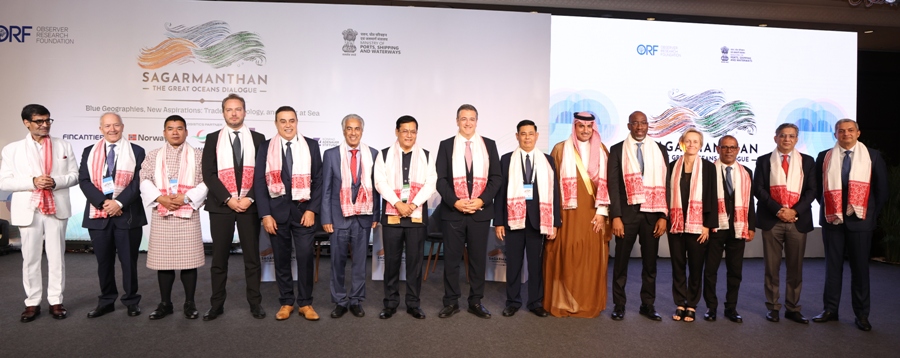
The event, organised
by the Ministry of Ports, Shipping and Waterways (MoPSW) in partnership with
the Observer Research Foundation (ORF), brought together ministers, naval
leaders, port authorities, shipbuilders, financiers, international institutions
and maritime experts from across five continents on its opening day.
Representatives from
Australia, Belgium, Bhutan, the European Union, France, Norway, the Republic of
Korea, the UAE, Nigeria, Ethiopia, Ghana, Egypt, Seychelles and Ecuador
participated in discussions alongside the OECD, UN Trade and Development, the
Asian Infrastructure Investment Bank and the African Union.
Union Minister for
Ports, Shipping and Waterways Sarbananda Sonowal, outlining India's maritime
roadmap, said the country's Maritime Amrit Kaal Vision 2047, PM Gati Shakti and
the Sagarmala programme represented not merely a domestic development agenda
but an offer of partnership to the global maritime community.
In a high-level
conversation titled "Maritime Amrit Kaal 2047: India's Ocean Vision and a
New Era of Global Maritime Cooperation", Sonowal, speaking with ORF
President Dr Samir Saran, positioned India as a "Vishwaguru" on the
oceans, sharing its knowledge, capabilities and talent to advance a more
collaborative global maritime agenda.
"India's bond
with the sea is civilisational. For thousands of years, Indian sailors carried
goods, ideas and culture across the oceans as partners, never as
conquerors," Sonowal said.
Under Modi's
leadership, India was offering the world a maritime model rooted in trust,
capability and mutual benefit, he said, adding that the country's approach was
to lead by example while growing together with partners.
"The global
maritime order is going through a great churning of disruption, fragmentation
and technological change," Sonowal said, adding that India aimed to bring
forth "amrit" for the world in the form of resilient supply chains,
green shipping corridors, a world-class shipbuilding ecosystem and a skilled
seafaring workforce.
He described Maritime
Amrit Kaal Vision 2047 as India's roadmap to a Viksit Bharat and an open
invitation to partners across the world's oceans.
Minister of State for
Ports, Shipping and Waterways Shantanu Thakur, delivering the scene-setting
ministerial address at the formal opening, highlighted India's port-led
development and new-generation maritime laws, saying these were creating
capacity not only for the country's growth but also for the wider region.
"Ports today are
not just gateways for cargo; they are strategic assets that shape
competitiveness, energy security and trust between nations," Thakur said.
With India's major
ports having nearly doubled their capacity and a modern legal framework now in place,
the country was ready to support trade across the Indo-Pacific and beyond, he
said.
MoPSW Secretary Vijay
Kumar delivered the opening address, while Saran delivered the welcome remarks.
The inaugural
ministerial plenary, "Tides of Trust: Ports, Partnerships, and the Making
of a New Maritime Century", examined the growing role of ports and
shipping networks as strategic economic assets.
The session,
moderated by Saran, featured former Australian prime minister and Global
President and CEO of Asia Society Kevin Rudd, Flemish Minister of Mobility,
Public Works, Ports and Sport Annick De Ridder, Bhutan Minister of
Infrastructure and Transport Chandra Bahadur Gurung, Chief of the Naval Staff
Admiral Krishna Swaminathan and DP World CEO and Managing Director Rizwan
Soomar.
Earlier, Soomar and
Saran discussed "The Great Churning: Trade, Power and Opportunity",
focusing on the manner in which maritime connectivity is reshaping economic
power.
A major focus of the
opening day was India's emerging cooperation with the European Union on green
shipping. The India-EU Green Shipping Corridor initiative seeks to combine
India's potential in green fuel production with growing European demand,
opening opportunities for green ammonia and methanol trade while supporting
maritime decarbonisation.
Following the launch
of the corridor's pre-feasibility study in 2025 and the establishment of an
industry coalition in 2026, the initiative is now moving towards
implementation.
The associated
session, "India-EU Green Shipping Corridor: Innovation, Action and
Scale", organised with the Rocky Mountain Institute, formally launched the
coalition and brought government and industry stakeholders together to discuss
investment, partnerships and a commercially viable pathway for scaling the
corridor.
European Commission
Commissioner for Sustainable Transport and Tourism Apostolos Tzitzikostas and
Thakur delivered ministerial addresses, while Vijay Kumar gave the opening
remarks.
India's maritime
partnership with South Korea also figured prominently, with the
"India-Korea in the Indo-Pacific: Maritime Cooperation and Economic
Resilience" roundtable reviewing progress since the April 2026
India-Republic of Korea Summit.
The discussion
focused on implementing the India-Korea Comprehensive Framework for Partnership
in Shipbuilding, Shipping and Maritime Logistics and its alignment with the
Special Strategic Partnership between the two countries.
Participants examined
cooperation in shipbuilding, maritime logistics, port-led development and
supply-chain integration, with an emphasis on structured collaboration among
governments, shipyards, shipping companies, port operators and maritime
technology firms.
The session also saw
the launch of the edited volume "Oceans of Alignment: India-South Korea
Cooperation in the Indo-Pacific".
Economic corridors
and their governance emerged as another key theme, with the curtain-raiser
session "Governing the Corridors of Tomorrow: Lessons for IMEC"
examining the institutional architecture needed to translate the India-Middle
East-Europe Economic Corridor from a strategic vision into a functioning
economic corridor.
The discussions
focused on frameworks that can support investment, interoperability and
long-term momentum while allowing the corridor to adapt to changing
geopolitical and economic conditions.
The sustainable blue
economy also featured prominently, with the OECD-associated session
"Tracking the Transition to Sustainable Blue Economies" examining how
improved measurement and benchmarking can help governments identify priorities,
guide investment and strengthen policy coordination.
The OECD Blue Economy
Scoreboards were discussed as a framework for evidence-based policymaking and
international cooperation aimed at sustainable and inclusive ocean development.
Africa's growing role
in global maritime connectivity was another important strand of the dialogue.
The session "Africa's Blue Gateways: From Corridors to Engines of
Connectivity" examined how initiatives such as the Lobito Corridor and
investments in regional connectivity can help diversify trade routes,
strengthen supply-chain resilience and unlock the continent's blue-economy
potential.
The discussions
highlighted the growing importance of African maritime corridors as
geopolitical disruptions, chokepoint vulnerabilities and shifting supply chains
reshape global trade.
The first day of Sagarmanthan 2026 thus brought together discussions on ports, shipping, shipbuilding, green fuels, economic corridors, blue-economy measurement and Africa's maritime potential, with India seeking to position itself as a trusted partner in shaping the next phase of global ocean cooperation.
The dialogue continues with further ministerial and expert-level sessions on the future of the maritime economy and the evolving global ocean order.