THEBUSINESSBYTES
BUREAU
NEW DELHI, AUGUST 4, 2026
The PM Surya Ghar: Muft Bijli Yojana has achieved a major
milestone by benefiting more than 50.06 lakh households through rooftop solar
installations across the country, marking a significant leap in India's clean
energy transition and reinforcing its position as a global leader in
decentralized renewable energy adoption.
The landmark has been achieved in just over two years since
the launch of the scheme, a remarkable acceleration compared to the 7.94 lakh
rooftop solar installations recorded during the previous ten years. The
achievement reflects the rapid implementation of the world's largest rooftop
solar programme, backed by an outlay of ₹75,021 crore. The PM Surya
Ghar: Muft Bijli Yojana is the Government of India's flagship rooftop solar initiative under the Ministry of New and
Renewable Energy.
Under the visionary leadership of Prime Minister Narendra
Modi, the programme is now benefiting one lakh households every six days,
making it one of the fastest-growing clean energy initiatives anywhere in the
world. The pace of installations has increased 3.2 times over the past nine
months, rising from 5,038 installations per day in October 2025 to nearly
16,328 installations per day in July 2026.
The momentum reached a new high in July 2026, when 5.06 lakh
households benefited from rooftop solar installations, the highest monthly
figure recorded since the launch of the scheme.
To sustain this rapid expansion, the government has released ₹28,024
crore in subsidies directly to beneficiaries
through the Direct Benefit Transfer (DBT) mechanism. The financial impact has
been substantial, with nearly 19 lakh households now enjoying zero electricity
bills, significantly reducing their monthly expenses.
In addition to savings on electricity costs, the scheme has
enabled households to generate additional income by selling surplus power back
to the grid. During FY 2024-25, more than 12 lakh households collectively
earned ₹421
crore, translating into an average annual income of approximately ₹3,500 per household.
The programme has also made rooftop solar accessible to
economically weaker sections through the Utility Led Aggregation model. Under
this initiative, 1.6 lakh installations have been completed for PMAY, BPL and
SC/ST households across four states, while the model has been sanctioned for
rollout in 12 states. Besides enabling low-income families to adopt rooftop
solar, the model is also helping states reduce their tariff subsidy burden.
Affordable financing has emerged as another major driver of
the scheme's success. Concessional loans at an interest rate of 5.75 per cent,
benchmarked to the Repo rate plus 50 basis points, have been sanctioned for
21.87 lakh applicants. Of these, 17.5 lakh installations have already been
completed through loan financing, supported by Jan Samarth integration, which
enables a completely paperless loan approval process.
The scheme has simultaneously generated a robust employment
and business ecosystem. Across the country, 34,219 vendors have registered
under the programme, with 29,469 currently active. In addition, more than 2.32
lakh people have been trained under capacity-building programmes supporting the
rooftop solar value chain. Cumulatively, the scheme has commissioned 14.8 GW of
rooftop solar capacity.
A key strength of the programme is its 100 per cent online,
end-to-end digital process, allowing consumers to complete everything from
application to subsidy release without any physical paperwork or office visits.
The seamless digital ecosystem has been enabled through Jan Samarth integration
for paperless loans, PFMS integration that facilitates subsidy release within
15 days, API integration with over 80 DISCOMs for faster processing, a Digital
Net Metering Agreement through the National Portal, and a vendor rating
framework that provides consumers with visible star ratings. Integration with
the DCR portal further ensures compliance with domestic content requirements.
To make rooftop solar adoption easier, the government has
introduced deemed approval and feasibility waiver for systems up to 10 kW.
Moreover, 32 States and Union Territories have removed application and net
metering charges for rooftop solar installations. The government has also
released ₹3,807.6 crore as incentives to DISCOMs and around ₹104 crore to Urban Local
Bodies. A City Accelerator Programme has been launched across 46 cities, while
nearly 23,000 third-party quality inspections have been conducted under the
vendor accountability framework to maintain installation standards.
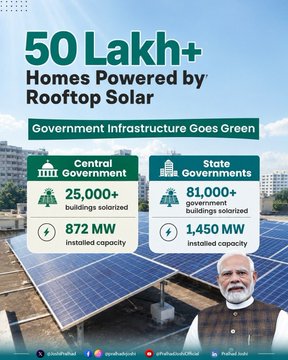
The scheme has also made significant progress in solarizing government infrastructure. Central Ministries have identified around 41,542 feasible government buildings with a rooftop solar potential of 1,418 MW, of which 25,255 buildings with 872 MW capacity have already been solarized. States have identified nearly 3.20 lakh feasible government buildings with a potential of 4,400 MW, and 81,329 buildings with 1,450 MW capacity have already been covered. Together, 1.06 lakh government buildings across the country have been solarized so far. To further support these projects, a Payment Security Mechanism has been introduced to encourage RESCO bidders by reducing payment risks and ensuring timely payments in state and Union Territory solarization projects.
With more than 50 lakh households now benefiting and installations continuing to gather pace, the PM Surya Ghar: Muft Bijli Yojana is reinforcing India's position as a global leader in citizen-led clean energy adoption while advancing the nation's twin objectives of energy security and energy independence for Indian households.