Underscores inclusive development, national
security and women-led growth
THEBUSINESSBYTES BUREAU
NEW DELHI, AUGUST 14, 2026
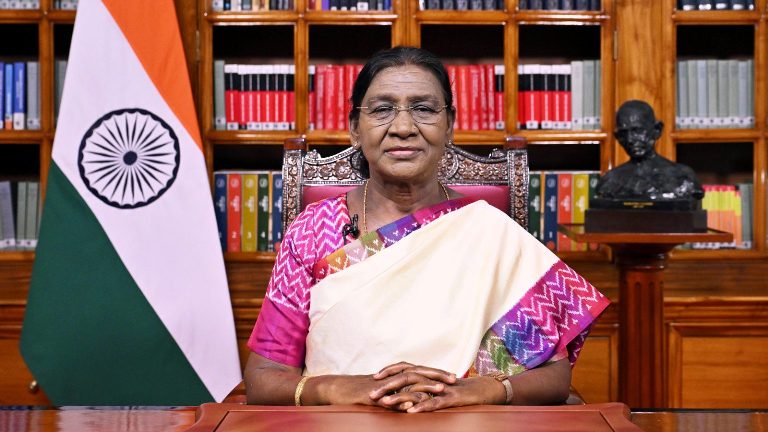
President Droupadi Murmu on Thursday made a stirring call for
a collective national effort to transform Swatantra Bharat into Viksit Bharat
by 2047, saying the true meaning of freedom lies in ensuring that every Indian
gets the opportunity to realise their aspirations, while underlining inclusive
development, women-led growth, youth participation, technological advancement
and national security as key pillars of the country’s journey.
In her address to the nation on the eve of the 80th
Independence Day, Murmu said India’s progress must be guided by the principle
of Antyodaya so that the benefits of development reach every citizen, and
asserted that the ultimate objective of a developed India is the wellbeing and
dignity of its people. Greeting citizens in India and abroad, she said the
Tricolour continues to embody the country’s freedom as well as its aspirations
for the future.
Paying tribute to the diverse sections of society engaged in
nation-building, the President praised students, teachers, scientists,
healthcare workers, farmers, workers, entrepreneurs, sportspersons, artists,
civil servants, social workers and security personnel, saying their collective
contribution was taking the country forward.
Recalling the freedom struggle, Murmu paid homage to Mahatma
Gandhi, Dr B R Ambedkar and other freedom fighters, noting that people
belonging to diverse ideological streams had come together with the common
objective of securing independence.
On Vibhajan Vibheeshika Smriti Divas, observed on August 14,
she remembered those who lost their lives or were displaced during Partition.
She also recalled the formidable task of integrating more than 550 princely
states into independent India and paid tribute to Sardar Vallabhbhai Patel for
his decisive role in the political integration of the country.
The President said public participation has always been at
the heart of India’s democratic tradition, while the Constitution guarantees
equality of status and opportunity and dignity of the individual. She noted
that the Executive, Legislature and Judiciary have distinct responsibilities
towards citizens.
Highlighting India’s development trajectory over the past
decade, Murmu said the country had witnessed rapid and inclusive growth while
successfully combining its rich heritage with modern development and overcoming
several long-standing impediments to progress.
More than 25 crore people have been lifted out of poverty,
she said, while nearly 59 crore people have entered the formal banking system
through the Pradhan Mantri Jan Dhan Yojana, including more than 32 crore women.
She said more than 80 crore people were receiving free
foodgrains under the government’s food security measures, while around 60 crore
people had access to healthcare coverage of up to Rs 5 lakh annually under
Ayushman Bharat Pradhan Mantri Jan Arogya Yojana.
The President also highlighted assistance to farmers through
PM-KISAN Samman Nidhi and Kisan Credit Cards, saying such initiatives were
strengthening the foundations of inclusive development.
Turning to India’s digital transformation, Murmu said the
country had built the world’s largest digital infrastructure, with digital
payments becoming commonplace even among small rural businesses and street
vendors.
More than half of the world’s real-time digital transactions
take place in India, she said, adding that technology was enabling the delivery
of welfare benefits in a more transparent manner.
She also pointed to the expansion of highways, waterways,
railways and airways, saying modern connectivity was opening new avenues for
enterprise, creating employment opportunities and boosting investor confidence.
Against the backdrop of wars and instability in different
parts of the world, Murmu said India’s economy continued to move forward as the
fastest-growing major economy. She said the Atmanirbhar Bharat initiative had
strengthened the foundations of the country’s economic progress as well as
national security.
The President also highlighted India’s progress in renewable
energy and said the country was moving ahead of schedule in achieving its
Sustainable Development Goals.
On India’s engagement with the world, she said national
interest remained the foundation of foreign policy, with peace, cooperation,
dialogue and the principle of Vasudhaiva Kutumbakam guiding the country’s
international outreach.
India’s Free Trade Agreements with various countries, she
said, were aimed at deepening economic cooperation, while the country continued
to play an important role among the nations of the Global South.
Urging citizens to protect the environment, Murmu said
conservation of natural resources was essential for future generations and
deeply rooted in India’s traditions. Referring to initiatives such as ‘Ek Ped
Maa Ke Naam’ and Lifestyle for Environment (LiFE), she called for individual as
well as collective action to safeguard nature.
Women, she said, were increasingly becoming a driving force
of India’s development, with their participation expanding across education,
sports, agriculture, defence and entrepreneurship.
Highlighting India’s performance at the recently concluded
Commonwealth Games in Glasgow, Murmu said women had won eight of the country’s
13 gold medals.
More than 10 crore women are members of Self Help Groups, she
said, adding that the target of creating three crore Lakhpati Didis had already
been achieved and the country was now moving towards creating another three
crore Lakhpati Didis.
The President also underlined women’s growing role in
entrepreneurship, noting that around two-thirds of beneficiaries who have
received financial assistance under the MUDRA Yojana are women.
She said the Nari Shakti Vandan Adhiniyam, enacted in 2023,
seeks to provide 33 per cent representation to women in the Lok Sabha and state
legislative assemblies.
With 65 per cent of India’s population below the age of 35,
Murmu described the youth as the country’s “most valuable asset”, praising
young entrepreneurs, innovators and professionals and saying India’s
flourishing startup ecosystem was opening new avenues for employment and
enterprise.
Calling students the architects of India’s future, she
stressed the need to protect their opportunities and strengthen public
examinations, which serve as gateways to careers.
The government, she said, was undertaking comprehensive
reforms to curb unfair practices and make examinations more transparent, secure
and trustworthy.
Murmu also called for greater attention to the physical and
mental wellbeing of young people, highlighting the importance of sports and the
Khelo India programme in youth development and nation-building.
At the same time, she urged greater sensitivity towards
senior citizens, noting that around six crore people aged 70 years and above
can avail themselves of free healthcare services of up to Rs 5 lakh annually.
On national security, the President paid tribute to the armed
forces on Kargil Vijay Diwas and recalled the completion of one year since the
launch of Operation Sindoor.
She said the operation demonstrated the capability of the
Indian Armed Forces to act with precision against terrorism and sent a firm
message to terrorists and those supporting them.
Murmu also described the suspension of the Indus Waters
Treaty with Pakistan as a decisive step in the national interest, particularly
in the interests of farmers.
She termed making India free from Naxalism a major
achievement, saying regions once affected by Left-Wing Extremism were now
witnessing development as well as greater participation in cultural and
sporting activities.
The President also underlined the importance of cultural
heritage in shaping India’s national identity. She noted that 12 forts
associated with the Maratha military tradition were included in the UNESCO
World Heritage List last year, while Sarnath was added to the list this year.
India’s development, she emphasised, must remain firmly
rooted in its cultural identity and heritage.
Concluding her address, Murmu said the dream of Viksit Bharat would ultimately be measured by the development, dignity and wellbeing of every Indian.
Quoting Telugu nationalist writer Gurajada Apparao, she underlined the idea that a nation is not merely its land but its people, and called for an inclusive spirit of patriotism as citizens dedicate themselves to the transformation of Swatantra Bharat into Viksit Bharat.