THEBUSINESSBYTES
BUREAU
BHUBANESWAR,
OCTOBER 3, 2026
“The Olive Ridley is an important part of
Odisha’s natural heritage and protecting it requires a deeper understanding of
its journey,” said Dr Priti G. Adani, Chairperson, Adani Foundation, as the
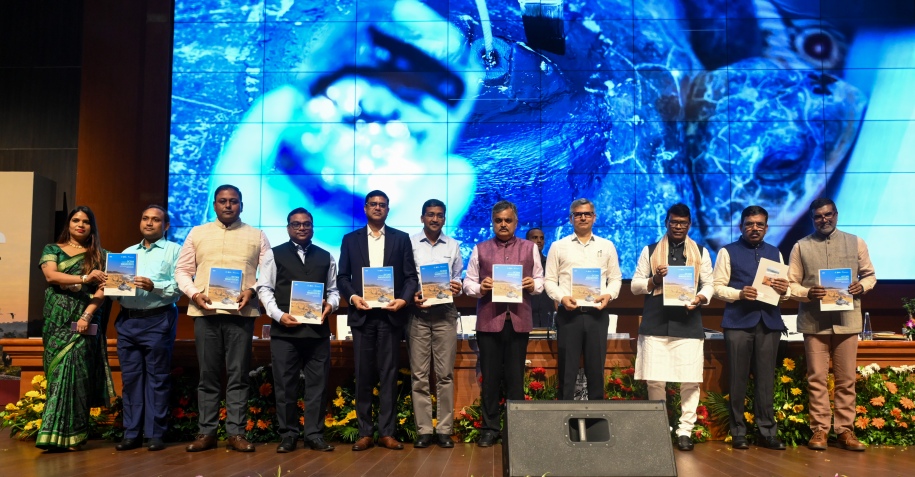
Odisha Government on Saturday released the first-year report of a three-year
scientific study tracking the movement and habitat use of Olive Ridley turtles
along the State’s coast.
Dr Adani said the
Foundation was pleased to support the Wildlife Institute of India’s (WII)
scientific work on the endangered marine species and welcomed the Odisha
Government’s focus on sustainability and environmental conservation under Chief
Minister Mohan Charan Majhi.
The study, led by the
Dehradun-based WII in partnership with the Odisha Wildlife Organisation,
Department of Forest, Environment & Climate Change, Dhamra Port Co. Ltd.
(DPCL), a part of Adani Ports and Special Economic Zone Limited (APSEZ), and
the Adani Foundation, combines satellite telemetry, boat-based surveys and
shoreline analysis to map Olive Ridley movements and nesting habitats.
Odisha’s Forest,
Environment & Climate Change Minister of State Ganesh Ram Singh Khuntia
released the report at an event in Bhubaneswar. Dr Abhishek Lakhtakia, Chief
Executive Officer of the Adani Foundation, represented the Foundation at the
event.
The findings offer
fresh insights into the movements of Olive Ridleys, which return in large
numbers to Odisha’s coastline for breeding and nesting. The State hosts two of
the species’ major nesting grounds — Gahirmatha in Kendrapara district and
Rushikulya in Ganjam district.
Protected under
Schedule I of the Wildlife Protection Act, 1972, the Olive Ridley turtle enjoys
the highest level of legal protection in India. The initial fieldwork under the
study focused on the Gahirmatha rookery, while satellite tagging was undertaken
at both Gahirmatha and Rushikulya. APSEZ operates the Dhamra and Gopalpur ports
in Odisha.
The first-year
telemetry data showed differences in the movement patterns of male and female
turtles. Male Olive Ridleys began their offshore migration earlier, while
females remained in nearshore waters for longer periods.
The tracking data
also indicated possible foraging stopovers along the continental shelf and
across the Bay of Bengal, pointing to the importance of marine habitats beyond
the immediate nesting grounds.
One female turtle
travelled 6,719 km over 271 days, reaching waters east of Sri Lanka. Another
covered nearly 200 km between Gahirmatha and Rushikulya and back, underlining
the connectivity between different sections of Odisha’s coastline.
“This study marks the renewal of satellite
tracking of Olive Ridley turtles in Odisha after nearly 15 years,” said Dr R.
Suresh Kumar, Senior Scientist, Department of Endangered Species Management,
WII.
The collaboration, he
said, had generated new insights into turtle movement patterns and habitat use
and would provide a scientific basis for evidence-based conservation planning.
WII plans to continue tracking additional turtles to build a larger dataset to
support long-term management strategies.
Boat-based surveys during the 2025-26 nesting season recorded 1,390 individual Olive Ridleys and 67 mating pairs. Most sightings were within two kilometres of the coastline.
The report has called
for sustained monitoring to deepen understanding of the relationship between
turtle movements, marine habitats and nesting areas, which could help
strengthen conservation planning along the Odisha coast.
The study comes amid
wider conservation and environmental initiatives involving the Adani Foundation
in Odisha. The Foundation has been working in the State for nearly a decade,
with its programmes reaching 283 villages across seven districts.
Its initiatives include education and scholarships, healthcare through wellness centres, mobile medical units and specialised health camps, besides livelihood programmes for farmers, women and young people. The Foundation has also supported community infrastructure projects covering roads, drinking water, sanitation and rural electrification.
The Olive Ridley research adds a scientific dimension to these efforts, placing satellite-based ecological research and long-term monitoring at the centre of conservation planning for one of Odisha’s most distinctive natural assets.