THEBUSINESSBYTES BUREAU
NEW DELHI, AUGUST 15, 2026
In a major push to bridge the gap between India’s vast
innovation ecosystem and the needs of its villages, Principal Scientific
Adviser to the Government of India Prof Ajay Kumar Sood on Saturday launched
the RSVC-AMRIT platform, a digital backbone designed to accelerate technology
transfer, foster rural innovation and take appropriate technologies closer to
the last mile.
Developed by the National Bank for Agriculture and Rural
Development (NABARD) in collaboration with the Office of the Principal
Scientific Adviser (OPSA) to the Government of India, the platform was launched
on the 80th Independence Day, marking a significant step towards technology-led
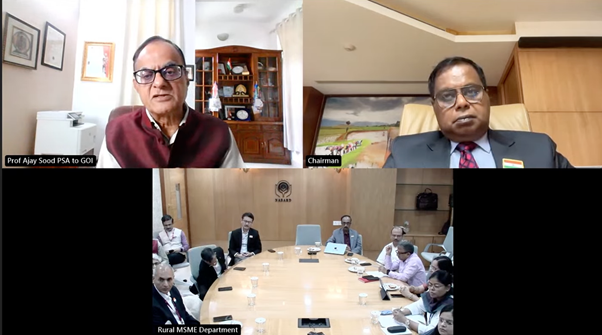
rural transformation. The launch event was attended by NABARD Chairman Dr Shaji
Krishnan V., representatives of various organisations and other stakeholders.
Addressing the gathering, Sood said AMRIT has been conceived
as a comprehensive digital ecosystem supporting the entire lifecycle of the
RuTAGe Smart Village Centre (RSVC) initiative — from discovery and validation
of technologies to their deployment, tracking, collaboration, monitoring and
knowledge management.
He said the platform would progressively bring innovators,
technology providers, startups, validators, accelerators, implementation
partners, funding agencies, academic institutions and rural communities onto a
common platform, creating a stronger bridge between technological capabilities
and grassroots requirements.
By connecting these diverse stakeholders, AMRIT is expected
to facilitate collaboration, speed up the dissemination of appropriate
technologies and help ensure that innovations reach rural communities where
they can have the greatest impact.
Highlighting the need for such an ecosystem, Krishnan said
India possesses a rich network of scientific institutions, innovators, startups
and technology providers, but ensuring that the right technologies reach the
right rural communities remains a key challenge.
AMRIT, he said, seeks to address this gap by connecting rural
needs with innovations, institutions and implementation mechanisms, thereby
strengthening technology dissemination and adoption at the grassroots level.
Krishnan also reaffirmed NABARD’s commitment to supporting
such initiatives across the country, in addition to the eight RSVCs currently
being supported by the development finance institution.
The RSVC initiative is aimed at facilitating the transfer of
appropriate, affordable and locally relevant technologies from research
institutions, innovators and startups to rural communities through
village-level technology hubs.
These centres cover a wide range of areas, including
agriculture, rural enterprises, renewable energy, education, assistive
technologies, water and sanitation and citizen services, creating local platforms
through which technology can be demonstrated, adapted and adopted.
With the launch of AMRIT, the physical outreach of RSVCs will
now be complemented by a digital layer, enabling innovations, technologies,
best practices and collaboration opportunities to be discovered and shared on a
wider scale.
NABARD expects the platform to evolve into a national
repository of rural innovations and technologies, while strengthening linkages
among innovators, institutions, implementation agencies and rural communities.
The initiative is also expected to contribute to the broader vision of Viksit
Bharat 2047 by enabling technology and innovation to become more accessible to
rural India.
The initiative builds on an earlier tripartite Memorandum of Understanding between OPSA, NABARD and NABFOUNDATION, a subsidiary of NABARD. NABARD has also established a Centre of Excellence on RSVCs at its head office in Mumbai to further strengthen the institutional framework for the initiative.
On the occasion, NABARD also shared the broad contours of its scheme for establishing RSVCs, which will be supported by NABARD and set up in collaboration with corporates through their Corporate Social Responsibility (CSR) initiatives, with NABFOUNDATION serving as the implementation partner.