
THEBUSINESSBYTES
BUREAU
NEW
DELHI, OCTOBER 12, 2026
India’s retail
inflation accelerated sharply to 5.54 per cent in September from 4.83 per cent
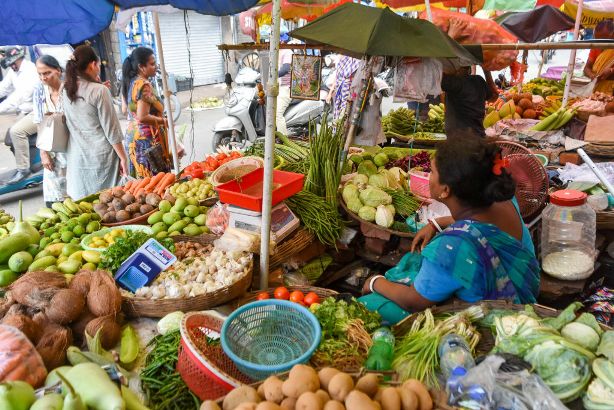
in August, driven by a steep rise in food prices, with onion inflation soaring
above 108 per cent, according to government data released on Monday.
Food inflation,
measured by the Consumer Food Price Index (CFPI), jumped to 7.74 per cent in
September from 5.97 per cent in the preceding month, signalling mounting price
pressures on household budgets.
The provisional
Consumer Price Index (CPI) data, based on the new series with 2024 as the base
year, showed inflation rising across both rural and urban areas. Rural
inflation climbed to 6.08 per cent in September from 5.24 per cent in August,
while urban inflation increased to 4.88 per cent from 4.31 per cent.
Food inflation
remained particularly elevated in rural markets at 8.06 per cent, compared with
6.17 per cent in August. In urban areas, it accelerated to 7.18 per cent from
5.64 per cent.
The combined CPI
index rose to 109.49 in September from 108.74 in August, while the combined
food price index increased to 112.17 from 110.73, reflecting a broad-based
monthly rise in consumer prices. September figures are provisional, while those
for August are final.
Among individual
items, onion prices emerged as a major source of inflationary pressure, with
year-on-year inflation surging to 108.09 per cent from 48.78 per cent in
August. Garlic inflation also accelerated to 54.62 per cent from 43.60 per
cent, while lemon inflation more than doubled to 36.41 per cent from 15.15 per
cent.
However, price
pressures eased in some other commodities. Inflation in silver jewellery
moderated to 87.80 per cent from 106.81 per cent, while ginger inflation
declined to 62.85 per cent from 73.82 per cent.
Several items
continued to record annual price declines, offering some relief to consumers.
Potato prices fell 11.50 per cent year-on-year, while tomato prices declined
8.62 per cent. Motor cars and jeeps, lady’s finger and coconut registered
deflation of 4.51 per cent, 4.48 per cent and 3.99 per cent, respectively.
In August, potato
prices had declined 13.15 per cent, tomatoes 31.09 per cent, motor cars and
jeeps 6.73 per cent, lady’s finger 5.41 per cent and coconut 3 per cent.
Across expenditure
divisions, personal care, social protection and miscellaneous goods and
services recorded the highest inflation at 13.75 per cent. Restaurants and
accommodation services followed at 9.36 per cent, while food and beverages
registered inflation of 7.36 per cent. Transport inflation stood at 5.01 per
cent.
Inflation in paan,
tobacco and intoxicants was recorded at 4.80 per cent, followed by education
services at 3.94 per cent, clothing and footwear at 3.93 per cent, and
furnishings, household equipment and routine household maintenance at 3.11 per
cent.
Housing, water,
electricity, gas and other fuels recorded inflation of 2.74 per cent.
Information and communication inflation stood at 2.44 per cent, recreation,
sport and culture at 2.16 per cent, while health registered the lowest
inflation among these major divisions at 1.40 per cent.
At a more granular
level, other personal effects recorded inflation of 38.69 per cent, while goods
transport services registered 14.73 per cent. Food and beverage serving
services saw inflation of 9.39 per cent, paan and tobacco 7.55 per cent, and
the operation of personal transport equipment 7.46 per cent.
Vehicle purchase
prices declined 2.56 per cent year-on-year, while recreational durables
recorded a fall of 0.85 per cent.
Among states with
populations exceeding 50 lakh, based on Census 2011 figures, Tamil Nadu
recorded the highest headline inflation at 6.81 per cent. Odisha followed at
6.70 per cent, ahead of Madhya Pradesh at 6.68 per cent, Telangana at 6.64 per
cent and Andhra Pradesh at 6.29 per cent.
Across all states and
Union Territories, Puducherry recorded the highest inflation at 6.86 per cent.
Mizoram registered the lowest rate at 2.85 per cent, followed by Nagaland at
3.22 per cent and Delhi at 3.40 per cent.
The latest reading marks a sustained upward movement in retail inflation over the past several months. Inflation stood at 2.74 per cent in January and rose to 3.21 per cent in February, 3.40 per cent in March, 3.48 per cent in April and 3.93 per cent in May. It climbed further to 4.38 per cent in June, 4.45 per cent in July and 4.83 per cent in August before reaching 5.54 per cent in September.
The data were compiled from price quotations collected across 1,407 urban markets, including online markets, and 1,465 villages across states and Union Territories. Field visits were conducted according to a weekly roster, with the National Statistical Office reporting a 100 per cent response rate in both rural and urban markets during September.