
Prime
Minister says Somnath symbolizes India’s indestructible consciousness and
inspires the nation for the next thousand years
THEBUSINESSBYTES
BUREAU
NEW
DELHI, MAY 11, 2026
“Somnath serves as a reminder that a nation
can sustain its strength over time only if it remains connected to its roots,”
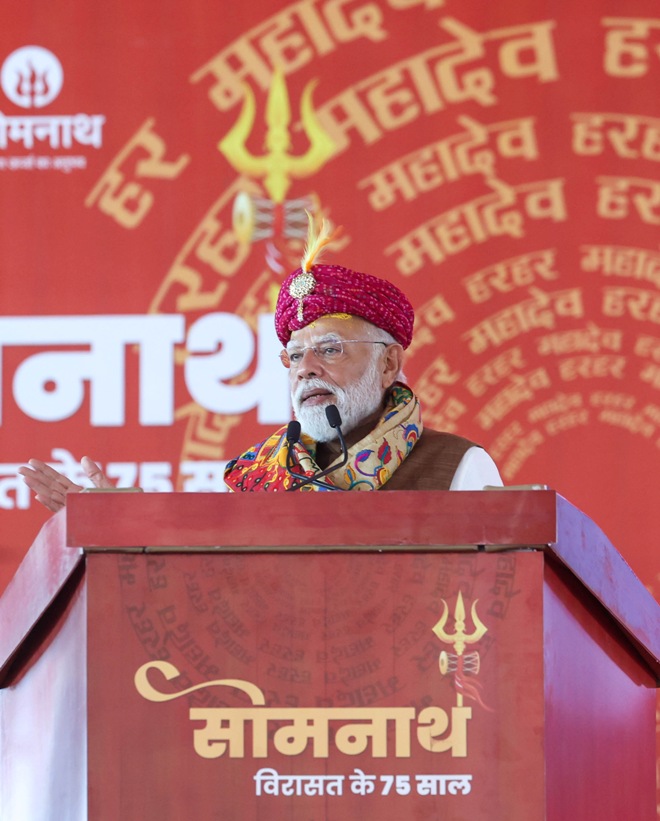
Prime Minister Narendra Modi said on Monday while participating in the Somnath
Amrut Mahotsav commemorating 75 years of the inauguration of the restored
Somnath Temple in Gujarat.
Addressing a grand
gathering at the temple complex on the occasion of its 75th consecration
anniversary, the Prime Minister described the event as far more than a
ceremonial celebration, calling it a declaration of India’s eternal
consciousness and civilisational resilience. The occasion witnessed vedic
chants, cultural performances and devotional fervour converging at the sacred
coastal shrine.
Invoking ancient
scriptural wisdom, Modi said, “Yato
jayate palyate yena vishwam, tamīsham bhaje līyate yatra vishwam, today we
are celebrating the festival of reconstruction of His abode.” Sharing his
personal bond with the shrine, he recalled his numerous visits to Somnath as a
devotee of Dada Somnath and said the journey to the temple on this occasion
felt like travelling through centuries of history.
Referring to the
Somnath Swabhiman Parv held a few months ago, the Prime Minister said the
nation had the opportunity to experience both the pride of Somnath’s
indestructibility despite repeated destruction over a thousand years and the
completion of 75 years of its modern consecration. “We have got the opportunity
to experience the immortal journey of a thousand years,” he remarked.
Highlighting the
significance of the 1951 consecration ceremony, Modi said it proclaimed the
“independent consciousness” of India after Independence in 1947. Drawing a
parallel between Sardar Vallabhbhai Patel’s role in unifying more than 500
princely states and his determination to rebuild Somnath, the Prime Minister
observed that the restoration of the temple signalled that India was reclaiming
its ancient glory.
“I am seeing here the resolve of creation in
destruction, which Somnath has fulfilled,” the Prime Minister said, adding that
the temple embodied the eternal victory of truth over falsehood and reflected
the indestructible spirit of India that centuries of invasions failed to erase.
Calling the Somnath
Amrut Mahotsav an inspiration for the next thousand years, Modi congratulated
devotees across the country and linked the day with another milestone in
India’s history — the anniversary of the Pokhran nuclear tests of 1998.
Recalling Operation Shakti, he said India had demonstrated both scientific
capability and political resolve under the leadership of former Prime Minister
Atal Bihari Vajpayee despite global pressure.
“Nation comes first, no power in the world can
make India bow or bring it under pressure,” Shri Modi asserted. Explaining the
name Operation Shakti, he said the worship of Shiva and Shakti has always been
integral to Indian tradition and continues to inspire India’s scientific
advancement.
Tracing Somnath’s
long history of destruction and reconstruction, the Prime Minister recalled
repeated attacks by invaders such as Mahmud of Ghazni and Alauddin Khilji, and
the subsequent rebuilding efforts by rulers including Raja Bhoj, Bhimdev I,
Kumarapala, Mahipala I and Rao Khangar. “Those who destroyed saw only stone and
mortar, but they never understood the intellectual and spiritual power of our
civilization,” he said.
The Prime Minister
also acknowledged the contributions of saints, scholars, rulers and freedom-era
leaders who preserved and restored Somnath’s heritage. He paid tributes to
personalities such as Punyashloka Ahilyabai Holkar, the Gaekwads of Baroda, Jam
Saheb Maharaja Digvijay Singh, Sardar Patel, Dr Rajendra Prasad and K M Munshi
for their dedication towards the temple’s revival.
Referring to the role
of cultural heritage in nation-building, Modi noted that several countries
across the world rebuilt heritage structures destroyed by invaders, while in
India, the restoration of Somnath faced opposition despite the efforts of
national leaders. “Yet Sardar Sahab’s unwavering resolve ensured that the
nation washed away centuries of shame,” he remarked.
The Prime Minister
cautioned against divisive thinking and stressed the need to move forward with
both development and heritage together. He highlighted the economic
transformation brought about by the Somnath Temple Trust, noting that the
shrine has become both a spiritual centre and a source of livelihood for
thousands.
Expanding the scope
to India’s broader cultural renaissance, Modi listed major initiatives
undertaken in recent years, including the reconstruction of Kedarnath, the
development of Kashi Vishwanath Dham, Mahakal Mahalok in Ujjain, the Chardham
highway project, the Kartarpur Corridor and the Buddhist Circuit.
“These cultural sites are not obstacles to
progress, but centres of India’s spiritual-social system and gateways to genuine
development,” the Prime Minister asserted.
Invoking the Upanishadic phrase “Sarvam Khalvidam Brahma”, Modi underlined India’s ancient philosophy of viewing nature as sacred and called for making India’s pilgrimage centres examples of harmonious development for the world.
Concluding his address, the Prime Minister said cultural continuity remains the foundation of national strength and self-confidence. “Today, that journey stands before us in even more expansive form. We must carry it to greater heights while remaining rooted in our traditions, this is the mandate of our times,” Modi said.