THEBUSINESSBYTES
BUREAU
NEW
DELHI, MAY 4, 2026
Emphasising that
technology-led innovation will anchor India’s next phase of economic
resurgence, Union Minister Dr. Jitendra Singh on Monday said the country’s
expanding science and technology ecosystem—fuelled by policy reforms, industry
participation and a thriving startup culture—is set to drive a new era of
growth, competitiveness and global leadership.
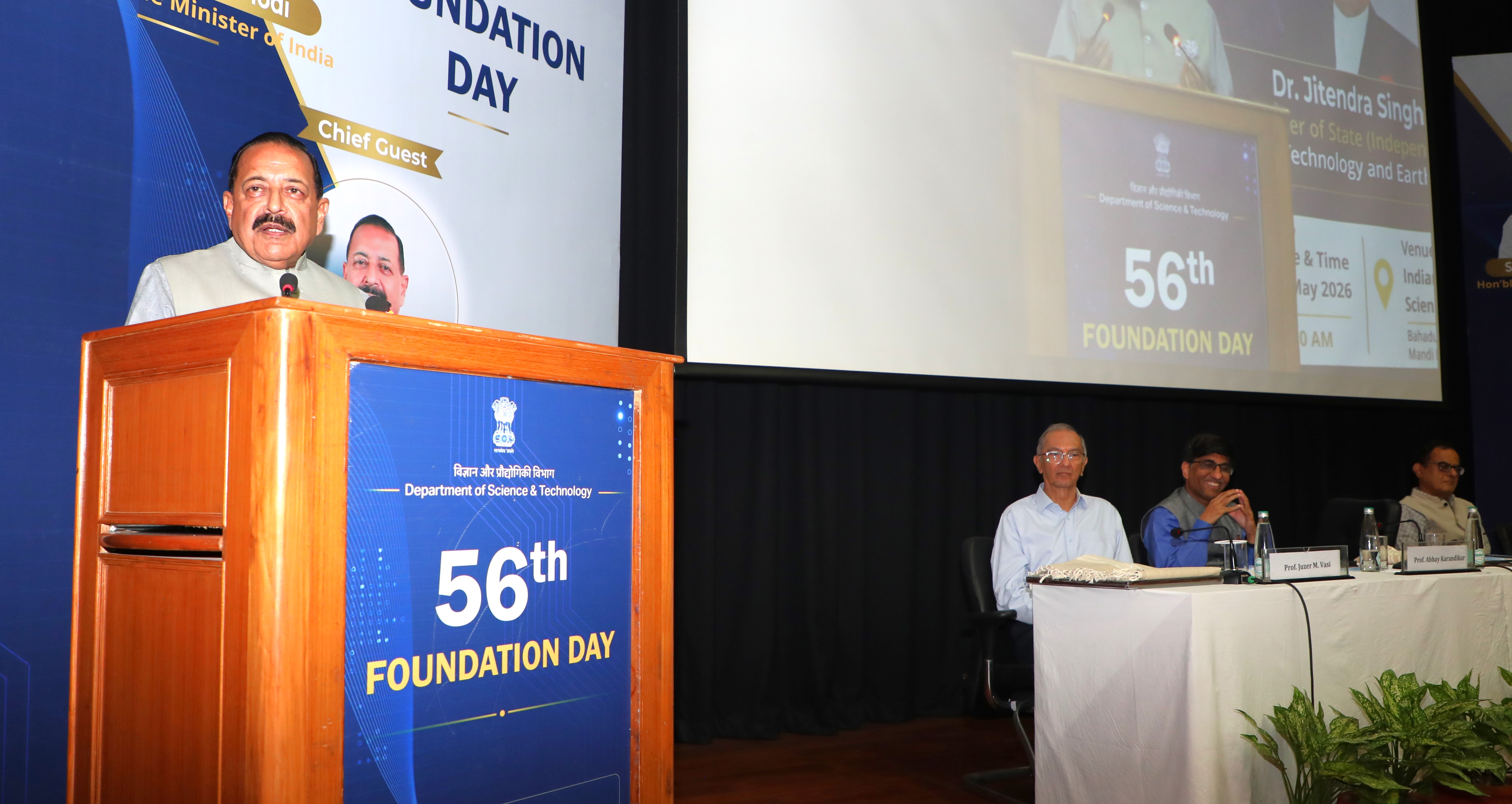
Addressing the 56th
Foundation Day of the Department of Science and Technology (DST) at the Indian
National Science Academy (INSA) Auditorium here, the Minister underlined that
innovation driven by technology has moved beyond laboratories to become a
cornerstone of industrial development, entrepreneurship and national progress
over the past decade.
Calling for a shift
in approach, Dr. Singh said science must transition “from laboratories to
markets and from ideas to impact,” reflecting a policy framework that
integrates research outcomes with economic value creation. He noted that
India’s science and technology landscape has undergone a decisive
transformation, aided by reforms that opened critical sectors such as space and
nuclear energy to private participation.
He highlighted that
these measures have catalysed new opportunities for startups and industry,
enabling India to leverage its vast talent pool and strengthen its global
innovation footprint. Referring to the rapid evolution of the space sector, the
Minister said that within a short span of opening it to private players, the
country has witnessed a surge in startup-led innovation, particularly in
satellite technologies, enhancing both economic potential and strategic
preparedness.
Dr. Singh stressed
that no nation can progress in science in isolation, urging deeper
collaboration among government, academia and industry. He also underscored the
importance of indigenous research, noting that India is increasingly developing
homegrown technologies across sectors, including critical areas like pharmaceuticals.
Pointing to India’s
rising global scientific stature, he said the country’s share of highly cited
research publications has grown significantly, reflecting both quality and
impact. He also cited the exponential growth of India’s startup ecosystem — from
a few hundred ventures a decade ago to over two lakh today — as a strong
indicator of a rapidly maturing innovation landscape.
The Minister
emphasised the need for scientific institutions to enhance outreach and
effectively communicate their achievements to attract partnerships and maximise
societal benefits. He added that while nurturing innovation is essential,
building a transparent, merit-based ecosystem is equally important to guide
young talent with clarity and purpose.
Dr. Singh also
referred to ongoing administrative reforms aimed at improving institutional
efficiency and aligning systems with contemporary technological needs,
including restructuring legacy frameworks and promoting decentralised
decision-making.
Earlier, Principal Scientific Adviser to the Government of India, Prof. Ajay Kumar Sood, highlighted the importance of aligning research with technology development and commercialisation, while DST Secretary Prof. Abhay Karandikar outlined key initiatives such as the Anusandhan National Research Foundation, the Research, Development and Innovation (RDI) Fund, and the National Quantum Mission to further strengthen the country’s innovation ecosystem.
Expressing confidence in India’s trajectory, Dr. Jitendra Singh said sustained reforms, robust institutional frameworks and active stakeholder participation will enable the science and technology sector to play a defining role in shaping the country’s economic growth and global leadership in the years ahead.