THEBUSINESSBYTES BUREAU
NEW DELHI, OCTOBER 7, 2026
Technology must
become a tool for inclusive and sustainable development, Prime Minister
Narendra Modi said on Wednesday, stressing that its democratisation is
essential to ensure that no section of society is left behind.
Modi made the remarks
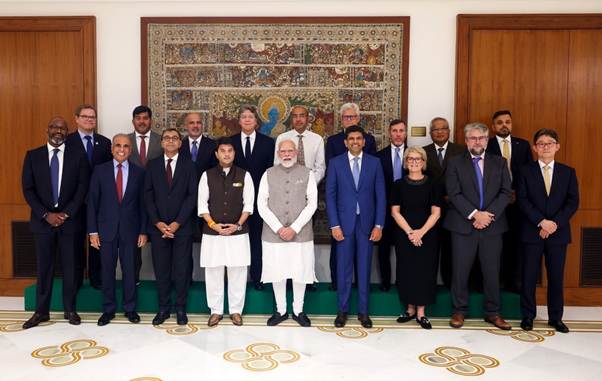
while interacting with members of the Global System for Mobile Communications
Association (GSMA) Board at Seva Teerth ahead of the India Mobile Congress
(IMC) 2026.
Union Minister for
Communications and Development of North Eastern Region Jyotiraditya Scindia,
Minister of State for Communications and Rural Development Dr Pemmasani Chandra
Sekhar and senior government officials attended the interaction.
The Prime Minister
underlined the need to make technology and digital services affordable and
accessible, particularly for countries of the Global South, and stressed the
importance of taking technology to the last mile to prevent the digital divide
from widening.
He highlighted the
potential of Digital Public Infrastructure (DPI) as a transformative force,
particularly for developing countries, and said discussions on DPI with several
world leaders had demonstrated its growing global relevance.
DPI platforms, Modi
said, can serve as a springboard for countries of the Global South, enabling
them to harness technology for inclusive growth and development.
Addressing the
growing challenge of digital and cyber fraud, the Prime Minister said the
problem requires technology-driven solutions. He also suggested sustained
awareness messages for users to alert people about potential fraud calls and
help strengthen digital safety.
Modi also emphasised
the need for global standards and common rules for emerging technologies. On
the growing threat posed by deepfakes and AI-generated content, he suggested
exploring mechanisms that would enable users to immediately identify the origin
of such content.
The GSMA Board
members, meanwhile, highlighted India's emergence as a global leader in digital
and mobile connectivity, pointing to the rapid expansion of 4G and 5G networks,
the scale of the country's Digital Public Infrastructure and the growth of its
telecom and mobile manufacturing ecosystem.
The global telecom
leaders appreciated India's investment-friendly policy framework and underlined
the importance of secure, resilient and trusted digital infrastructure in
sustaining the country's continued digital growth.
They also highlighted
growing opportunities for international cooperation with India in areas such as
5G, 6G, artificial intelligence, cybersecurity, digital inclusion and satellite
connectivity.
The interaction comes
as India prepares to host the 10th edition of the India Mobile Congress, which
will bring together global technology and telecom leaders in New Delhi.
Scindia has been leading India's international engagement on next-generation connectivity and digital technologies. At Mobile World Congress 2026 in Barcelona, he led India's engagements with the global telecom ecosystem and addressed the GSMA Ministerial Programme on making connectivity more affordable, inclusive and future-ready.
India's engagement with global technology leaders reflects its growing role in shaping the future of telecommunications, including the evolution of 6G, secure digital infrastructure, artificial intelligence and globally interoperable technology standards.