THEBUSINESSBYTES
BUREAU
NEW
DELHI, MARCH 3, 2026
Asserting
that “This year’s Union Budget reinforces our commitment to sustaining and
strengthening economic growth,” Prime Minister Narendra Modi on Tuesday
outlined a forward-looking blueprint to accelerate India’s economic momentum,
urging stakeholders to rally behind the call to “Build more, produce more, connect
more, export more” and drive the nation closer to the vision of ‘Viksit
Bharat.’
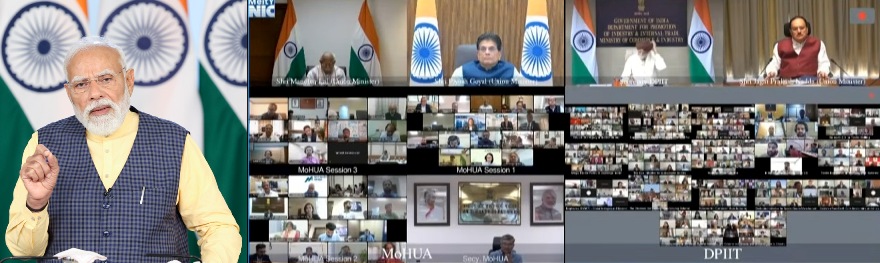
Addressing
the second installment of the Budget Webinar series centered on “Sustaining and
Strengthening Economic Growth,” the Prime Minister said the government’s
direction and resolve are unequivocally clear. Reflecting on the momentum
generated by the first webinar, he noted that it had produced constructive
suggestions for effective implementation of budget provisions, and emphasized
that the current deliberations would further strengthen the country’s growth
trajectory.
 Highlighting
the rapid reshaping of global supply chains, the Prime Minister observed that
India’s robust economic performance has emerged as a beacon of hope for the
world. “The rapid progress of the economy is a massive foundation for a ‘Viksit
Bharat’,” Modi remarked, underscoring that India stands at a pivotal moment in
the evolving global order.
Highlighting
the rapid reshaping of global supply chains, the Prime Minister observed that
India’s robust economic performance has emerged as a beacon of hope for the
world. “The rapid progress of the economy is a massive foundation for a ‘Viksit
Bharat’,” Modi remarked, underscoring that India stands at a pivotal moment in
the evolving global order.
Reaffirming
the government’s vision, the Prime Minister reiterated the core mantra of
“Build more, produce more, connect more, and export more,” stating that today’s
discussions and recommendations would play a decisive role in accelerating
development across sectors. He explained that manufacturing, logistics, MSMEs
and urban centers function not as isolated silos but as interconnected pillars
of a single economic structure. While manufacturing drives exports, competitive
MSMEs enhance flexibility and innovation. “This year’s budget has provided
great strength to all these pillars,” Modi affirmed.
However,
he cautioned that policy direction alone cannot deliver results without active
participation from industry, financial institutions and state governments. He
urged stakeholders to focus on enhancing manufacturing capacity, boosting
production and improving cost competitiveness. “Your suggestions in these
directions will be pivotal in making the development reach every corner of the
country,” Modi said.
The
Prime Minister highlighted targeted interventions such as Dedicated Rare Earth
Corridors and container manufacturing to remove bottlenecks and strengthen
India’s trade ecosystem. He also spotlighted the ‘Biopharma Shakti Mission’
announced in the budget, aimed at positioning India as a global hub for
biologics and next-generation therapies. “We want to move towards leadership in
advanced biopharma research and manufacturing,” Modi expressed.
Against
the backdrop of shifting global dynamics, the Prime Minister emphasized that
the world is seeking reliable and resilient manufacturing partners. “The world
is looking for reliable and resilient manufacturing partners, and today India
has the opportunity to firmly fulfill this role,” he stated, urging industry to
invest confidently in research, adopt cutting-edge technologies and uphold
global quality benchmarks.
Touching
upon India’s Free Trade Agreements, the Prime Minister said these have opened “a
very large door of opportunities” and placed greater responsibility on domestic
industry to ensure uncompromising quality. “India has signed Free Trade
Agreements with many countries, a very large door of opportunities has opened
for us, and in such a situation, it is our responsibility to never compromise
on quality,” Shri Modi emphasized, calling for deeper research into global
consumer preferences to create user-friendly products.
On
the MSME front, the Prime Minister noted that recent classification reforms
have eliminated the fear of expansion among small enterprises. While the
government is facilitating access to credit and technology upgrades, he
stressed that real transformation depends on MSMEs embracing global
competition. “Now is the time for MSMEs to further increase their productivity,
raise their quality standards, and connect with digital processes and strong
value chains,” Shri Modi emphasised.
Describing
infrastructure and logistics as the backbone of national growth, the Prime
Minister pointed to record capital expenditure in the current budget. He
highlighted investments in high-speed rail, multi-modal connectivity and ship
repair facilities as key enablers of efficiency, adding that industry must
strategically align with this expanding infrastructure ecosystem to maximize
benefits.
On
urbanization, Modi underlined that India’s future growth is closely linked to
effective planning and management of cities. He invited suggestions on how
Tier-II and Tier-III cities can evolve into new growth engines, reinforcing the
need for balanced and inclusive development.
Addressing the global shift toward sustainability, the Prime Minister observed that markets today evaluate not only cost but also environmental responsibility. He described the Carbon Capture, Utilisation and Storage Mission as a critical initiative and stressed that integrating sustainability into core business strategies is no longer optional. “A major transformation is happening in the world economy today, as markets now look not only at cost but also at sustainability,” he said, adding, “The industries that invest in clean technology in time will be able to build better access to new markets in the coming years.”
Calling for collective ownership of the development agenda, the Prime Minister urged stakeholders to translate discussions into tangible action in partnership with the government’s framework. “Every suggestion and every experience of yours has the potential to bring excellent results on the ground,” Shri Modi concluded, reiterating that a resilient, sustainable and innovation-led economy is the foundation of a truly ‘Viksit Bharat.’