
THEBUSINESSBYTES
BUREAU
BHUBANESWAR,
JULY 21, 2026
Calling for a unified
and evidence-driven approach to regulate India’s rapidly evolving bike taxi
sector, CUTS International has released a comprehensive report advocating a
harmonised regulatory framework to safeguard gig workers’ livelihoods,
strengthen commuter safety and enhance affordable urban mobility. The report also
recommends structured authorisation of non-transport motorcycles, greater
platform accountability, harmonised safety standards and an incentive-based
transition to electric vehicles.
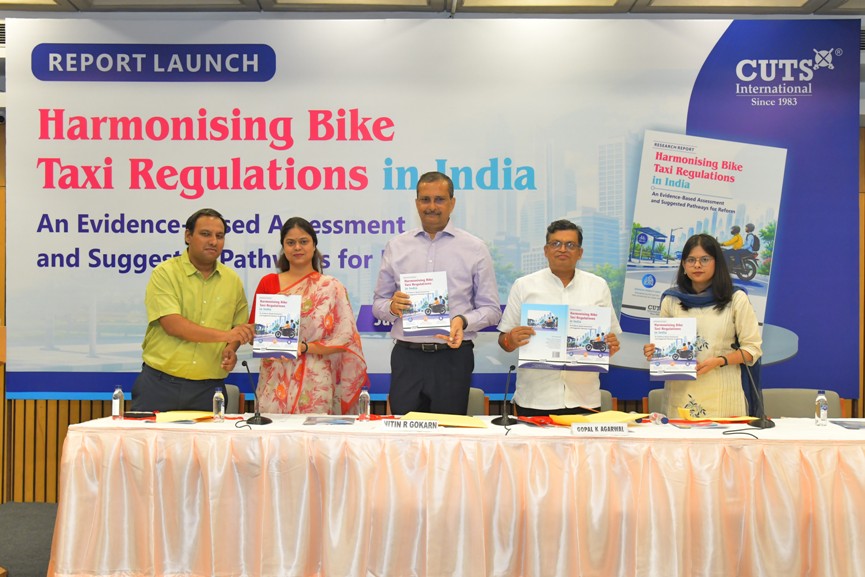
Titled “Harmonising Bike Taxi Regulations in India:
An Evidence-Based Assessment and Suggested Pathways for Reform,” the report
was recently launched in New Delhi by Gopal Krishna Agarwal, National
Spokesperson for Economic Affairs of the Bharatiya Janata Party. Emphasising
the importance of an integrated mobility ecosystem, Agarwal said that as India
advances its ease of living agenda, a well-regulated bike taxi ecosystem can
significantly improve connectivity, generate employment, enhance productivity
and contribute to sustainable economic growth.
The report comes at a
critical juncture when bike taxi regulations vary widely across states, with
some adopting enabling frameworks and conditional permissions while others
impose restrictions, EV-only mandates or operate amid legal uncertainty.
According to CUTS International, these divergent approaches have created
confusion for commuters, gig workers, platform aggregators and regulators
alike, underscoring the urgent need for a predictable, coherent and
proportionate national policy framework.
The report was
followed by a panel discussion on “Harmonising
Regulation Across States: Bridging Policy Gaps and Legal Ambiguities,”
moderated by Amol Kulkarni, Director (Research), CUTS International. The panel
featured Chhavi Banswal, Founder and Principal Consultant, Chiral Consulting;
Paroma Bhat, Head of Public Policy and Government Relations, Uber India and
South Asia; Pravesh Biyani from the Centre of Excellence on Sustainable
Mobility at IIIT Delhi; Shantanu Sharma, Senior Manager (Law, Policy and
Regulations), Rapido; and Nikhil Rathi, Senior Account Director (Public
Policy), Chase Advisors.
The panellists
unanimously stressed the need for a balanced regulatory framework that promotes
commuter safety, worker welfare, innovation, consumer choice and regulatory
certainty. They also highlighted the growing role of bike taxis in India’s
urban mobility ecosystem, particularly in providing affordable short-distance
travel, improving first- and last-mile connectivity and creating flexible
livelihood opportunities for thousands of gig workers.
Reaffirming its
commitment to evidence-based policymaking, CUTS International said it will
continue engaging with governments, industry, academia and civil society to
support transparent, predictable and inclusive regulations that can unlock the
full potential of bike taxis as a key pillar of India’s urban transport
network.