
THEBUSINESSBYTES BUREAU
JAMNAGAR/KUTCH, AUGUST 17, 2026
In a significant conservation milestone coinciding with
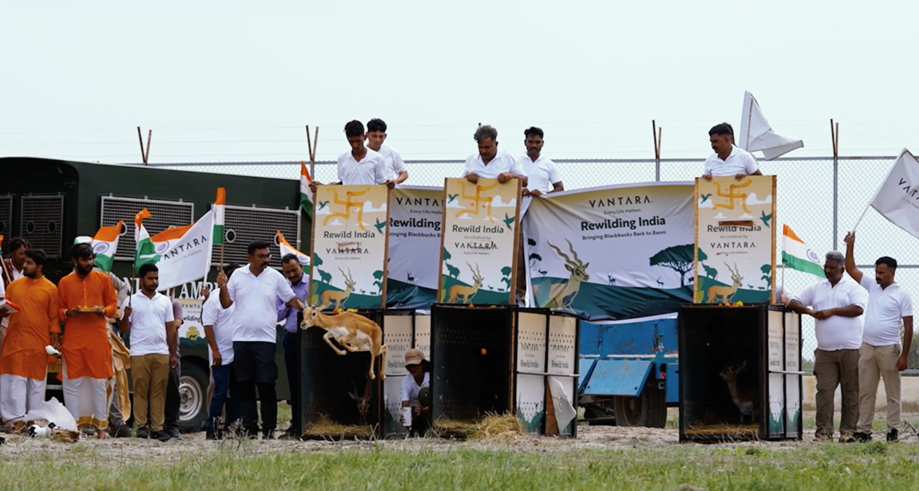
India’s 80th Independence Day, 20 blackbucks were rewilded in the Banni
Grasslands of Kutch, marking a major step towards restoring the native
herbivore community and reviving the ecological character of one of the
country’s most important grassland landscapes.
The Gujarat Forest Department, with technical support from
Greens Zoological Rescue and Rehabilitation Centre (GZRRC), Vantara, released
the 20 blackbucks into Banni on Saturday, comprising five males and 15 females,
following requisite approvals from the Chief Wildlife Warden, Gujarat, and the
Central Zoo Authority (CZA).
The animals were transferred from Vantara, Jamnagar, after
undergoing veterinary examination, health screening, quarantine, disease
surveillance and other prescribed safeguards before being transported and
released in accordance with established wildlife translocation protocols.
The initiative, however, goes well beyond the release of 20 animals,
with conservationists viewing the restoration of native herbivores as an
important component of rebuilding Banni’s ecological fabric, strengthening its
prey base and restoring natural predator-prey relationships that underpin a
resilient grassland ecosystem.
Banni, a vast grassland landscape that supports pastoral
communities as well as diverse wildlife, has historically been home to an
assemblage of native herbivores, including blackbuck, chinkara, nilgai and wild
boar. The recovery of these species, coupled with habitat conservation and
scientific grassland management, is expected to contribute to the restoration
of the landscape’s biodiversity and ecological character.
The initiative also reflects India’s broader conservation
focus on restoring native species and their habitats, with ecological
restoration, prey-base strengthening, scientific wildlife management and
community participation emerging as key pillars of species recovery programmes.
Chief Wildlife Warden, Gujarat, Dr Jaipal Singh, IFS, said
restoring native wildlife was fundamental to restoring healthy landscapes.
“Restoring native
wildlife is fundamental to restoring healthy landscapes. The release of these
20 blackbucks into Banni on India’s Independence Day is an important milestone
in our continuing effort to recover the ecological character and biodiversity
of this unique grassland,” he said.
He added that such restoration required science, sustained
management and collaboration, and appreciated Vantara’s technical support in
carrying out the programme in accordance with prescribed protocols.
Ajit Kulkarni, Special Director, Compliance & Due
Diligence, Vantara, said the initiative represented an opportunity to
contribute to a future in which India’s native species could continue to live
and flourish in their natural landscapes.
“There can be no
greater privilege on Independence Day than contributing to a future in which
India’s native species continue to live and flourish in the natural landscapes
to which they belong,” Kulkarni said.
He stressed that species restoration was not merely about
releasing animals but required a comprehensive understanding of habitat,
species and individual animals, along with population planning, habitat
dynamics and the active participation of local communities.
“We are honoured to
support the Gujarat Forest Department and the Government’s conservation vision
for Banni, and to contribute our technical capabilities wherever they can
strengthen India’s wildlife conservation efforts,” he said.
The Banni release forms part of a wider Gujarat programme
aimed at strengthening native herbivore populations across the state. The
Central Government, through the Ministry of Environment, Forest and Climate Change,
has approved the translocation of 500 blackbucks and 100 chinkaras, with the
Chief Wildlife Warden, Gujarat, issuing the necessary directions for the
exercise.
While a component of the wider programme is linked to
prey-base augmentation in connection with the planned cheetah reintroduction
programme, the Banni initiative also carries a distinct species-restoration
objective — rebuilding populations of wildlife native to the grassland
ecosystem.
The Banni Grassland Forest Division has sought Vantara’s
technical assistance for the wider translocation programme, including
specialised herbivore transport vehicles, portable boma systems, veterinary
expertise and technical support for the safe handling and transportation of
animals.
The latest initiative builds on the Gujarat Forest
Department’s continuing conservation efforts. With the approval of the Chief
Wildlife Warden, Gujarat, Vantara has previously supported the Forest
Department in the rewilding of nearly 80 spotted deer in Barda Wildlife Sanctuary,
contributing to biodiversity strengthening within the Asiatic lion conservation
landscape.
The Banni programme further reinforces this model of conservation collaboration, with the Gujarat Government and Forest Department providing leadership and stewardship while Vantara contributes specialised capabilities in veterinary medicine, wildlife management, translocation and post-release monitoring.
As India marks its 80th Independence Day, the return of the blackbucks to Banni carries a wider conservation message: protecting the country’s natural heritage is not only about safeguarding individual species, but also about restoring the landscapes where native wildlife can once again live, reproduce and thrive in the wild.