
THEBUSINESSBYTE BUREAU
BHUBANESWAR, JUNE 29, 2026
Calling for a robust and future-ready statistical ecosystem
across all government departments, Development Commissioner-cum-Additional
Chief Secretary Deoranjan Kumar Singh on Monday said the most meaningful tribute
to the legendary statistician Prof. P. C. Mahalanobis would be to follow the
path he envisioned by strengthening the State's statistical system and
harnessing the power of quality administrative data for evidence-based
governance. He stressed that while administrative data holds immense potential
for improving public service delivery, it must always be used cautiously and
validated through survey data to ensure accuracy and reliability.
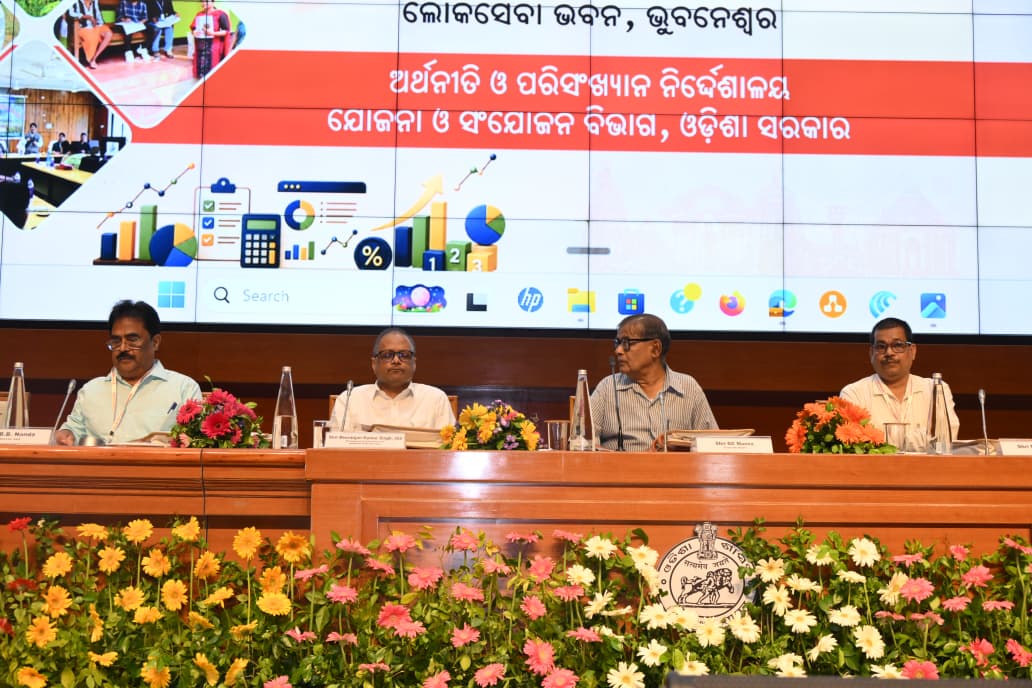
Singh was addressing the inaugural session of the 20th
National Statistics Day celebrations and the two-day workshop on
"Harnessing Administrative Data for Efficient Public Service
Delivery", organised by the Directorate of Economics & Statistics
(DE&S), Planning & Convergence Department, Government of Odisha, at the
State Convention Centre, Loka Seva Bhawan, Bhubaneswar. The workshop, being
held on June 29 and 30, is aligned with the Ministry of Statistics and
Programme Implementation's (MoSPI) vision of unlocking the potential of
administrative data for better governance.
The programme commenced with floral tributes to Prof. P. C.
Mahalanobis, regarded as the architect of India's modern statistical system.
The inaugural session was attended by eminent statistician G. C. Manna, senior
government officials, policymakers, academicians, development partners and
subject experts, who deliberated on the transformative role of administrative
data in strengthening evidence-based policymaking and efficient public service
delivery.
Setting the context, Dr. B. B. Nanda, Director, Economics
& Statistics, highlighted Odisha's sustained efforts towards modernising
its statistical ecosystem through a series of digital initiatives aimed at
enhancing data quality, accessibility and governance.
On the occasion, Singh launched a host of new digital
initiatives of DE&S, including the Data Catalogue and Metadata Management
Portal, STATOdisha Mobile Application, Web-Based Progress Reporting System
(eTathya), Integrated Inventory and Asset Management System, CAPI Management
Information System (MIS) Dashboard, RIPAE&S Website and Learning Management
System, Library Management System of RIPAE&S and DE&S, and the
GIS-enabled Statistical Dashboard. These initiatives are expected to
significantly strengthen the collection, management, dissemination and
accessibility of official statistics across the State.
Several key statistical publications were also released
during the inaugural session. These included the Energy Statistics Report-2025,
Women and Men Odisha Report-2025, Annual Activity Report 2025-26, Technical
Reports of EARAS (2023-24 & 2024-25), First Census of Water Bodies Report,
Samikhya Journal-2026, District Statistical Handbook-2024 covering 13
districts, Annual Survey of Industries Report 2021-22, and the Index of
Industrial Production-2024.
Recognising excellence in statistical activities, the Government
presented the Best Performing District Planning & Monitoring Unit (DPMU)
Awards to Sambalpur, Dhenkanal and Mayurbhanj districts.
The inaugural session concluded with a vote of thanks by
Manas Ranjan Samal, Officer-on-Special Duty, DE&S, who also delivered a
presentation on addressing the challenges of harmonising administrative data in
Odisha.
The two-day technical workshop features expert deliberations
on digital transformation of statistical systems, metadata management, data
quality assurance, quantum-safe data security, environmental statistics and
strategies for leveraging administrative data for evidence-based policymaking.
Experts from the World Bank, Government of India, academia, development
partners and civil society organisations shared national and global best
practices, while presentations by the Forest & Environment Department,
Pollution Control Board, Geological Survey of India and GRIDCO showcased
innovative applications of administrative data in governance.
The workshop concluded with a collective resolve to
strengthen data harmonisation, interoperability and institutional collaboration
for building a technology-driven statistical ecosystem capable of supporting
timely, reliable and evidence-based decision-making. The event reaffirmed the
Government of Odisha's commitment to leveraging data as a strategic asset for
transparent, inclusive and effective governance.