THEBUSINESSBYTES
BUREAU
NEW
DELHI, JULY 2, 2026
Stressing that
plastic waste is a global challenge requiring coordinated international action,
Secretary of the Department of Chemicals and Petrochemicals (DCPC), Ministry of
Chemicals and Fertilizers, Tejveer Singh on Thursday called for concerted and
aligned efforts to address the growing menace of plastic pollution, while
advocating technology-driven recycling, circular economy practices and stronger
collaboration among governments, industry and academia.
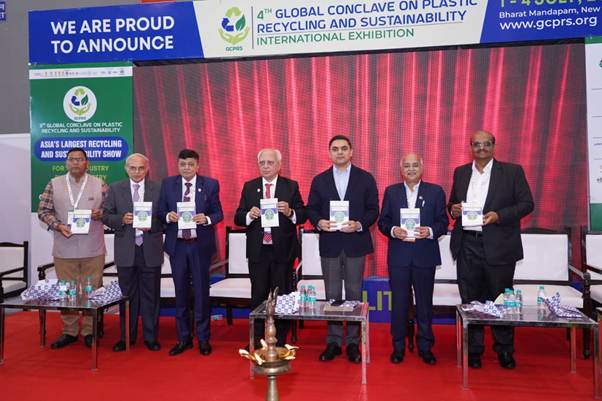
He was addressing the
inaugural session of the 3rd Global Conclave on Plastic Recycling and
Sustainability (GCPRS) and the accompanying International Exhibition at Bharat
Mandapam in New Delhi. The four-day event, recognised as India's premier
platform dedicated to plastic recycling and sustainability, brings together
policymakers, industry leaders, researchers, entrepreneurs and sustainability
experts from across India and abroad.
Addressing the
gathering, Singh underlined that although countries across the world are
working towards solutions for plastic waste, these efforts remain fragmented.
He stressed the need to align with global frameworks such as the UN Global
Plastics Treaty, which seeks to establish unified and legally binding
approaches to plastic production, usage and waste management.
He also emphasised
the importance of learning from international best practices and adopting
advanced technologies to improve plastic waste management systems.
Highlighting the
growing significance of the circular economy, Singh said plastics and plastic
recycling are indispensable to the economy and should be viewed as a modern,
technology-driven, high-value industry rather than being perceived as a dirty
industry.
Commending the
industry's initiatives towards biodegradable plastic packaging, he urged
plastic manufacturers and their research and development wings to develop
long-term solutions to address the challenge of plastic litter, particularly
smaller packaging materials that are difficult to collect and recycle.
The Secretary also stressed
the need for stronger collaboration between industry and academia and assured
that the Department of Chemicals and Petrochemicals would facilitate such
partnerships to accelerate innovation and sustainable solutions.
Recognising the
contribution of waste collectors, Singh said the informal workforce plays a
critical role in maintaining environmental cleanliness. He called for
integrating and formalising waste collectors into the mainstream waste
management ecosystem as the economy evolves.
The conclave is
jointly organised by the All India Plastics Manufacturers' Association (AIPMA)
and the Chemicals & Petrochemicals Manufacturers Association (CPMA) with
the support of the Department of Chemicals and Petrochemicals under the
Ministry of Chemicals and Fertilizers.
The event has also
received support from the Department for Promotion of Industry and Internal
Trade (DPIIT) under the Ministry of Commerce and Industry, the Ministry of
Environment, Forest and Climate Change, the Ministry of Housing and Urban
Affairs, and the Ministry of Micro, Small and Medium Enterprises (MSME).
More than 400
exhibitors are showcasing the latest innovations in plastic recycling
technologies, machinery, sustainable materials and waste management solutions.
The organisers expect the conclave to attract over 50,000 business visitors,
including policymakers, industry leaders, entrepreneurs, researchers, investors
and sustainability professionals from India and overseas.
Besides industry participants, several leading government and private educational and research institutions, including the Central Institute of Petrochemicals Engineering and Technology (CIPET), CSIR–National Physical Laboratory, SIDBI, and the School of Packaging SIESSOP, are participating in the event.
The conclave assumes added significance as the plastic recycling industry continues to witness strong growth. The Indian recycled plastics market is projected to reach USD 3.81 billion by 2032, registering a Compound Annual Growth Rate (CAGR) of 10.95 per cent during 2024–2032. Globally, the waste plastic recycling market is expected to expand to USD 80.5 billion by 2033, reflecting the increasing importance of sustainable recycling technologies and circular economy-based business models.