THEBUSINESSBYTES
BUREAU
MUMBAI,
JULY 2, 2026
Expressing confidence
that India will remain the growth engine of the global steel industry despite
mounting geopolitical and economic uncertainties, Tata Steel Chairman Natarajan
Chandrasekaran on Thursday highlighted the company's record financial
performance, accelerated capacity expansion and steady progress in its green
steel transformation across India and Europe.
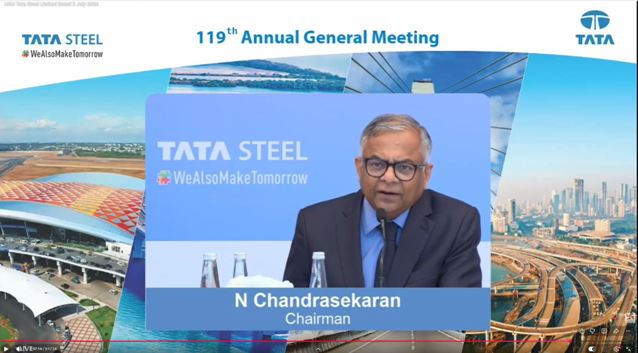
Addressing
shareholders at the 119th Annual General Meeting (AGM) of Tata Steel,
Chandrasekaran said the company has demonstrated resilience amid global
economic uncertainties, driven by robust domestic demand, operational
excellence and strategic investments.
"The year began
with optimism across global markets, supported by expectations of steady
growth, easing inflation and improving financial conditions. While geopolitical
tensions in West Asia later altered the global economic landscape, India's
economy remained resilient with strong growth driven by domestic demand and
manufacturing," he said.
Highlighting the
performance of the global steel industry, the Chairman noted that worldwide
crude steel production declined by two per cent to 1.85 billion tonnes during
calendar year 2025 due to China's slowdown, weak demand in Western markets,
cost volatility and regulatory challenges. In contrast, India's steel sector
continued its growth trajectory, with production rising 10.7 per cent to 168.4
million tonnes and demand increasing 7.6 per cent to 163.7 million tonnes,
supported by infrastructure, construction, automotive and industrial demand.
Against this
backdrop, Tata Steel posted robust financial results for FY2025-26.
The company's
consolidated revenue grew six per cent year-on-year to ₹2,32,140 crore, backed by record
annual crude steel production of nearly 23.4 million tonnes and deliveries of
about 22.5 million tonnes. Consolidated EBITDA surged 35 per cent to ₹34,848
crore, while Profit After Tax registered a remarkable 243
per cent jump to ₹10,886
crore.
In India, the company
reported revenues of ₹1,40,302
crore and EBITDA of ₹34,272 crore, representing a 17 per cent increase with
EBITDA margins improving to 24 per cent, driven by cost efficiencies, an improved
product mix and higher sales volumes. Consolidated net debt also reduced to ₹80,144 crore, significantly
strengthening the company's balance sheet.
Reflecting confidence
in the company's financial health, the Board has recommended a dividend of ₹4 per equity share for
FY2025-26.
A key highlight of
the year was the successful commissioning of Phase-II expansion at Tata Steel's
Kalinganagar plant in Odisha, increasing the company's total steelmaking
capacity to 26.1 million tonnes per annum (MTPA) while expanding Kalinganagar's
capacity from 3 MTPA to 8 MTPA.
The expanded facility
houses India's largest blast furnace and a state-of-the-art Cold Rolling Mill,
significantly enhancing Tata Steel's capabilities in high-value flat steel
products for sectors such as automotive and defence.
Chandrasekaran
described the expansion as a decisive milestone in Tata Steel's long-term
strategy to achieve 40 MTPA capacity in India.
The company also
continued to strengthen its portfolio of value-added products through deeper
digital engagement and expansion into emerging sectors including defence and
shipbuilding. Simultaneously, downstream businesses such as tubes, tinplate and
wires witnessed capacity enhancement.
During the year, Tata
Steel consolidated ownership in Tata Steel Colors and acquired a majority stake
in Thriveni Pellets, moves that the Chairman described as critical for
enhancing long-term competitiveness.
Further strengthening
its long products business, Tata Steel recently commissioned a 0.75 MTPA
Electric Arc Furnace (EAF) in Ludhiana and is progressing with the planned
expansion of Neelachal Ispat Nigam Limited. The Board has also approved the
amalgamation of NINL with Tata Steel to unlock operational synergies and
simplify the corporate structure.
On the international
front, Chandrasekaran said Tata Steel's European operations have entered a
decisive transformation phase focused on sustainable steelmaking.
In the United
Kingdom, the company has commenced construction of its GBP 1.25 billion Electric
Arc Furnace project at Port Talbot, representing the country's largest
low-carbon steel transition initiative in partnership with the UK Government.
The Chairman said
engineering design and project execution are progressing as planned.
In the Netherlands,
Tata Steel has significantly improved operational performance, with EBITDA
tripling to Euro 267 million during the year. However, he acknowledged that the
operating environment has become increasingly challenging due to environmental regulations
that exceed European Union standards.
He said the company
is actively engaging with the Dutch Government and other stakeholders to
establish a long-term pathway that is environmentally compliant, financially
sustainable and operationally viable.
To strengthen energy security and support its decarbonisation roadmap, Tata Steel Netherlands also acquired Vattenfall's co-generation power plants during the year.
Concluding his address, Chandrasekaran reaffirmed Tata Steel's commitment to sustainable growth, technological advancement and value creation through disciplined execution, strategic investments and operational excellence, while positioning the company to capitalise on India's long-term steel demand and the global transition towards greener manufacturing.