
THEBUSINESSBYTES
BUREAU
NEW
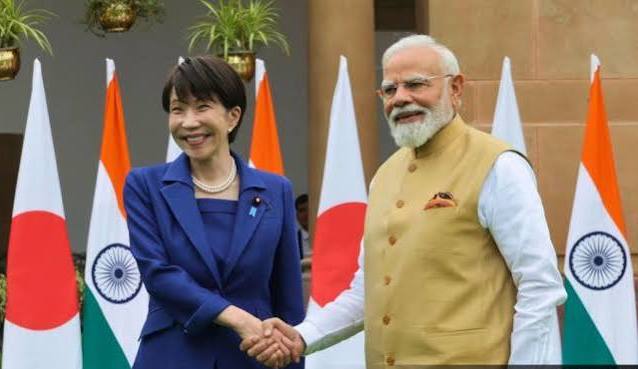
DELHI, JULY 2, 2026
India and Japan on Thursday unveiled an
ambitious roadmap to significantly deepen their Special Strategic and Global
Partnership, with Prime Minister Narendra Modi and Japanese Prime Minister
Sanae Takaichi committing to stronger cooperation in defence, economic
security, clean energy, artificial intelligence, critical technologies and
resilient supply chains amid an increasingly volatile global geopolitical
environment.
The wide-ranging
decisions were announced in the Joint Statement issued after the 16th
India-Japan Annual Summit, during Prime Minister Takaichi's first official
visit to India. The two leaders reaffirmed that India and Japan are
"natural and indispensable partners" committed to promoting shared
growth, prosperity and resilience while upholding a free, open and rules-based
Indo-Pacific.
Recognising the
growing strategic importance of bilateral ties, both Prime Ministers agreed to
focus future cooperation on three priority pillars—defence and security,
economic partnership encompassing economic security, energy resilience,
technology and innovation, and enhanced people-to-people exchanges.
In a major boost to
defence ties, the two countries decided to hold the fourth round of the 2+2
Ministerial Meeting in Tokyo later this year while expanding maritime security
cooperation through joint exercises, maritime domain awareness, naval
maintenance, repair and overhaul (MRO), and defence equipment collaboration
under India's "Make in India" initiative. They also welcomed the
agreement reached in principle on the remaining technical aspects of the
Unified Complex Radio Antenna (UNICORN) project and expressed optimism for its
early conclusion.
Economic security
emerged as another major pillar of the summit, with both sides adopting the
India-Japan Joint Declaration on Economic Security Cooperation. The agreement
aims to promote project-based collaboration in semiconductors, critical
minerals, information and communication technology, pharmaceuticals and clean
energy while strengthening resilient global supply chains and reducing
dependence on any single country.
The leaders also
reaffirmed their commitment to closer cooperation in energy security,
supporting uninterrupted global energy trade and maritime navigation through
critical sea lanes, including the Strait of Hormuz. They welcomed the adoption
of a Joint Statement on Energy Resilience and agreed to deepen collaboration on
strategic petroleum reserves, clean ammonia, green hydrogen, solar technologies
and nuclear energy. Japan also reaffirmed support for the landmark clean
ammonia project in Odisha.
Artificial
intelligence and emerging technologies featured prominently in the discussions.
The two Prime Ministers welcomed the inaugural India-Japan AI Strategic
Dialogue and adopted a Joint Statement on AI Cooperation to advance trusted,
resilient and responsible AI development while strengthening digital
infrastructure and innovation ecosystems.
On the economic
front, both leaders expressed satisfaction over the progress towards achieving
the target of 10 trillion Yen in Japanese investment in India. They agreed to
accelerate the review of the India-Japan Comprehensive Economic Partnership
Agreement (CEPA), improve investment facilitation, and strengthen cooperation
in logistics, agriculture, healthcare, textiles, food processing, automotive
manufacturing and financial services.
The summit also saw
renewed emphasis on infrastructure collaboration. The leaders reaffirmed their
commitment to the Mumbai-Ahmedabad High-Speed Rail project and expressed
willingness to explore future high-speed rail corridors across India. They
welcomed the signing of a Memorandum of Cooperation on the Next-Generation
Mobility Partnership while encouraging greater Japanese participation in
India's expanding transportation infrastructure.
The two countries
also strengthened collaboration in science, technology and space, reviewing
progress on the Lunar Polar Exploration (LUPEX) Mission, expanding research
partnerships in quantum technologies, and promoting greater academic and
scientific exchanges.
To further strengthen
people-to-people ties, India and Japan pledged to expand Japanese language
education, tourism, student exchanges and cultural cooperation, while
encouraging greater collaboration among startups, SMEs, universities and
regional governments.
On regional and
global issues, the two Prime Ministers reaffirmed their commitment to the Quad
framework, ASEAN centrality and a free, open and rules-based Indo-Pacific. They
expressed serious concern over developments in the East and South China Seas,
North Korea's nuclear programme and the situation in Myanmar, while supporting
a just and lasting peace in Ukraine and reiterating commitment to stability in
the Middle East.
The two leaders also
strongly condemned terrorism in all its forms, including cross-border terrorism
from Pakistan. They condemned the terrorist attacks in Pahalgam and Delhi and
called for bringing the perpetrators, organisers and financiers to justice
while urging concerted global action against UN-designated terrorist
organisations.
Reaffirming mutual
support for each other's candidature for permanent membership of a reformed
United Nations Security Council, both countries pledged to work closely for
comprehensive UN reforms. Marking the 75th anniversary of diplomatic relations
as the India-Japan Year of Shared Horizons, Prime Minister Takaichi invited
Prime Minister Modi to visit Japan next year for the 17th India-Japan Annual
Summit, an invitation that was accepted.