
Courts
emerging as important sites where changing demographic and social realities are
interacting with existing legal frameworks
THEBUSINESSBYTES
BUREAU
BHUBANESWAR,
MAY 10, 2026
In a
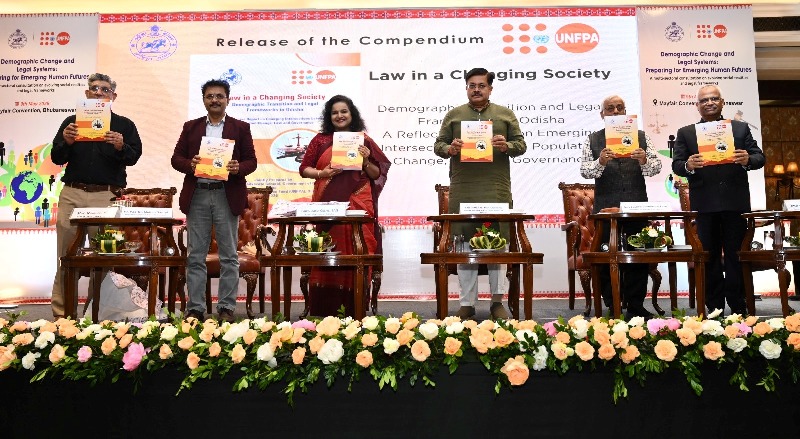
first-of-its-kind initiative examining the interface between demographic
transition and legal systems in Odisha, the Department of Law, Government of
Odisha, in collaboration with the United Nations Population Fund (UNFPA), has
released a reflective compendium titled “Law in a Changing Society: Demographic
Transition and Legal Frameworks in Odisha.”
The compendium
presents an extensive analysis of nearly 400 judicial decisions and
adjudications to understand how changing demographic realities are increasingly
shaping legal systems, governance institutions and social welfare frameworks in
the state.
The report highlights
that Odisha is currently undergoing a rapid demographic transition marked by
declining fertility, increasing life expectancy, changing family structures and
a steadily rising elderly population. With fertility levels declining to around
1.7 and the elderly population projected to rise significantly in the coming
decades, the state is witnessing important structural shifts in age
composition, caregiving systems and social relationships.
Drawing upon
demographic projections, judicial trends and evolving institutional responses,
the analysis argues that demographic transition is no longer merely a
population issue, but is increasingly emerging as a governance, legal and social
justice concern.
One of the central
observations emerging from the report is that courts are increasingly becoming
spaces where tensions between changing demographic realities and existing legal
frameworks are becoming visible. While laws are often framed around past and
present realities, demographic transition gradually reshapes the contexts
within which those laws operate.
The report highlights
that courts and institutions are increasingly dealing with disputes arising
from changing family forms, ageing, infertility, adolescent relationships,
migration, reproductive technologies and evolving caregiving responsibilities.
A major section of
the report examines how demographic transition is influencing emerging legal
questions relating to ageing and care systems. With rising longevity, shrinking
family sizes and migration, traditional systems of familial support are
increasingly coming under strain. Judicial trends analysed in the report
indicate growing disputes relating to maintenance, abandonment, caregiving
responsibilities and property involving elderly persons.
The compendium also
examines emerging legal and institutional questions linked to Assisted
Reproductive Technologies (ART), surrogacy and infertility. The report notes
that delayed marriages, declining fertility and changing reproductive realities
are gradually creating social contexts that legal frameworks are only beginning
to address.
The report further
highlights that demographic transition is deeply gendered. Women continue to
disproportionately shoulder caregiving burdens while simultaneously navigating
changing reproductive expectations, labour force participation and vulnerabilities
linked to social protection and access to justice.
Discussions during
the consultation also highlighted emerging concerns around legal disputes
linked to changing family realities, including issues arising from two-child
norm provisions in local governance laws, questions of parentage, adoption,
timing of childbirth and evolving family structures.
The compendium argues
that courts are not merely adjudicating disputes, but are increasingly
responding to deeper social transformations emerging from demographic
transition.
The report calls for
greater integration between demographic evidence, governance systems and legal
frameworks as Odisha advances towards Viksit Odisha 2036 and 2047. It
emphasises the importance of anticipatory governance, evidence-based policymaking
and continuous institutional dialogue to ensure that laws and institutions
remain responsive to emerging human futures.
The initiative is
expected to contribute to future discussions on governance reforms, legal
interpretation, institutional preparedness and social policy in the context of
Odisha’s ongoing demographic transition and long-term development vision.