Odisha’s KG-to-PG free education scheme removes a major financial barrier, but unless education is aligned with skills, employment, and entrepreneurship, can free degrees alone truly deliver prosperity, asks Priyabrat Biswal
Odisha’s
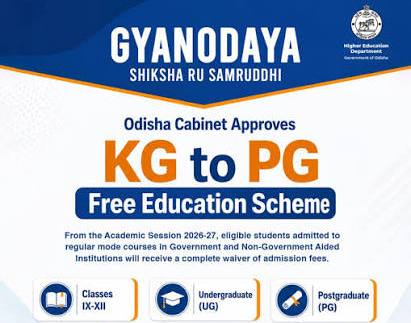
announcement of free education from Kindergarten (KG) to Postgraduate (PG) has
understandably attracted considerable attention. Under the Gyanodaya – Shiksharu Samruddhi
scheme, beginning with the 2026–27 academic session, the state government has
announced a waiver of admission and tuition fees for eligible students pursuing
regular education in government and aided institutions. Backed by an allocation
of ₹5,467
crore over five years
and expected to benefit more than 32
lakh students, the initiative is a significant attempt to
ensure that poverty does not force students out of education. For low-income
families, particularly girls who may otherwise discontinue their studies after
school, the financial relief could be substantial.
But
there is another question that deserves equal attention: What happens after the free
education?
That
question matters because the scheme has important exclusions. Professional and
technical courses, private unaided institutions, self-financing programmes,
teacher education programmes, distance and correspondence education, and
courses under the Public-Private Partnership (PPP) model remain outside its
principal ambit. Even eligible students will continue to bear examination and
hostel-related expenses. These qualifications do not diminish the value of the
initiative, but they do add an important caveat to the much-publicised phrase “KG to PG free education.”
Removing
the financial barrier to education is undoubtedly a welcome social measure.
Odisha already provides free education up to Class 10, and extending support
through Classes 11 and 12 and regular undergraduate and postgraduate education
can improve access and retention. But access
is only the beginning. The ultimate purpose of education cannot simply be to produce
degree-holders; it must be to produce capable, employable and economically
independent citizens.
A
student may now be able to pursue a B.A., B.Sc., B.Com. or postgraduate degree
without paying admission and tuition fees. But if that qualification does not
equip the student with skills demanded by the labour market, the government may
simply be removing the financial cost of obtaining a degree without addressing
the much larger challenge of unemployment and underemployment.
The
world of work is changing rapidly. Artificial Intelligence, automation,
digitisation, advanced manufacturing, renewable energy, healthcare technology,
electronics, logistics, data services and the digital economy are transforming
virtually every sector. Employers increasingly seek practical competence,
technological literacy, problem-solving ability, communication skills,
adaptability and demonstrable capabilities — not merely academic certificates.
This
is where the policy could have a significant blind spot. If professional and
technical education remains outside the principal promise of free education,
students from poorer families may still face a financial barrier at precisely
the point where education becomes most directly connected to employment. A poor
student could obtain a general degree without paying tuition fees, yet struggle
to afford a professional, technical or specialised course that might provide a
clearer pathway to a job or entrepreneurial opportunity.
In
other words, we could end up making degrees free while
leaving employability expensive.
This
is not an argument against general education. A healthy society needs people
educated in the humanities, sciences, commerce, social sciences and research.
Education has intellectual, cultural and civic purposes that cannot be reduced
to salaries and job placements. But higher education policy cannot remain
disconnected from the economic realities confronting young people.
A degree without relevant skills can eventually become little more
than a certificate without economic value.
The
answer is not to abandon general education but to make it more relevant to a
changing economy. Undergraduate education should incorporate employability
modules, internships, apprenticeships, digital literacy, communication skills,
financial literacy and industry exposure. Colleges should build stronger
partnerships with local industries, businesses, startups and emerging sectors.
Students pursuing conventional degrees should also have opportunities to
acquire credible additional certifications in areas such as Artificial
Intelligence, data analysis, coding, cybersecurity, accounting, electronics,
healthcare support, renewable energy, logistics and digital marketing.
The
principle should be straightforward: a
general degree should not mean a general lack of employable skills.
Entrepreneurship
deserves equal attention. Education should not train young people only to look for jobs; it
should also give them the confidence, knowledge and resources to create jobs. Incubation
centres, mentoring, business training, access to credit and market linkages can
help transform educated youth from lifelong job-seekers into entrepreneurs and
job-creators. A graduate who can identify a local problem, develop a viable
solution, use technology and build an enterprise represents a far more powerful
form of educational success than one who simply possesses a degree.
The
government’s ₹5,467-crore
investment should therefore be seen not merely as the cost of making education
free, but as an opportunity to rethink Odisha’s entire human-capital strategy. The state deserves credit for
recognising that economic hardship should not prevent deserving students from
pursuing higher education. But the success of the scheme cannot be measured
only by enrolment, fees waived or degrees awarded.
The
harder questions are: How
many students actually learn? How many acquire relevant skills? How many secure
meaningful employment? How many become entrepreneurs? And how many are able to
build economically independent lives because of the education they received?
The
requirement of a minimum 75
per cent classroom attendance, relaxed to 65 per cent in
exceptional circumstances, is a useful feature because it connects public
investment with actual participation. But attendance is not learning, and
learning is not employability. The
real test is what a student can do after completing a course.
Odisha therefore
needs to build a genuine education-to-employment and education-to-enterprise ecosystem — connecting classrooms with laboratories, colleges with
industries, students with mentors, curricula with emerging technologies and
education with economic opportunity.
The
ambition should no longer stop at “KG
to PG free education.” It should become:
That
would give Shiksharu
Samruddhi — prosperity through education — a deeper meaning. Prosperity does not
arrive merely when a student receives a free degree. It arrives when education
gives that student the skills to earn, the confidence to innovate, the opportunity to build
and the capacity to contribute.
Free education can open the door. Relevant education, skills and employability must show the way forward.
And if Odisha wants its massive investment in education to become an investment in prosperity, the ultimate objective should be clear: Not free degrees alone — but capable citizens, meaningful livelihoods, thriving enterprises and a stronger economy.
(The views expressed in this article are
solely those of the author and do not necessarily reflect the views of the
website or its management. The author may be reached at: [email protected])