THEBUSINESSBYTES
BUREAU
NEW
DELHI, OCTOBER 29, 2026
Commerce and Industry
Minister Piyush Goyal on Thursday said quality, economies of scale, global
market access and inclusivity would be the key drivers of India’s industrial
transformation, asserting that collaboration between the government, private
sector and academia was essential to make the country a globally recognised
manufacturing powerhouse.
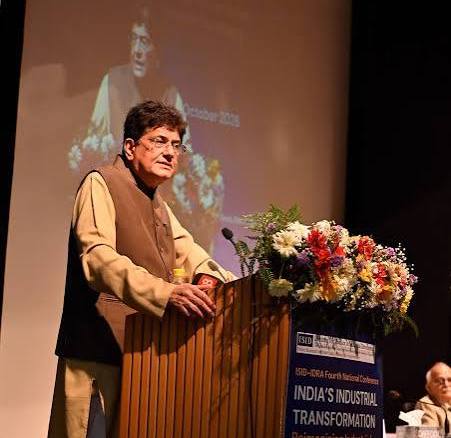
Addressing the Fourth
National Conference on India’s Industrial Transformation, organised by the
Institute for Studies in Industrial Development (ISID) and IDRA, Goyal said
India must leverage its vast domestic market, expanding international trade
partnerships and growing technological capabilities to strengthen its
manufacturing ecosystem and achieve the vision of Viksit Bharat 2047.
Identifying quality
as the foremost priority, the minister reiterated Prime Minister Narendra
Modi’s emphasis on “Zero Defect, Zero Effect”, stressing that Indian products
must meet global standards while ensuring environmental sustainability.
With free trade
agreements opening access to markets across the world, India must focus on
increasing its global market share and leveraging preferential access to
strengthen exports, he said.
Goyal noted that
India’s domestic market of 1.4 billion people, coupled with access to
international markets, offered manufacturers significant opportunities to
achieve economies of scale, improve affordability and reduce production costs.
He emphasised that
industrial growth must be sustainable and inclusive, ensuring that the benefits
of economic progress reach all sections of society.
Describing Viksit
Bharat 2047 as a collective commitment of 1.4 billion Indians, Goyal called for
coordinated efforts among the government, industry, academia and research
institutions. He said India must draw lessons from its economic history, assess
its current position realistically and develop a clear roadmap for the future.
Highlighting the
importance of intergenerational collaboration, he said the experience of senior
professionals and the energy and fresh perspectives of young people must be
brought together to address emerging challenges rather than allowing
institutions to operate in silos.
On India’s evolving
trade strategy, Goyal said the country’s trade agreements went well beyond
tariff reductions, rules of origin and conventional market access. They were
comprehensive economic partnerships designed to identify export opportunities,
protect sensitive sectors and facilitate access to critical technologies and
products, including graphics processing units, memory technology and medical
equipment.
The agreements also
covered services, investment, education, skill development, technology
partnerships and cooperation on climate objectives, he said, adding that
extensive stakeholder consultations were undertaken to safeguard India’s
interests before agreements were finalised.
Referring to the
ongoing India-US trade deal negotiations, Goyal expressed confidence that the
details, when made public, would demonstrate that the interests of farmers and
other sensitive stakeholders had been protected and that India would secure a
strong comparative advantage.
Trade, he said,
should be assessed through the lens of comparative advantage and
competitiveness rather than absolute figures alone. He observed that several
developed economies had structured their tariff regimes in ways that imposed
high duties on labour-intensive products, often using them as negotiating
instruments.
Goyal said India’s
trade agreements covered 38 developed and relatively prosperous countries,
creating opportunities for complementary economic engagement in which India
could export products required by its partners while importing goods and
technologies needed for domestic development.
Describing such
arrangements as mutually beneficial partnerships, he stressed that trade
agreements must be fair, equitable and balanced.
The minister said the
nine free trade and bilateral trade agreements concluded by the government had
opened preferential market opportunities in economies with a combined gross
domestic product of USD 60 trillion, compared with USD 10 trillion covered by
agreements concluded before 2014.
He said the earlier
agreements were largely with economies competing with India, while the current
approach focused on building complementary economic relationships that could
support exports, investment and industrial development.
Highlighting the
growing international demand for Indian talent, Goyal recalled his conversation
with the German foreign minister regarding the India-Germany migration
agreement and Germany’s requirement for 90,000 Indians annually. He said
Germany had indicated that its need for Indian professionals was substantially
higher.
The presence of
Indian professionals in senior positions at Fortune 500 companies and their
contributions to cutting-edge technologies reflected the strength of the
country’s skilled workforce, he said.
Goyal expressed
confidence that India would remain the world’s fastest-growing major economy
for the next 20 to 25 years, attributing the outlook to the talent, skills,
energy and entrepreneurial capabilities of its people.
On climate action,
the minister said global efforts must be guided by the principles of polluter
pays and common but differentiated responsibilities, with adequate financial
and technological assistance for developing countries.
He highlighted that
60 per cent of India’s installed electricity capacity came from green and
renewable sources, while maintaining that coal continued to play an important
role in ensuring energy security and affordable power.
Goyal said India had
progressively moved from being predominantly a buyer of products manufactured
elsewhere to emerging as a significant manufacturing destination. Initiatives
such as Make in India and phased manufacturing programmes across sectors had
helped attract factories, expand domestic production and strengthen local
supply chains.
He said India would
continue to increase the share of goods manufactured domestically, reducing
dependence on imports wherever feasible and enhancing its competitiveness in
global markets.
Innovation, he
stressed, would remain central to the country’s industrial transformation,
requiring closer collaboration between public institutions, private enterprises
and academia. The government, he said, should primarily act as a facilitator
and catalyst for private-sector-led innovation.
Pointing to the
scientific knowledge and research capabilities available at IITs, engineering
colleges and other higher education and research institutions, Goyal called for
stronger links between research and industry to convert discoveries into
commercially viable products and technologies.
Referring to the
Startup Fund of Funds, he said the first fund had been fully utilised and a
second fund was now in place. He also highlighted the Research, Development and
Innovation Fund (RDIF), saying such initiatives had contributed to the growth
of India’s startup ecosystem, which is the world’s third-largest.
The minister also
underlined the opportunities created by opening the space sector to private
participation. Valued at USD 8.4 billion at the time of his address, India’s
space economy had the potential to expand to USD 44 billion by 2033, he said.
International
partners were increasingly looking to collaborate with India in space,
artificial intelligence, computing and startups, reflecting growing confidence
in the country’s technological capabilities.
Recalling his recent
visit to Germany, Goyal said research institutions employing between 12,000 and
30,000 people were working closely with the private sector and had expressed
interest in collaborating with Indian institutions and companies.
He attributed the
growing interest to the trust underpinning India-Germany cooperation and
international confidence in India’s talent, skills, commitment to fair play and
equal opportunities.
The minister said new
trade agreements and international partnerships under Prime Minister Modi’s
leadership were creating avenues for joint research, technology development and
industrial collaboration. Such partnerships could accelerate India’s economic
transformation by combining domestic capabilities with international expertise,
investment and innovation, he added.
Concluding his address, Goyal commended ISID for organising three days of deliberations on India’s industrial future and reiterated that sustained attention to quality, global market access, economies of scale and inclusivity would determine the success of the country’s manufacturing ambitions.
He expressed confidence that coordinated efforts across industry, innovation and research would strengthen India’s position in the global economy and contribute significantly to the realisation of Viksit Bharat 2047.