THEBUSINESSBYTES
BUREAU
NEW
DELHI, OCTOBER 29, 2026
Prime Minister
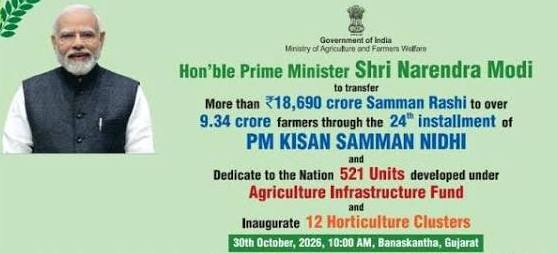
Narendra Modi will release more than ₹18,690 crore to over 9.34 crore farmers across the
country under the 24th instalment of the Pradhan Mantri Kisan Samman Nidhi
(PM-KISAN) scheme on October 30, during an event in
Banaskantha, Gujarat.
The amount will be
transferred directly into beneficiaries' bank accounts through the Direct
Benefit Transfer (DBT) mechanism, providing financial support to eligible
farmer families for meeting agricultural and household expenses.
According to a
statement issued by the Ministry of Agriculture and Farmers Welfare, the Prime
Minister will also dedicate to the nation 521 units established under the
Agriculture Infrastructure Fund (AIF) and inaugurate 12 horticulture clusters aimed
at strengthening agricultural infrastructure, promoting high-value crops and
enhancing farmers' income potential.
The release of the
24th instalment comes after more than ₹4.47 lakh crore was disbursed to eligible farmers through
the first 23 instalments of PM-KISAN, one of the
government's key income-support initiatives for the agricultural sector.
Union Agriculture and
Farmers Welfare Minister Shivraj Singh Chouhan will participate in the
programme from Raisen in Madhya Pradesh, where a large number of farmers from
the region are expected to attend.
The programme will
highlight the impact of PM-KISAN and other government initiatives aimed at
improving farmers' livelihoods, strengthening agricultural infrastructure and
promoting prosperity in rural India.
Agriculture remains a
key pillar of India's economy, supporting the livelihoods of crores of farmers
while contributing to the country's food and nutritional security.
Over the past 12
years, the government has introduced several initiatives to improve farm
incomes, expand access to institutional credit, strengthen crop protection and
encourage modern and sustainable agricultural practices.
These include
PM-KISAN, the Pradhan Mantri Fasal Bima Yojana, the Kisan Credit Card scheme,
Minimum Support Price (MSP) measures and the Per Drop More Crop initiative.
The government is
also pursuing greater self-reliance in agriculture through the National Mission
on Edible Oils and the Mission for Aatmanirbharta in Pulses. The National
Mission on Natural Farming seeks to encourage environmentally sustainable
farming practices through the development of clusters across the country.
The initiatives are
designed to address multiple challenges facing the agricultural sector,
including income security, production risks, access to credit, efficient use of
resources and the adoption of technology-driven farming practices.
The Agriculture
Infrastructure Fund is aimed at encouraging investment in post-harvest
management and community farming assets, including warehouses, cold storage
facilities, primary processing centres and other essential infrastructure.
Under the scheme,
investments of approximately ₹1.75
lakh crore have been made across more than 2.28 lakh
projects, supporting the development of agricultural infrastructure across the
country.
The investments are
expected to improve storage and processing capacity, reduce post-harvest
losses, strengthen farmers' access to markets and help them secure better
returns for their produce.
The dedication of 521
AIF-supported units is expected to further underline the importance of modern
infrastructure in improving the efficiency of agricultural supply chains and
reducing wastage.
The inauguration of
12 horticulture clusters is aimed at promoting diversification towards
high-value agricultural activities and creating additional income opportunities
for farmers.
Horticulture has
emerged as an important avenue for diversifying farm production, strengthening
value chains and improving the commercial potential of agricultural activities.
The cluster-based
approach is intended to support the production and marketing of high-value
crops while strengthening linkages across the horticulture sector.
Together, the initiatives seek to expand direct financial assistance, modernise post-harvest infrastructure, encourage crop diversification and improve the overall resilience of India's agricultural economy.
The government has positioned these measures as part of its broader vision of building a prosperous, resilient and self-reliant agricultural sector in line with the goal of Viksit Bharat.