THEBUSINESSBYTES
BUREAU
NEW
DELHI, OCTOBER 29, 2026
The National
Cooperative Development Corporation (NCDC) has disbursed financial assistance
of Rs 4.15 lakh crore to cooperative institutions across the country since the
establishment of the Ministry of Cooperation, with Union Minister Amit Shah
calling for an ambitious 25-year roadmap to strengthen the corporation’s
financial capacity and expand its reach.
The cumulative
disbursement stood at Rs 4,14,586 crore as of October 25, 2026, according to
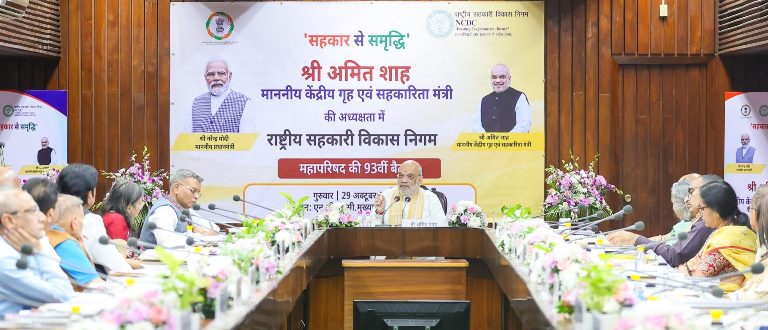
financial details presented at the NCDC’s 93rd General Council meeting held
here on Thursday under the chairmanship of Shah, who is also the Union Home
Minister.
The corporation
sanctioned projects worth Rs 1,55,408 crore and disbursed Rs 1,27,596 crore
during the 2025-26 financial year, registering a net profit of Rs 1,475 crore.
Its loan recovery rate stood at 99.84 per cent, while its net non-performing
assets (NPAs) remained zero, according to a statement issued by the Ministry of
Cooperation.
NCDC’s annual
disbursement has risen nearly fivefold from Rs 24,733 crore in 2020-21 to Rs
1,27,596 crore in 2025-26. The 3,339 units and projects sanctioned during the
last financial year are expected to benefit 14,881 cooperative societies.
Addressing the
meeting, Shah commended the corporation’s performance in financial management,
loan sanctions, disbursements and profitability, and called for a comprehensive
long-term strategy to position it as a stronger institution capable of meeting
the growing financing needs of the cooperative sector.
He proposed
constituting a group of experienced cooperative-sector representatives and
professional experts to examine NCDC’s organisational structure, capital
mobilisation avenues, financial autonomy, participation of cooperative
societies and emerging business opportunities.
Shah also suggested
holding a workshop on these issues and directed that a special meeting be
convened after March 31, 2027, for a detailed presentation and discussion, with
progress towards necessary decisions targeted by December 2027.
Emphasising the need
to scale up financing, Shah referred to disbursement targets of Rs 1.70 lakh
crore for 2026-27, Rs 2.10 lakh crore for 2027-28 and Rs 2.50 lakh crore for
2028-29.
He called for further
expansion in subsequent years, proposing disbursements of around Rs 3.50 lakh
crore in both 2029-30 and 2030-31, citing the significant growth potential in
dairy, fisheries, cooperative banking and other sectors.
The minister stressed
that NCDC should develop financial and organisational models that reduce
excessive dependence on government assistance and government banks. He called
for exploring consortium financing and co-financing arrangements with NABARD,
state cooperative banks and commercial banks, along with innovative models to
meet the financing requirements of the dairy cooperative sector.
Shah also appreciated
the support extended by the Reserve Bank of India and the Ministry of Finance
in addressing the corporation’s financial and regulatory challenges.
Highlighting the role
of cooperatives in inclusive economic growth, Shah said the movement could
connect small farmers, livestock rearers, rural women, fishers and economically
weaker sections with the national development process.
He cited Amul, IFFCO
and Lijjat Papad as examples of successful cooperative enterprises
demonstrating how cooperative values, backed by professional management, could
create globally competitive institutions.
The minister
underscored NCDC’s role in developing institutions such as National Cooperative
Exports Limited (NCEL), Bharatiya Beej Sahakari Samiti Limited (BBSSL),
National Cooperative Organics Limited (NCOL), Bharat Taxi, Sahakar Sarathi and
the umbrella organisation for urban cooperative banks, NUCFDC.
He said improving the
livelihoods of small farmers, livestock rearers and fishers was as important as
financing large cooperative enterprises.
In the fisheries
sector, NCDC has provided financial assistance for around 100 trawlers for
deep-sea fishing. Shah said the initiative could substantially improve the
monthly incomes of fishing families and create better opportunities for their
children, urging the corporation to expand such grassroots interventions.
He also called for
circular-economy-based business models for cooperative sugar mills, referring
to proposed multi-state cooperative initiatives in Kolhapur and Pune in
Maharashtra. Shared processing and industrial facilities could help mills
unable to independently invest in modern plants, he said, stressing that the
resulting profits should accrue to the concerned cooperative sugar mills.
Shah further
suggested involving eligible young people who had completed training and
internships under the Sahakar Mitra programme in new multi-state cooperative
societies. He also recommended drawing on the management model of Banas Dairy
for NCDC’s future institutional development.
Giving special
emphasis to the northeastern region, Shah said a target had been set to make
the region self-reliant in animal husbandry, dairy and fisheries by 2030.
Achieving this goal
could raise the region’s income by approximately Rs 32,800 crore and generate
nearly eight lakh employment opportunities, he said.
He directed NCDC’s
regional offices to prepare practical projects in these sectors, arrange
financing and implement them in coordination with state governments.
The General Council
also discussed the National Cooperative Development Corporation (Amendment)
Act, 2026, which was passed by both Houses of Parliament and received
presidential assent before being published in the Gazette of India on August
14, 2026.
The amendment expands
avenues for financial assistance, institutional participation and investment
through equity and share capital, thereby strengthening NCDC’s capacity to
support cooperative development.
To make financing
more accessible and competitive for cooperative societies, the Centre has
approved grant assistance of Rs 2,000 crore for NCDC, enabling it to mobilise
Rs 20,000 crore from the market over four years.
Under the initiative,
loans worth Rs 9,380 crore were disbursed in 2025-26, while a further Rs 6,172
crore was disbursed in 2026-27 up to October 25.
NCDC has launched the
Sahakar Navachar Yojana to promote innovation and entrepreneurship in the
cooperative sector. The scheme provides 100 per cent grant assistance of up to
Rs 25 lakh to eligible cooperative societies.
An initial fund of Rs
10 crore has been created, with 20 per cent earmarked for cooperatives in the
northeastern region, hilly areas and disadvantaged sections. Grant assistance
of Rs 85 lakh has so far been sanctioned to five cooperative societies.
The corporation is
also extending support in business development, digital accounting, financial
management, branding and market linkages.
In another
initiative, NCDC has registered 1,863 cooperative Farmer Producer Organisations
(FPOs), including 1,117 formed through Primary Agricultural Credit Societies
(PACS). Disbursements to FPOs and related institutions under the scheme reached
Rs 356.90 crore up to October 2026.
The corporation is also
supporting fisheries cooperatives, women’s cooperatives, dairy and animal
husbandry enterprises, food processing units and other rural livelihood
activities.
On human-resource
development, NCDC’s Laxmanrao Inamdar National Academy for Cooperative Research
and Development (LINAC) and its regional training centres conducted 227
training programmes involving 21,688 participants during 2025-26.
The corporation’s agreement with IRMA (TSU) to strengthen modern management practices, digital technology, financial discipline, branding and professional efficiency in cooperative institutions was also highlighted.
The General Council reviewed NCDC’s audited annual accounts, annual report and financial performance for 2025-26, besides deliberating on future financing programmes, resource mobilisation, the sector’s growing credit requirements and the corporation’s long-term strategy.