Industry
seeks stronger raw-material security, viable mining economics and competitive
power costs as India targets 300 million tonnes of steelmaking capacity
THEBUSINESSBYTES
BUREAU
BHUBANESWAR,
SEPTEMBER 21, 2026
India’s accelerating
steel demand is opening a significant growth opportunity for the domestic
ferro-alloys industry, positioning the country to deepen its role in global
supply chains, the Indian Ferro Alloy Producers’ Association (IFAPA) said at
the 6th International Ferro Alloys Conference (IFAC 2026) in Goa.
With India targeting
around 300 million tonnes of steelmaking capacity by FY31, industry leaders
said the next phase of growth will depend not only on expanding steel
production but also on ensuring reliable access to critical minerals,
competitive energy costs and a globally competitive raw-material ecosystem.
Organised by IFAPA
under the theme “Fueling India’s Steel Surge: The Rising Importance of Ferro
Alloys,” IFAC 2026 is bringing together industry leaders, policymakers and
global experts to discuss manganese security, critical minerals, energy costs,
global trade and the evolving demand for ferro-alloys.
India produced around
165 million tonnes of crude steel in calendar year 2025, recording growth of
more than 10% year-on-year, while steel demand is expected to expand at around
7% annually. The sustained growth, along with rising demand for specialised and
value-added steel, is expected to drive higher consumption of manganese,
chromium, silicon and other alloying inputs.
India has also
crossed a significant threshold in steel consumption, with per-capita steel use
rising from around 24 kg in 1991 to approximately 109 kg in 2025. With
consumption now above 100 kg per capita, the next phase of economic and
infrastructure development could generate substantial additional demand for
steel — and, consequently, for the ferro-alloys essential to its production.
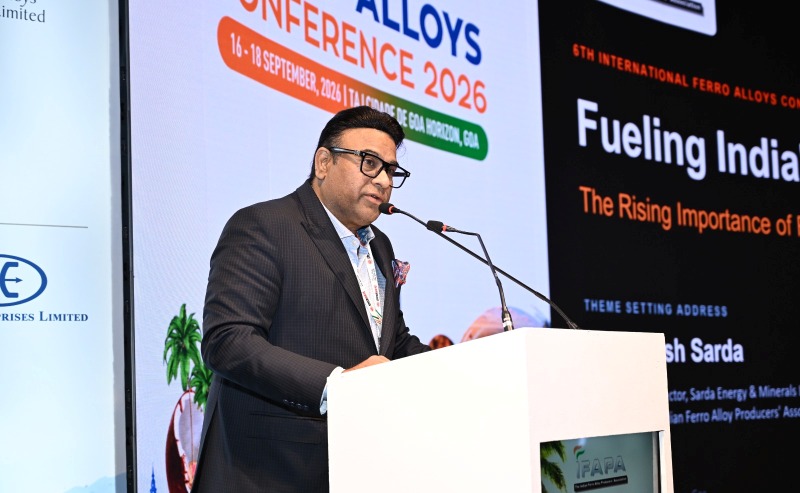
Manish Sarda,
Chairman, Indian Ferro Alloy Producers’ Association (IFAPA), said securing
indigenous sources of critical raw materials must be a priority if India is to
build a globally competitive and self-reliant ferro-alloys industry.
“Securing indigenous sources of critical raw
materials must be a priority for Indian ferro-alloy producers to become
globally competitive and support the vision of Aatmanirbhar Bharat. We need
faster exploration and development of domestic manganese, chrome and other
critical minerals,” Sarda said.
He noted that
although several manganese ore mines had been auctioned at high premiums, many
remained non-operational because the economics were often unviable.
“Auction frameworks should therefore encourage
actual mine development and production, not simply the highest bid. A producing
mine creates value for the industry and the economy; an unviable mine does
not,” he said.
Sarda added that
commercially viable access to domestic mineral resources would be critical to
reducing import dependence and strengthening India’s ferro-alloys value chain.
IFAPA also
highlighted the need to improve the cost competitiveness of the ferro-alloys
industry as India moves towards its 300-million-tonne steelmaking capacity
target.
The Association said
import policy should consider zero duties on manganese ore and raw materials
required for noble alloys where suitable domestic grades are not available. It
also called for competitive power costs for energy-intensive ferro-alloy
producers and rationalisation of electricity-related charges and levies.
Ferro-alloys combine
iron with elements such as manganese, chromium and silicon to impart specific
properties to steel, including strength, hardness and corrosion resistance.
They are essential inputs for steel used in infrastructure, automobiles,
railways, defence and specialised industrial applications.
The changing
composition and scale of India’s steel demand are already translating into
higher ferro-alloys production.
According to BigMint
data, silico-manganese production increased from around 1.9 million tonnes in
FY20 to nearly 3.5 million tonnes in FY26, while ferro-manganese production
rose from around 0.9 million tonnes to approximately 1.7 million tonnes over
the same period.
The increase reflects
the expansion of India’s steelmaking base and the growing requirement for
alloying materials across conventional and specialised steel applications.
India was also the
world’s leading exporter of manganese alloys in 2025, according to BigMint. The
combination of a large and expanding domestic market and an established export
base provides Indian producers with an opportunity to increase scale and
strengthen their position in global supply chains.
Despite the growth
potential, securing adequate supplies of critical raw materials remains a key
challenge for the industry.
India’s manganese ore
imports increased 27% year-on-year to 4.03 million tonnes in the first half of
2026. At the same time, domestic chrome ore production rose 12% to 3.53 million
tonnes in FY2025-26, while ferro-chrome production increased 10% to 1.49
million tonnes.
The trends underline
both the continuing need for imported raw materials and the potential to expand
domestic mineral development and value addition.
IFAC 2026 features
more than 700 participants, 35 speakers and over 15 knowledge sessions covering
manganese security, steel and alloy demand, global trade, ferro-chrome and
ferro-silicon, energy efficiency and critical minerals.
The conference brings together senior representatives from Sarda Group, MOIL, JSW Steel, MFA, Shyam Metalics, Eramet, The Sandur Manganese & Iron Ores Limited (SMIORE), SAIL, Sumitomo Metal Mining, Nava Limited, Hira Group of Industries and the International Manganese Institute, among others.
Founded in 1961, the Indian Ferro Alloy Producers’ Association is the apex industry body representing India’s bulk and noble ferro-alloy producers. Over more than six decades, IFAPA has provided a platform for the industry to engage with policymakers, address sectoral challenges and work towards measures supporting the long-term development and competitiveness of India’s ferro-alloys industry.