THEBUSINESSBYTES
BUREAU
NEW DELHI,
JANUARY 19, 2026
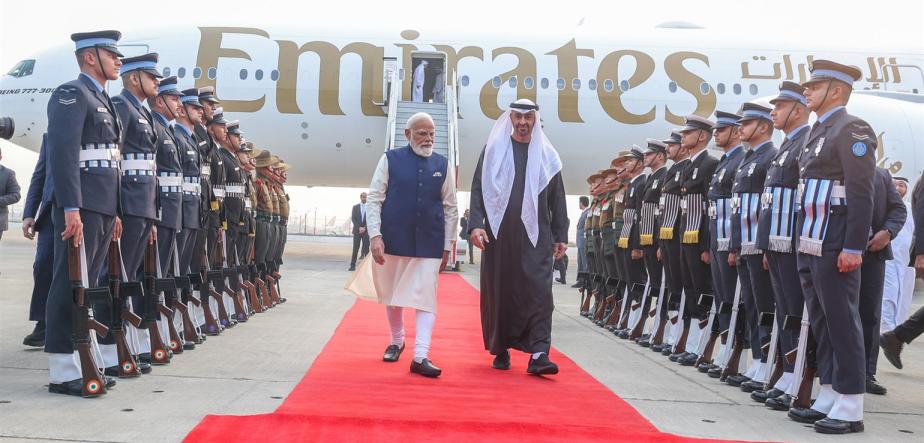
India and the United Arab Emirates
took their Comprehensive Strategic Partnership to unprecedented heights as
President Sheikh Mohamed bin Zayed Al Nahyan paid an official
visit to India at the invitation of Prime Minister Narendra Modi. Marking
his fifth visit to India in a decade and his third as UAE President, the visit
underscored the depth, continuity and growing global significance of bilateral
ties between the two nations.
During wide-ranging discussions, the
two leaders reviewed the full spectrum of cooperation and expressed
satisfaction at the steady strengthening of the India–UAE partnership over the
past ten years. They welcomed the recent visits of the Crown Princes of Abu
Dhabi and Dubai, noting that these engagements reflected generational
continuity and long-term commitment to the relationship. The leaders also
endorsed the outcomes of recent high-level investment, joint commission and
strategic dialogue meetings, which have laid a strong foundation for future
collaboration.
 A major highlight of the visit was the
renewed focus on economic engagement. Both sides welcomed the remarkable growth
in bilateral trade since the signing of the Comprehensive Economic Partnership
Agreement in 2022, with trade touching a historic US$100 billion in FY 2024-25.
Reflecting strong confidence in their economic complementarities, the two
leaders agreed to double bilateral trade to US$200 billion by 2032. They
emphasized closer integration of Micro, Small and Medium Enterprises, calling
for rapid implementation of initiatives such as Bharat Mart, the Virtual Trade
Corridor and Bharat–Africa Setu to expand market access across West Asia,
Africa and Eurasia.
A major highlight of the visit was the
renewed focus on economic engagement. Both sides welcomed the remarkable growth
in bilateral trade since the signing of the Comprehensive Economic Partnership
Agreement in 2022, with trade touching a historic US$100 billion in FY 2024-25.
Reflecting strong confidence in their economic complementarities, the two
leaders agreed to double bilateral trade to US$200 billion by 2032. They
emphasized closer integration of Micro, Small and Medium Enterprises, calling
for rapid implementation of initiatives such as Bharat Mart, the Virtual Trade
Corridor and Bharat–Africa Setu to expand market access across West Asia,
Africa and Eurasia.
Investment cooperation featured
prominently in the discussions, with the leaders expressing satisfaction over
the impact of the Bilateral Investment Treaty signed in 2024. They welcomed
talks on a potential UAE partnership in developing the Special Investment
Region at Dholera in Gujarat, envisaging collaboration across strategic
infrastructure including an international airport, ports, railways, energy facilities
and smart urban development. Prime Minister Modi also invited UAE sovereign
wealth funds to participate in India’s second NIIF Infrastructure Fund,
scheduled for launch in 2026. The establishment of DP World and First Abu Dhabi
Bank branches in GIFT City was hailed as a milestone in strengthening financial
connectivity and positioning the city as a global financial hub.
The leaders reaffirmed their shared
commitment to food security, recognizing its strategic importance amid global
uncertainties. They stressed the role of innovation, public-private
partnerships and knowledge exchange in building resilient and sustainable
agricultural systems. Cooperation was also expanded into futuristic domains,
with both sides agreeing to deepen collaboration in space sciences through a
joint initiative aimed at commercialisation, joint missions, start-ups and
high-skilled employment.
Science, technology and innovation
emerged as another pillar of the partnership, particularly in artificial
intelligence and emerging technologies. The two leaders welcomed plans to
collaborate on a supercomputing cluster in India, explore data centre
partnerships and examine the establishment of mutually recognised Digital
Embassies. President Sheikh Mohamed bin Zayed Al Nahyan expressed strong
support for India hosting the AI Impact Summit in February 2026.
Energy cooperation remained a
cornerstone of the relationship, with the UAE’s contribution to India’s energy
security being widely acknowledged. The leaders welcomed the signing of a
10-year LNG supply agreement between HPCL and ADNOC Gas, beginning in 2028, and
noted new opportunities created by India’s SHANTI law for enhanced civil
nuclear cooperation. Both sides agreed to explore partnerships in advanced
nuclear technologies, including large reactors and Small Modular Reactors,
alongside cooperation in safety, operations and maintenance.
Cultural, educational and
people-to-people ties also received renewed emphasis. Prime Minister Modi
welcomed the UAE’s decision to provide artefacts for the National Maritime
Heritage Complex at Lothal, while both leaders agreed to establish a ‘House of
India’ in Abu Dhabi as a lasting symbol of friendship. Education was identified
as a cornerstone of the partnership, building on the presence of IIT Delhi and
IIM Ahmedabad campuses in the UAE, with a focus on student exchanges,
innovation labs and integration of India’s DigiLocker with UAE platforms for
seamless academic credential verification.
On strategic and security matters, the
leaders reaffirmed mutual respect for sovereignty, territorial integrity and
strategic autonomy. They welcomed the momentum in defence cooperation,
including high-level military exchanges, joint exercises and the signing of a
Letter of Intent towards a Strategic Defence Partnership. Both leaders
unequivocally condemned terrorism in all its forms and reiterated their
commitment to counter terror financing through cooperation within the FATF
framework.
The two sides also exchanged views on
regional and global developments, recalling the launch of the India–Middle
East–Europe Economic Corridor and underscoring their shared interest in peace,
stability and multilateral cooperation. The UAE conveyed full support for
India’s BRICS Chairmanship in 2026, while India extended support for the UAE
co-hosted UN Water Conference later in the year. Cooperation in polar science
was also highlighted as a growing area contributing to climate action and
global scientific efforts.
President Sheikh Mohamed bin Zayed Al
Nahyan thanked Prime Minister Narendra Modi for the warm welcome and gracious
hospitality, reaffirming the UAE’s commitment to an enduring partnership with
India that is increasingly shaping regional and global outcomes.