
THEBUSINESSBYTES
BUREAU
MUMBAI,
OCTOBER 15, 2026
Sometimes, the seeds
of a business revolution are sown in the most ordinary moments of life. For
Jio, one of India’s most transformative digital ventures, the spark came from a
frustrating experience during a college break — a failed attempt to submit an
assignment online.
Recounting the
origins and decade-long journey of Jio Platforms Ltd at a press conference in
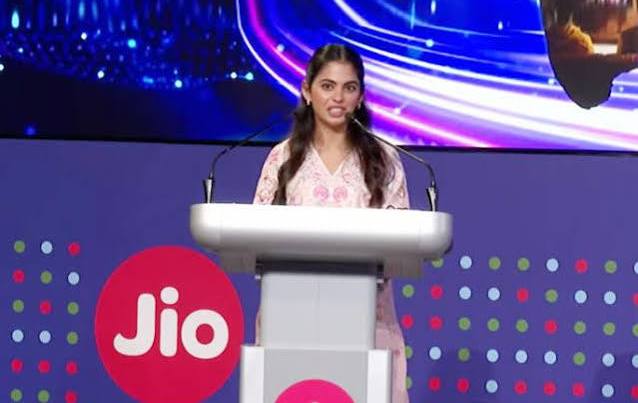
Mumbai on Thursday, Isha Ambani, Director of Jio Platforms, took the audience
back to around 2009-10, when she and her brother Akash Ambani were studying in
the United States.
Back home in Mumbai
for a break, Isha had an online assignment to submit. But the internet failed
her, and she could not complete the submission.
What might have
remained a moment of personal frustration instead became the starting point of
a much larger conversation — one that questioned why India should lag behind
the developed world in digital connectivity.
“I tried to submit the assignment, but unfortunately
the internet did not work, and I couldn’t submit it,” Isha recalled.
“What followed was a conversation about why
should India be left behind? Why was it that we didn’t have the same type of
connectivity that we enjoyed in the West?”
That question, she
explained, became central to the thinking that eventually led to Jio. Akash
Ambani firmly believed that the answer lay in creating a digital technology
platform company.
In 2016, Jio was
launched. Ten years later, as the company stands at a significant moment in its
corporate journey, that early conversation has become a story about ambition,
technological infrastructure and the possibilities of a digitally connected
India.
The emotional power
of Isha’s recollection lies in its simplicity. Jio’s origin story, as she
narrated it, was not merely about identifying a commercial opportunity. It
began with a question about fairness, access and the aspiration that Indians
should not have to settle for less than the digital possibilities available elsewhere
in the world.
For Isha, the story
of Jio is also a reflection of the broader Reliance philosophy of building
businesses. She described it as a combination of long-term thinking, scale,
technological capability and disciplined execution.
At Reliance, she
said, businesses are not built simply to meet immediate needs or capture
short-term opportunities. The ambition is to anticipate what the country and
its consumers will require decades into the future.
“First, ideas are
backed with a very long-term perspective,” she said, explaining the thinking
that underpins the group’s business-building approach.
Scale is the second
principle. For Reliance, the question is not merely how large a business can
become, but how large it must be to fundamentally change the economics of the
industry in which it operates.
The third principle
is execution — a quality Isha described as deeply embedded in the
organisation’s culture.
“To know Reliance is to know that we are a
deeply technical company,” she said. “Execution is very much a hard-coded habit
across our entire organisation.”
That combination of
vision, scale and execution offers an insight into how the group approached
Jio: not simply as a telecom business, but as a long-term technology platform
intended to reshape how people access and use digital services.
While the story of
Jio is rooted in a technological aspiration, Isha was equally emphatic about
the importance of financial discipline.
She said financial
prudence remained embedded in Reliance’s DNA, citing a commitment made by her
father, Mukesh Ambani, to shareholders in 2019.
At the time, he had
promised that Reliance Industries would become net-debt-free by 2021. The
intervening period brought the COVID-19 pandemic and a global economic
slowdown, creating an exceptionally challenging environment for businesses.
Yet, according to
Isha, the company delivered on that commitment nine months ahead of schedule.
“And that is what shareholder commitment means
to us at Reliance,” she said.
The example was more
than a reference to balance-sheet management. It was a reminder that the
group's growth ambitions are accompanied by an emphasis on financial
credibility and fulfilling promises made to investors.
Isha identified two
guiding principles for financial performance: building and protecting what she
described as “fortress-like balance sheets” and generating compounding free
cash flow.
Together, these
principles support a cycle of building businesses, investing in them, scaling
operations, generating cash and reinvesting in future growth.
The objective, she
indicated, is to create businesses that can sustain expansion over the long
term without losing sight of financial resilience.
For investors
watching Jio's next chapter, the emphasis on disciplined capital allocation and
long-term value creation is an important part of the narrative surrounding the
company's IPO-related media engagement.
The most personal
moment of Isha’s address came when she turned her attention to her grandfather,
Dhirubhai Ambani, who took Reliance Industries public in 1977.
Nearly half a century
later, she spoke of him with affection and gratitude, describing a legacy that
extended beyond financial performance or corporate expansion.
“In 1977, my grandfather Dhirubhai Ambani took
Reliance Industries public. That’s almost 50 years ago today,” she said, before
recalling the scale of the company's long-term shareholder returns.
She then articulated
what she believes was the deeper meaning of his enterprise.
“For him, Reliance was never just a company.
Reliance is a promise that every Indian should have the opportunity to
participate in India’s growth, to share in India’s prosperity, and to believe
in a better future.”
Those words brought
the family’s business history into sharper focus. For Isha, the Reliance story
is not only about the building of an industrial conglomerate or the expansion
of a digital platform. It is also about the idea that ordinary Indians should
have an opportunity to participate in the country's economic progress.
She recalled how
Dhirubhai would fill football stadiums and inspire thousands with his vision of
a stronger, more confident and prosperous India.
His message, she
said, was simple but powerful: “Dare to dream, be fearless, think big, pursue
excellence through relentless innovation.”
It was a philosophy
that helped shape Reliance's identity and, in Isha's telling, continues to
guide the ambitions of the next generation.
The Jio story, as
presented by Isha, connects three generations of the Ambani family through a
common belief in growth and the transformative power of ambition.
Dhirubhai Ambani
built the foundation and invited Indians to participate in Reliance's journey
as shareholders. Mukesh Ambani carried that ambition into new industries and
technologies. Today, his children Akash, Isha and Anant represent the next
generation entrusted with carrying the legacy forward.
“Three generations later, Akash, Anant, and I
remain absolutely married to our motto, which is ‘Growth is Life,’” Isha said.
She added that they
were carrying forward not only their grandfather's vision but also “the trust
of millions of shareholders who believed in his vision and made it their own.”
It was a statement
that placed shareholder confidence alongside family legacy as a responsibility
to be preserved.
For a business
preparing for a potentially defining new phase, that message has particular
significance. Corporate valuations, financial performance and market
opportunities may shape investor decisions, but the confidence of shareholders
ultimately rests on the company's ability to deliver on its promises.
Isha's address sought
to connect those business imperatives with the founding philosophy of Reliance:
think long term, build at scale, execute relentlessly and remain financially
disciplined.
A decade after Jio's
launch, the memory of a failed internet connection remains a compelling way to
explain the company's original motivation.
The story began with
a young student unable to submit an assignment. It developed into a
conversation between siblings about why India should not enjoy the same quality
of connectivity as the West. That conversation helped inspire a business
ambition that would take years of planning, investment and execution to bring
to life.
In recalling that
moment, Isha gave the company's history a human dimension — one that links a
personal frustration to a broader national aspiration.
Her message was
ultimately about continuity: the continuity of a dream across generations, of a
business philosophy across industries, and of a promise to shareholders who
have placed their trust in Reliance.
As Jio looks towards
the next phase of its journey, the story Isha chose to tell was not simply one
of technological progress. It was about the question that started it all: why
should India be left behind?
For the Ambani family, the answer was to build.
And for Isha Ambani, ten years after Jio's launch, that remains the enduring spirit of the Reliance motto: “Growth is Life.”