
PRIYABRAT
BISWAL
BHUBANESWAR,
OCTOBER 15, 2026
Reliance Industries'
Jio is positioning itself to capture a significant share of India's digital
economy, projected to reach USD 1.4 trillion by fiscal year 2030-31 (FY31),
banking on its 533 million-plus customer base, expanding 5G network and
in-house technology capabilities, Akash Ambani, chairman of Reliance Jio, said
on Thursday.
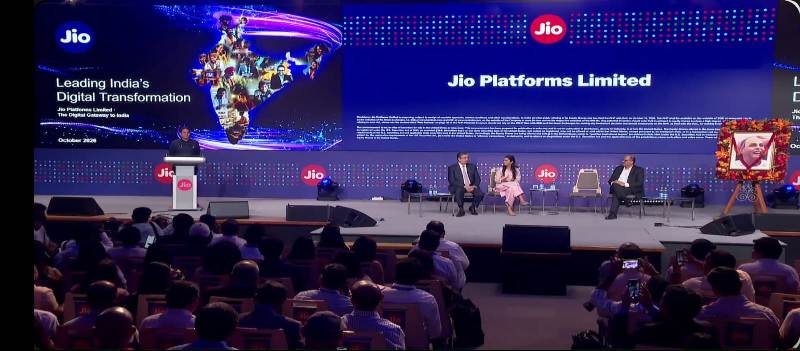
"We see goal of
enabling India as a premier digital society. Jio Platform is as an able partner
to enable that," Ambani said at a press conference in Mumbai ahead of the
initial public offering (IPO) of Jio Platforms Ltd (JPL).
 Emphasising
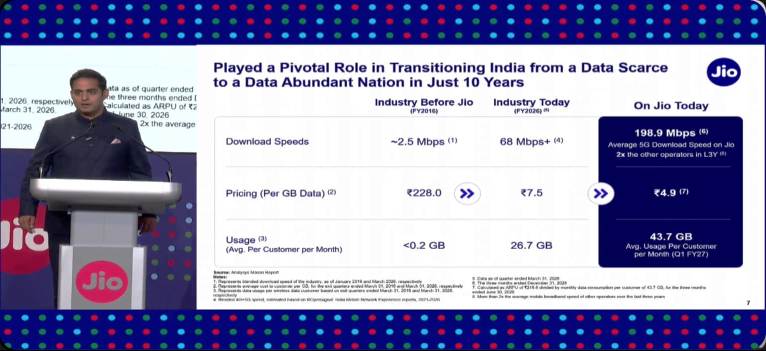
affordability as the foundation of the company's strategy, Ambani said Jio's
data pricing was among the lowest in the world. The company, which has
transformed India's digital connectivity landscape over the past decade, is now
looking to extend its reach beyond telecom services into artificial
intelligence (AI), cloud computing and enterprise digital solutions.
Emphasising
affordability as the foundation of the company's strategy, Ambani said Jio's
data pricing was among the lowest in the world. The company, which has
transformed India's digital connectivity landscape over the past decade, is now
looking to extend its reach beyond telecom services into artificial
intelligence (AI), cloud computing and enterprise digital solutions.
Jio Platforms is set
to launch its IPO to raise up to ₹30,213 crore through a fresh issue of up to 270 million
equity
shares of face value ₹10
each. The issue will open for subscription on October 21 and close on October
23, 2026, with bidding by anchor investors scheduled for October 19.
The company has fixed
a price band of ₹1,065-1,119
per share. At the upper end, the issue would value Jio
Platforms at around ₹10.3
lakh crore.
Ambani said the
entire amount raised through the public issue would be used to repay debt as
Jio Platforms works towards achieving a net debt-free position.
The company has
reserved shares worth up to ₹500
crore for eligible employees and ₹2,500 crore for eligible Reliance Industries Ltd.
shareholders, including individuals and Hindu Undivided
Families. Eligible employees applying under the employee reservation portion
will receive a discount of ₹54
per share. The lot size is 12 shares, with subsequent bids in multiples of 12.
 Jio's scale in the
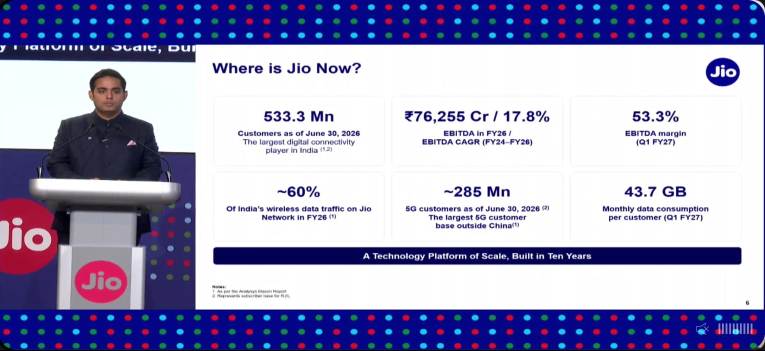
Indian market remains central to its growth ambitions. Ambani said the company
carries more than 60 per cent of India's data tariff, underlining its strong
position in the telecom sector. According to the company's investor
presentation, Jio had 533.3 million connectivity customers as of June 30, 2026,
while its 5G customer base stood at around 285 million, making it the largest
outside China.
Jio's scale in the
Indian market remains central to its growth ambitions. Ambani said the company
carries more than 60 per cent of India's data tariff, underlining its strong
position in the telecom sector. According to the company's investor
presentation, Jio had 533.3 million connectivity customers as of June 30, 2026,
while its 5G customer base stood at around 285 million, making it the largest
outside China.
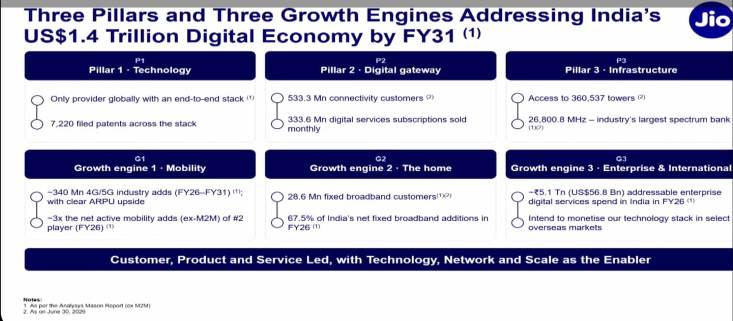
The company is
seeking to turn this extensive customer reach into a broader digital-services
opportunity, with mobility, home broadband, and enterprise and international
services identified as its three principal growth engines. Its digital
ecosystem includes 333.6 million digital-services subscriptions sold monthly,
while the company is targeting further growth in broadband adoption, customer
spending and digital-service usage.
Jio's infrastructure
provides a further foundation for expansion. The company has access to 360,537
telecom towers and more than one million route kilometres of fibre, backed by
spectrum holdings of 26,800.8 MHz, which its presentation describes as the
industry's largest spectrum bank.
On technology
development, Ambani said Jio's decision to build its own systems had enabled it
to develop a proprietary technology stack, reducing its dependence on external
providers.
"We built our
own stack to serve our customers better," he said, highlighting the
company's investments in research and development.
 Jio Platforms has
submitted 7,220 patent applications in India and abroad, making it the only
Indian company among the world's top 20 applicants in the World Intellectual
Property Organisation's 2025 Patent Cooperation Treaty rankings, Ambani said. A
team of more than 12,000 engineers is driving the company's technology
development, he added.
Jio Platforms has
submitted 7,220 patent applications in India and abroad, making it the only
Indian company among the world's top 20 applicants in the World Intellectual
Property Organisation's 2025 Patent Cooperation Treaty rankings, Ambani said. A
team of more than 12,000 engineers is driving the company's technology
development, he added.
The company is also
preparing for the next phase of mobile communications, with plans to implement
sixth-generation (6G) technology through software upgrades rather than an
entirely new infrastructure build-out.
"6G is on our
horizon. What this really means is that we will implement 6G as a software
upgrade rather than through a new infrastructure build-out..." Ambani
said.
Such a software-led
approach could allow Jio to build on its existing systems and reduce the need
for fresh physical infrastructure on the scale associated with earlier
generations of mobile networks.
Artificial
intelligence (AI) is another key area of expansion. Jio plans to roll out
AI-powered services, including call summarisation and transcription in 12
Indian languages, to make the technology more accessible to its vast customer
base.
The tools are
designed to help users summarise conversations, transcribe calls and take
action based on discussions. Support for multiple Indian languages is expected
to widen access to AI services among customers across the country.
Jio is also looking to expand its enterprise and international business, with its investor presentation identifying an Indian enterprise digital-spending opportunity of around ₹5.1 lakh crore, or USD 56.8 billion, in FY26. The company plans to monetise its technology stack in select overseas markets, creating opportunities beyond domestic connectivity services.
Its financial performance provides the foundation for these expansion plans. Jio Platforms reported revenue of ₹76,255 crore in FY26, while EBITDA grew at a compound annual growth rate of 17.8 per cent between FY24 and FY26. Its EBITDA margin stood at 53.3 per cent in the first quarter of FY27, while EBITDA less cash capital expenditure amounted to 28.6 per cent of revenue in FY26, according to the investor presentation.