THEBUSINESSBYTES BUREAU
NEW DELHI, OCTOBER 7, 2026
A breakthrough
metal-free porous catalyst developed by scientists could pave the way for
cheaper, safer and more sustainable next-generation clean-energy technologies
by replacing platinum in a key electrochemical reaction, researchers said.
The newly developed
material, which has demonstrated nearly 96 per cent of the performance of
commercial platinum catalysts, could help lower the cost of zinc-air (Zn-air)
batteries and other clean-energy systems that rely on efficient oxygen
reduction reactions (ORR).
Zn-air batteries are
considered promising for future energy storage as they use abundant,
inexpensive and relatively safe zinc while drawing oxygen directly from the
air, eliminating the need to store an active cathode material. Compared with
conventional lithium-ion batteries, they offer the potential for higher
theoretical energy density, lower material costs, improved safety and greater
sustainability. However, challenges involving rechargeability, cycle life and
the slow kinetics of ORR have so far limited their wider adoption.
Efficient oxygen
electrochemistry is also critical to hydrogen fuel cells, which currently rely
heavily on platinum as an ORR catalyst. Although platinum offers excellent
catalytic performance, its scarcity, high cost and limited availability pose
significant barriers to the large-scale deployment of clean-energy
technologies.
Against this
backdrop, researchers from the S N Bose National Centre for Basic Sciences (SNBNCBS),
Kolkata, and the Institute of Nano Science and Technology (INST), Mohali, both
under the Department of Science and Technology (DST), along with scientists
from SRM University, Amaravati, have developed a specially designed metal-free
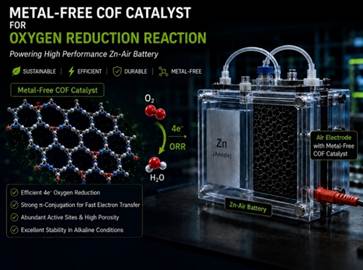
organic porous material called TTT-DHTD.
The material is
synthesised using 2,4,6-tris(4-aminophenyl)-1,3,5-triazine (TTT) and
4,8-dioxo-4,8-dihydrobenzo[1,2-b:4,5-b’]dithiophene-2,6-dicarbaldehyde (DHTD)
linkers. The findings have been published in the journal Science Advances.
Built entirely from
abundant elements including carbon, sulfur, nitrogen and hydrogen, TTT-DHTD
forms an ultra-porous, honeycomb-like network that provides favourable sites
for oxygen molecules to attach and undergo reactions needed for electricity
generation.
Laboratory tests
showed that when used as the air-electrode catalyst in Zn-air batteries, the
material achieved about 96 per cent of the performance of commercial platinum
catalysts while exhibiting remarkable stability. Even after 120 hours of
continuous operation, it retained its performance without the degradation or
contamination often associated with conventional metal-based catalysts.
The researchers, led
by Dr Pradip Pachfule of SNBNCBS, Prof Ramendra Sundar Dey of INST and Prof
Ranjit Thapa of SRM University, Amaravati, also employed advanced computer
simulations to understand the origin of the material's catalytic performance.
The simulations
indicated that the carefully engineered molecular architecture creates
favourable active sites where oxygen molecules can readily bind and react,
enabling the oxygen reduction process to proceed rapidly and efficiently.
The development could
have wider implications for clean transportation, portable power systems and
renewable-energy storage, where reducing dependence on costly precious metals
is crucial for achieving commercial scalability.
Compared with
hydrogen fuel cells, Zn-air batteries can offer a simpler and more compact
energy-storage option without the need for high-pressure hydrogen storage or
extensive hydrogen infrastructure. A durable, platinum-free catalyst could
therefore strengthen the case for Zn-air technology as an affordable
energy-storage solution.
The researchers said
the work demonstrates how innovative molecular design, coupled with
computational studies, can enable earth-abundant materials to approach the
performance of precious metals in critical clean-energy reactions.
The advance also underscores India's growing capabilities in sustainable materials research and could contribute to efforts to make efficient and durable clean-energy technologies more accessible.
As countries seek economical alternatives to fossil-fuel-based energy systems, the development of TTT-DHTD offers a promising route towards reducing material costs and making next-generation batteries and fuel-cell technologies more affordable and scalable.