What
Odisha needs today is not endless debate over whether industrialisation should
happen, but a more mature framework on how it should happen efficiently,
transparently and inclusively, writes Priyabrat Biswal
Odisha today stands
at a critical economic juncture. Endowed with some of India’s richest mineral
reserves and enormous industrial potential, the state has all the ingredients
required for rapid economic transformation. Yet, despite decades of policy
discussions and investment announcements, large-scale migration from many
districts continues unabated. Thousands of workers still leave the state every
year in search of livelihood opportunities elsewhere, exposing a deep
contradiction between Odisha’s natural wealth and its employment realities.
This contradiction
raises an important question: why does a resource-rich state continue to
witness distress-driven migration?
The answer lies not
in the absence of opportunity, but in the delayed conversion of opportunity
into execution.
Migration from Odisha
is not merely a social issue; it is fundamentally an economic and developmental
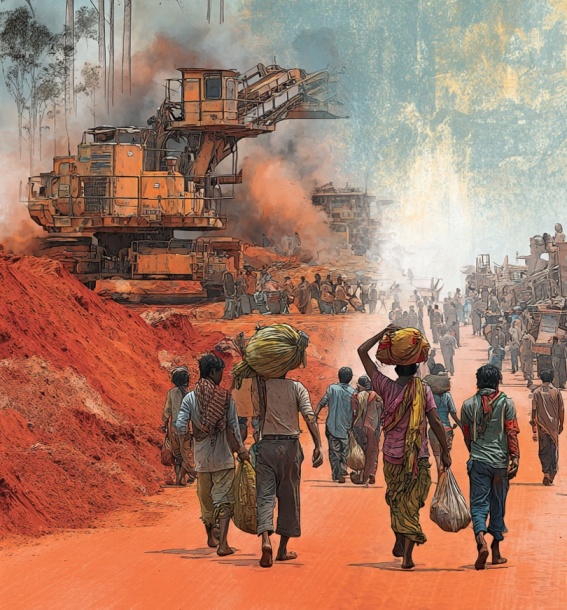
challenge. Large numbers of workers from western and southern Odisha travel to
states such as Telangana, Andhra Pradesh, Tamil Nadu, Gujarat and Kerala to
work in brick kilns, construction sites, factories and other labour-intensive
sectors. While migration itself is a natural economic phenomenon, the concern
arises when migration is driven less by aspiration and more by the absence of
adequate local employment.
In many districts,
agriculture alone is no longer capable of sustaining livelihoods. Dependence on
erratic rainfall, fragmented landholdings, limited irrigation facilities, low
productivity and weak market linkages have steadily reduced the viability of
farming as a dependable source of income. Seasonal agriculture often leaves
long periods of underemployment, particularly for younger populations seeking
stable earnings.
At the same time,
Odisha possesses immense industrial possibilities. The state holds vast
reserves of coal, iron ore, bauxite, manganese, limestone and chromite —
minerals that form the backbone of industries such as steel, aluminium, power
and cement. Few states in India possess such a strategic combination of natural
resources and industrial potential.
Yet, the economic
benefits of these resources have not fully translated into widespread
employment generation at the local level. One major reason is the prolonged
delay in operationalising industrial and mining projects despite clear economic
demand and policy intent.
For decades, Odisha
has witnessed a pattern where major projects are announced with significant
expectations but face years of uncertainty before implementation. Delays in
land acquisition, environmental clearances, litigation, administrative
bottlenecks and prolonged protests often stretch project timelines beyond
viability. In many cases, investors either scale down plans or withdraw
altogether.
Every stalled project
represents more than lost investment. It means lost jobs, delayed
infrastructure, reduced industrial activity and missed economic momentum. More
importantly, it deepens migration pressures because local economies fail to
generate alternative opportunities at the required scale.
This is where the
conversation on mining and industrialisation in Odisha requires a policy shift.
The debate can no
longer remain trapped between simplistic binaries of development versus
resistance. The real challenge is how to ensure timely, transparent and
professionally managed execution of projects while safeguarding legitimate
environmental and social concerns.
Odisha’s future
growth depends heavily on its ability to move from policy announcements to
policy delivery.
Mining remains
central to modern industrial economies. Steel production cannot happen without
iron ore. Aluminium production depends on bauxite. Power generation requires
coal. Infrastructure expansion across sectors depends on mineral extraction and
industrial supply chains. For a state like Odisha, mineral-led
industrialisation is not optional; it is a strategic economic advantage.
Importantly, Odisha
has already demonstrated how mining revenues can strengthen the state economy.
During periods of economic stress, particularly around the pandemic years,
mining emerged as a major fiscal support system for the state government.
Increased mineral revenues contributed significantly to public expenditure
capacity and economic resilience.
However, revenue
generation alone is not enough. The larger objective must be to create an
ecosystem where mining catalyses industrial corridors, downstream industries, logistics
networks, urban growth and large-scale employment generation.
That transformation
requires decisive management and governance reforms.
One of the biggest
requirements today is faster and more predictable project execution. Investors
require policy stability and administrative clarity. Projects cannot remain
trapped indefinitely between approvals, disputes and procedural delays.
Time-bound decision-making mechanisms must become integral to Odisha’s
industrial strategy.
Single-window systems
need to function in practice, not merely on paper. Inter-departmental
coordination must improve substantially so that clearances move simultaneously
rather than sequentially. Digital monitoring of project timelines,
accountability mechanisms for delays and institutionalised review systems can
help accelerate implementation.
Equally important is
the need for early-stage communication and stakeholder engagement. In several
instances, mistrust surrounding projects has intensified because information
gaps allowed uncertainty and misinformation to dominate public discourse.
Transparent communication regarding compensation, rehabilitation, environmental
safeguards, employment generation and long-term regional benefits is essential.
Communities are more
likely to support projects when they see clarity, accountability and visible
benefits rather than ambiguity and prolonged uncertainty.
Another critical area
requiring policy attention is industrial infrastructure. Mining alone cannot
transform regional economies unless supported by manufacturing, logistics and
ancillary industries. Odisha must therefore focus on creating integrated
industrial ecosystems rather than isolated extraction zones.
Improved road and
rail connectivity, logistics parks, industrial clusters, warehousing
infrastructure and power reliability are essential for attracting large-scale
manufacturing investment. Mineral extraction should serve as the foundation for
value addition within the state rather than the mere export of raw resources.
Skill development
must also align with industrial expansion. Odisha possesses a large young
workforce, but skill gaps continue to limit local participation in emerging
industries. Technical training institutions, vocational education centres and
industry-linked skill programmes must expand aggressively in high-growth
districts so that industrialisation directly translates into local employment.
A crucial aspect of
this transition is political and administrative continuity. Large projects
often extend across multiple years and governments. Frequent policy reversals,
inconsistent messaging or shifting priorities weaken investor confidence and
delay outcomes. Odisha requires a long-term industrial roadmap insulated from
short-term disruptions.
At the same time,
environmental sustainability cannot be ignored. Responsible mining practices,
scientific reclamation, pollution monitoring and ecological safeguards are
essential for maintaining long-term balance. Economic growth and environmental
responsibility must move together rather than being projected as opposing
goals.
What Odisha needs
today is not endless debate over whether industrialisation should happen, but a
more mature framework on how it should happen efficiently, transparently and
inclusively.
The state has already
laid much of the policy foundation. What remains is execution at scale.
Migration pressures
will not reduce through welfare measures alone. Sustainable reduction in
migration requires stable employment generation within Odisha itself. That
scale of employment can emerge only through accelerated industrialisation,
infrastructure expansion and mining-linked economic growth.
The challenge before
Odisha is therefore not one of resources, but of management. The state has
minerals, investment potential, industrial demand and strategic importance.
What it now needs is speed, coordination and policy certainty.
Timely execution of
mining and industrial projects can fundamentally reshape Odisha’s economic
landscape. It can convert mineral wealth into manufacturing growth,
infrastructure expansion and large-scale employment opportunities. Most
importantly, it can reduce the economic compulsions that continue to drive
migration from many parts of the state.
Odisha’s next phase
of growth will depend not merely on what lies beneath its soil, but on how
effectively the state manages the opportunities above it.
(The
views expressed in this article are those of the author and do not necessarily
reflect the views of the website or its management.)