THEBUSINESSBYTES
BUREAU
NEW
DELHI, APRIL 28, 2026
Emphasising
that India's maritime sector is undergoing a transformational shift, Secretary,
Ministry of Ports, Shipping and Waterways (MoPSW), Vijay Kumar on Tuesday
called for deeper collaboration between the Centre and coastal states to unlock
the full potential of the country's blue economy and realise the Maritime Amrit
Kaal Vision 2047.
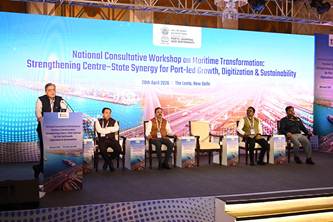
Addressing
the National Consultative Workshop with Coastal States and Union Territories in
New Delhi, Vijay Kumar said India has made remarkable strides in recent years,
with significant improvements in port efficiency, enhanced global rankings, and
stronger integration with international trade networks. He noted that a
combination of policy reforms, robust infrastructure development, and rising
private sector participation is steadily positioning India as a formidable
maritime power.
The
high-level workshop brought together representatives from coastal states, Union
Territories, and key maritime stakeholders to align national priorities with
state-level initiatives. Deliberations centred on accelerating port-led
development, boosting logistics efficiency, and promoting digital and
sustainable maritime practices to enhance India's global competitiveness.
Anchored
in the Maritime Amrit Kaal Vision 2047, the government's long-term roadmap
envisages substantial investments across ports, coastal shipping, inland
waterways, shipbuilding, and green shipping. Vijay Kumar highlighted that
India's port capacity and operational capabilities are poised for substantial
expansion over the coming decades, driven by mechanisation, infrastructure
modernisation, and port-led industrialisation. He also underscored shipbuilding
as a strategic priority for strengthening India's position in the global
maritime value chain.
A
major focus of the workshop was the critical role of non-major ports, which
currently handle nearly 46 per cent of India's cargo. The Ministry stressed the
need to better integrate these ports with national frameworks through
standardised processes, digital adoption, and operational efficiency
improvements.
The
discussions were organised around three key pillars—sectoral growth, regulatory
and digital reforms, and state-led capacity expansion initiatives. Participants
reviewed progress in infrastructure creation, public-private partnership
models, and ease-of-doing-business measures, while identifying fresh
opportunities for growth.
Technology
and regulatory modernisation featured prominently, with detailed discussions on
the implementation of the One Nation One Port Process (ONOP) and the Maritime
Single Window, Sagar Setu. These initiatives are expected to streamline
operations and enable seamless end-to-end digital transactions across India's
maritime ecosystem. The Indian Ports Act, 2025, was also highlighted as a
landmark reform that will strengthen Centre-State coordination and create a
transparent, future-ready regulatory environment.
Coastal
states and Union Territories showcased their initiatives spanning port
infrastructure expansion, green port development, digital transformation, and
the establishment of shipbuilding and maritime industrial clusters. Their
presentations reflected strong alignment with the Centre's strategic vision and
a shared commitment to building a resilient, efficient, and sustainable
maritime ecosystem.
The
workshop saw participation from Gujarat, Maharashtra, Goa, Karnataka, Kerala,
Tamil Nadu, Andhra Pradesh, Odisha, West Bengal, and the Union Territories of
Dadra & Nagar Haveli and Daman & Diu, Puducherry, Andaman & Nicobar
Islands, and Lakshadweep.
Concluding
the deliberations, Joint Secretary (Ports, IT & e-Governance), MoPSW,
Venkatesapathy S., said initiatives such as ONOP, Maritime Single Window (Sagar
Setu), and the Indian Ports Act, 2025, will play a pivotal role in driving
efficiency, transparency, and seamless integration across the maritime sector.
The
Ministry described the workshop as a significant milestone in strengthening
cooperative federalism in the maritime domain, reaffirming India's commitment
to becoming a leading global maritime nation by 2047.