
THEBUSINESSBYTES
BUREAU
NEW
DELHI, APRIL 28, 2026
In
a major push towards building a digitally empowered and economically resilient
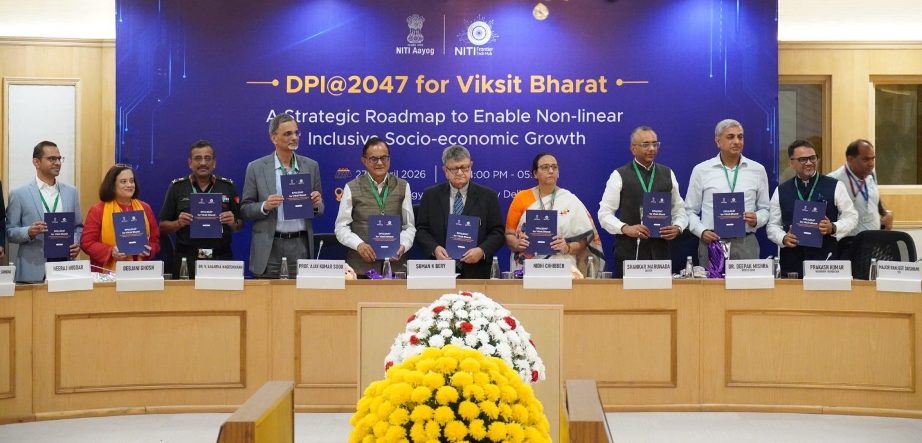
India, NITI Aayog has launched the DPI@2047 roadmap, a strategic blueprint
aimed at driving inclusive, non-linear and productivity-led growth through the
next generation of Digital Public Infrastructure (DPI).
Unveiled
by Suman Bery, Vice Chairman, NITI Aayog, and Prof. Ajay Kumar Sood, Principal
Scientific Adviser to the Government of India, the roadmap charts India's
digital transformation journey through two distinct phases—DPI 2.0 from 2025 to
2035, focused on livelihood-led growth, and DPI 3.0 from 2035 to 2047, aimed at
delivering broad-based prosperity. The immediate thrust will be on DPI 2.0.
Speaking
on the occasion, Suman Bery said that the focus has shifted from GDP to
productivity. Higher quality employment, stronger incomes, and better living
standards depend on rising productivity. DPI 1.0 has shown that harnessing
networks is the secret of where we have reached. This roadmap makes that shift
clear. The next phase of India’s development will be shaped by how AI and DPI
raise productivity at scale, placing it at the centre of India’s development
journey and helping lay the foundation for Viksit Bharat 2047.
The
roadmap has been developed in collaboration with EkStep Foundation and
Deloitte, reflecting a strong partnership between government, industry and the
innovation ecosystem. It lays out eight sectoral transformations spanning
MSMEs, agriculture, education and healthcare, while also strengthening critical
enablers such as credit access, decentralised energy and efficient benefit
delivery.
At
the heart of the strategy are four execution imperatives—district-led demand
aggregation, scaling technology entrepreneurship, leveraging artificial
intelligence, and unlocking value across sectors through trusted data flows,
digital transactions, stronger human capacity and the democratisation of AI.
Prof.
Ajay Kumar Sood highlighted that technology leadership will increasingly be
defined by our ability to translate science and innovation into scalable,
trusted public outcomes. India’s DPI has demonstrated the power of open,
interoperable systems at population scale. The next phase must build on this
foundation, integrating frontier technologies with strong scientific rigour and
safeguards. This roadmap reflects that direction, focusing on responsible
deployment and real-world impact. India has the scientific depth and digital
foundations to lead by example.
The
DPI@2047 roadmap marks a significant shift in India's digital evolution — from
enabling access and inclusion to fostering productivity, livelihoods and market
access at scale. It seeks to extend India's digital rails beyond identity,
payments and welfare into the core engines of economic growth and enterprise.
NITI
Aayog CEO Nidhi Chhibber underscored the critical role of states in this
journey. Chibber emphasised that a significant part of the NITI FTH roadmap
focuses on supporting States in their transformation journeys. The intent is to
equip them with practical pathways they can adapt and implement. Our
perspective is simple: when States grow fast, India grows faster. DPI can
become a significant enabler in accelerating inclusive growth for states.
Debjani Ghosh, Distinguished Fellow, NITI Aayog, said the roadmap will help India harness its unique strengths in the global AI race. Ghosh remarked that the roadmap sets out how DPI 2.0 can move India from digital inclusion to productivity-led, livelihood-centred growth on the road to Viksit Bharat 2047. The global AI race is no longer only about frontier models, chips and capital; it is increasingly about a country’s ability to connect digital infrastructure with economy-wide diffusion and impact. India enters this next phase with a powerful structural advantage: its Digital Public Infrastructure. By combining DPI, AI and entrepreneurship, India can build an inclusive, vernacular and population-scale model of AI adoption that improves lives, strengthens livelihoods and unlocks productivity across critical sectors.
With industry leaders, start-ups and development partners rallying behind the initiative, DPI@2047 is poised to become a cornerstone of India's ambition to emerge as a developed nation by 2047, leveraging technology as a force multiplier for broad-based prosperity.