
THEBUSINESSBYTES
BUREAU
BHUBANESWAR,
JULY 1, 2026
In a major policy
push aimed at strengthening education, digital governance, food security, power
infrastructure and the Blue Economy, the Odisha Cabinet on Wednesday approved
12 significant proposals across eight departments, including a landmark
decision to provide free education from Kindergarten to Postgraduate level and
establish a next-generation State Data Centre at an investment of ₹268.44 crore.
The 42nd Cabinet
meeting, chaired by Chief Minister Mohan Charan Majhi at Lok Seva Bhavan,
cleared a series of transformative initiatives designed to accelerate inclusive
growth, modernise public services and improve citizens' quality of life. While
the Chief Minister briefed the media on the flagship education proposal, Chief
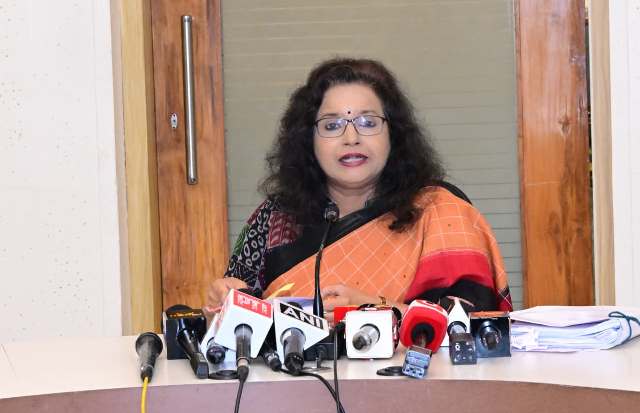
Secretary Anu Garg outlined the remaining Cabinet decisions.
The approved
proposals cover the Higher Education, Fisheries and Animal Resources
Development, Electronics and Information Technology, Food Supplies and Consumer
Welfare, Works, Water Resources, School and Mass Education, and Revenue and
Disaster Management departments.
Odisha to Build State-of-the-Art
Data Centre
In a major boost to
digital governance, the Cabinet approved the establishment of the Odisha State
Data Centre 2.0 (OSDC 2.0), a Tier-III compliant, secure and fully state-owned
digital infrastructure that will replace the existing data centre operational
since 2011.
The present facility
hosts more than 600 government applications across 39 departments but is
nearing the end of its operational life. OSDC 2.0 will provide a scalable and
high-availability platform capable of meeting the state's growing digital
governance requirements.
The project includes
migration of all existing government applications, strengthened cyber security
architecture and a modern Disaster Recovery facility to ensure uninterrupted
delivery of public services. It will also adopt green and energy-efficient
technologies.
The Cabinet approved
an outlay of ₹268.44
crore, covering establishment as well as operation and maintenance for five
years. The project is expected to lay the digital foundation for Odisha's
governance needs over the next decade.
Free Education from KG to PG
In one of its most
ambitious social sector decisions, the Cabinet approved the "Gyanodaya –
Shiksharu Samruddhi" scheme, fulfilling the government's commitment to
provide free education from Kindergarten to Postgraduate level.
Beginning with the
academic session 2026-27, students enrolled in regular courses in Government
and Government-Aided institutions will receive a complete waiver of admission
fees.
The scheme covers
students of Classes IX to XII in Government and aided schools as well as
Undergraduate and Postgraduate courses in State Public Universities, Government
Colleges and Government-Aided Colleges. Since education from KG to Class VIII
is already free, Odisha will now provide free education throughout the academic
journey from KG to PG.
More than 32 lakh
students are expected to benefit annually. The government estimates an
expenditure of ₹895.57
crore in the first year and ₹5,467.55 crore over five years, making it one of
the largest investments in the state's education sector.
The scheme excludes
self-financing courses, unaided institutions, PPP-mode institutions and
professional or technical programmes. It aligns with the National Education
Policy (NEP) 2020, Odisha Vision 2036 and Vision 2047.
Private Fair Price Shop Dealers
Get Extension
To ensure
uninterrupted distribution of subsidised food grains, the Cabinet approved an
amendment extending the tenure of private dealers operating Fair Price Shops
(FPS) under the Public Distribution System (PDS) till September 30, 2026.
The government said
immediate replacement of all private dealers could disrupt food distribution
and create administrative difficulties.
Odisha currently has
12,349 Fair Price Shops, including 5,472 managed by private dealers, besides
Gram Panchayats, Self Help Groups and cooperative societies. The earlier
provision facilitating gradual replacement of private dealers with
institutional operators had expired on March 31, 2026.
Big Push for Power Infrastructure
The Cabinet also
approved leasing up to 200 acres of government land to the Odisha Power
Transmission Corporation Ltd (OPTCL) for establishing 765 kV Grid Sub-stations
at concessional premium rates under the Industrial Policy Resolutions (IPRs).
The decision
addresses the rapidly growing demand for electricity driven by
industrialisation, urbanisation and increasing domestic consumption.
Chief Secretary Anu
Garg said the decision would help OPTCL complete high-capacity transmission
projects on schedule and ensure reliable power supply across Odisha.
While concessional
land provisions already existed for 400 kV, 220 kV and 132 kV substations, no
such policy earlier covered 765 kV infrastructure.
Inland Shrimp Farming Gets
Regulatory Framework
The Cabinet approved
a comprehensive regulatory framework and operational guidelines for scientific
cultivation of SPF Litopenaeus vannamei (white leg shrimp) and other
brackish-water species in inland saline areas located beyond the jurisdiction
of the Coastal Aquaculture Authority.
The framework
provides for online registration, scientific site selection, strict biosecurity
measures, disease surveillance, water-quality monitoring and mandatory Effluent
Treatment Systems (ETS), while promoting cluster-based aquaculture with shared
infrastructure.
The initiative forms
a key component of the proposed Odisha Shrimp Mission under the state's Blue
Economy strategy.
By 2036, Odisha aims
to bring an additional 25,000 hectares under shrimp farming, increase annual
shrimp production from 1.6 lakh metric tonnes to 9 lakh metric tonnes, raise
seafood exports from ₹5,429
crore to ₹15,000 crore, and generate nearly 2.5 lakh livelihoods.
The state also aims
to emerge as one of India's leading shrimp-producing and exporting states by
2047 through environmentally sustainable aquaculture practices.