
THEBUSINESSBYTES BUREAU
NEW DELHI, JULY 23, 2026
Private investment in India's space sector has crossed USD
618.5 million following the Centre's space sector reforms, while 105
authorisations have been granted to non-government entities (NGEs) to undertake
space activities, the government informed the Rajya Sabha on Thursday.
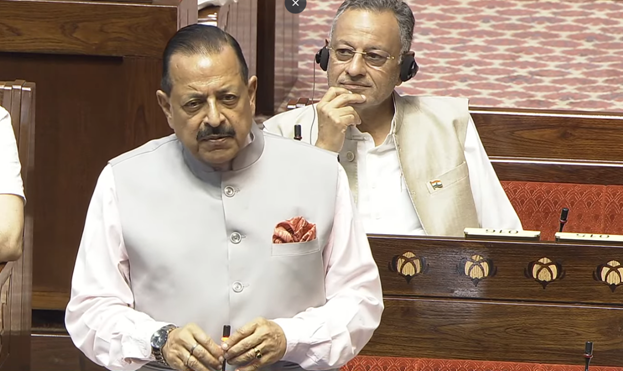
Replying to an Unstarred Question in the Upper House, Union
Minister of State (Independent Charge) for Science and Technology, Earth
Sciences, and Minister of State in the Prime Minister's Office, Dr Jitendra
Singh said private investment worth USD 187 million has been reported during
2026, while 105 authorisations had been issued to NGEs as on July 14, 2026.
He said cumulative private funding has grown nearly six-fold
over the past few years, increasing from USD 100.5 million in 2021-22 to USD
348.5 million in 2023-24 before reaching USD 618.5 million by March 31, 2026,
reflecting rising investor confidence in India's expanding space ecosystem.
The minister said the government has strengthened the
regulatory framework to ensure that rapid commercial growth is accompanied by
robust national security safeguards.
He informed the House that every application for private
space activities is evaluated under the Indian National Space Promotion and
Authorisation Centre's (IN-SPACe) Norms, Guidelines and Procedures with due
consideration to strategic, security and national interests before
authorisation is granted.
He further said that IN-SPACe is preparing dedicated Safety
and Security Guidelines for space activities in consultation with stakeholders
to further strengthen the country's regulatory architecture as private
participation continues to expand.
Dr Jitendra Singh said the government has also put in place a
comprehensive policy, regulatory and financial ecosystem to accelerate the
growth of the private space industry.
The measures include implementation of the India Space Policy
2023, a liberalised Foreign Direct Investment (FDI) policy, streamlined
authorisation procedures through IN-SPACe, concessional access to ISRO
facilities, a ₹1,000 crore Venture Capital Fund, a ₹500 crore Technology Adoption Fund, the IN-SPACe
Seed Fund Scheme, technology transfer from ISRO, entrepreneurship and
incubation support, affordable testing infrastructure, skill development
initiatives and sustained industry outreach programmes.
The minister informed the Rajya Sabha that 17 space startups
have so far been authorised by IN-SPACe to undertake space activities,
underscoring the emergence of a vibrant startup ecosystem contributing to
India's space ambitions.
Sharing the findings of IN-SPACe's impact assessment of the
2020 space sector reforms, Dr Jitendra Singh said the reforms have transformed
India's private space landscape within six years.
According to the assessment, the number of active space
startups has increased from just one in 2014 to over 400, while private
investment has crossed USD 600 million.
The assessment also noted that Indian private companies have
demonstrated launch and orbital capabilities, placed more than 30 satellites
into orbit, and flown nearly 45 payloads through platforms such as the PSLV
Orbital Experimental Module (POEM), indicating growing technological capability
and commercial maturity.
It further highlighted India's expanding global presence in the space economy, with Indian space companies attracting international investment, expanding overseas operations and collaborating with global partners. IN-SPACe has also established working relationships with more than 45 countries and signed cooperation agreements with foreign space agencies.
The assessment said the Earth Observation Public-Private Partnership (EO-PPP) has brought together leading Indian companies to develop the country's first privately owned Earth observation satellite constellation with a private investment commitment of around ₹1,200 crore, reflecting growing industry confidence in India's space sector reforms.