
THEBUSINESSBYTES
BUREAU
PURI,
JULY 13, 2026
In the run-up to the
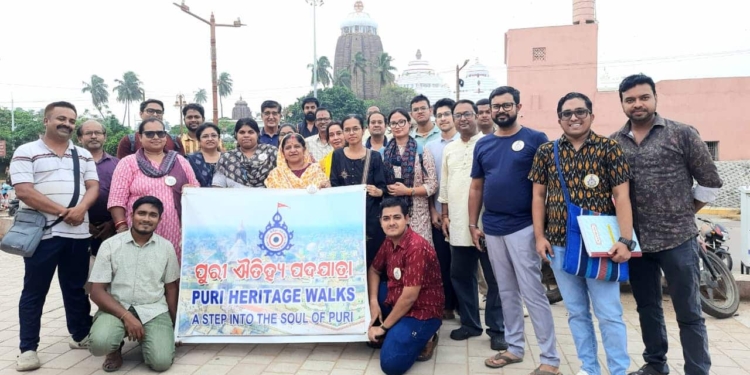
world-famous Rath Yatra, the 23rd edition of the Puri Heritage Walks (PHW)
offered heritage enthusiasts a fascinating journey into the lesser-known
rituals and living traditions of Lord Jagannath, highlighting the centuries-old
artistry behind the sacred “Tahia Seva” and the significance of the “Anasara”
rituals inside the Shree Jagannath Temple.
The heritage walk
began at the historic Raghab Das Math, located near the southern gate of the
Srimandir, where participants explored the monastery’s enduring role in
preparing the ornate “Tahia” floral headgear worn by Lord Jagannath and Lord
Balabhadra during the sacred “Pahandi” processions and the deities’ “Hati
Besha”. The Math has preserved this revered tradition since the royal era,
making it an integral part of Jagannath culture.
Master artisan
Satyanarayan Behera, who leads the monastery’s Tahia craftsmanship,
demonstrated the meticulous process of creating the elaborate headgear using
eco-friendly and traditional materials such as bamboo frames, fragrant flowers,
sola pith decorations, silver zari, cotton threads and natural Kaitha gum,
without the use of synthetic colours or adhesives.
He informed
participants that nearly 24 Tahias and Topors are handcrafted annually by a
team of 20 to 25 artisans for six major ceremonial occasions, including Snana
Purnima, Rath Yatra, Bahuda Yatra and Niladri Bije. He also explained that the
dimensions of each Tahia are precisely designed to suit the temple gates
through which the deities ceremonially pass.
The walk later
proceeded inside the Shree Jagannath Temple, where participants witnessed the
sacred “Patti Dian Darshan” during the ongoing Anasara period, when the sibling
deities remain in seclusion following Snana Purnima. Heritage enthusiast Arpana
Gaurab Das elaborated on the spiritual significance of the rituals, explaining
that during Anasara, Sri Narayan is worshipped in place of Lord Jagannath, Sri
Ananta Vasudeva represents Lord Balabhadra, and Goddess Bhuvaneswari stands in
for Devi Subhadra.
Participants also
learned about the representative deities worshipped during this period,
including Madanmohan, Nrusingha, Dolagovinda, Sridevi, Bhudevi and
Rama-Krushna. The heritage trail further covered important temple landmarks
such as the Bhoga Mandapa, Koili Baikuntha and Snana Bedi, while discussions on
the architectural heritage of the Srimandir culminated with an observation of
the sacred Patitapabana Bana fluttering atop the Neelachakra.
As a mark of gratitude for his outstanding contribution to preserving Odisha’s traditional craftsmanship, the PHW team felicitated master artisan Satyanarayan Behera. The programme was coordinated by PHW convener Dr. Kumar Arojyoti and co-convener Ashokamanjari Nayak.
Heritage researcher Debi Prasanna Nanda, along with heritage lovers from Puri, Khordha, Bhubaneswar, Cuttack, Rourkela and several other parts of Odisha, participated enthusiastically in the walk, transforming the event into a vibrant celebration of Odisha’s living heritage and the timeless traditions of Jagannath culture ahead of Rath Yatra 2026.