
THEBUSINESSBYTES
BUREAU
MADANAPALLE
(ANDHRA PRADESH), OCTOBER 2, 2026
Reliance Industries
Ltd. plans to invest ₹1
trillion in Andhra Pradesh to establish compressed biogas (CBG) plants, in a
major clean-energy push that is expected to create more
than three lakh jobs and generate nearly ₹60,000 crore in revenue for the State over the coming
decades, Executive Virector Anant M. Ambani said on Friday.
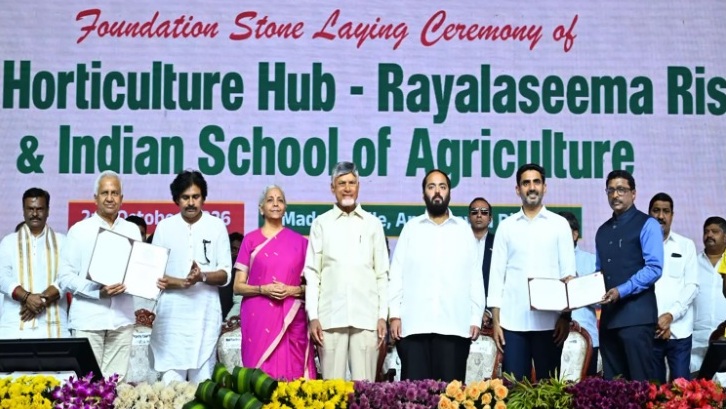
Speaking at the
foundation stone laying ceremony for the Rayalaseema Horticulture Hub and Indian
School of Agriculture in Madanapalle, Ambani said the proposed investment would
link the State’s agricultural economy with India’s growing clean-energy
requirements while creating new income opportunities for farmers.
“Our kisans
(farmers), who ensure India’s food security, will now strengthen India’s energy
security too — making India self-reliant in energy,” he said.
The CBG plants are
expected to process agricultural residue, animal dung, food waste and other
forms of biomass into methane-rich renewable gas. CBG can be used as an
alternative to conventional natural gas in transportation, industry and
commercial applications, while also helping convert agricultural and organic
waste into energy and bio-manure.
Ambani said the
projects would create more than three lakh jobs and contribute nearly ₹60,000 crore in revenue to Andhra
Pradesh over the coming decades. Reliance is also investing in clean-energy
projects in Rayalaseema and exploring opportunities in advanced
manufacturing, he added.
Citing State
government data, Ambani said Andhra Pradesh had approved 388 mega projects
since June 2024, representing investment commitments of more than ₹14 trillion and the potential to
generate nearly 11 lakh jobs. Around a third of these
investments, he said, were headed towards the Rayalaseema region.
The proposed
Rayalaseema Horticulture Hub, backed by an investment of ₹40,000 crore, is aimed at promoting
technology-led agriculture in the region. Ambani said
the initiative would seek to combine modern technology with the traditional
knowledge of farmers.
The Indian School of
Agriculture, meanwhile, will focus on applications including artificial
intelligence-based pest prediction, drone-enabled crop monitoring, precision
irrigation, robotics and agricultural price intelligence.
“Here in this School, Artificial Intelligence
will meet the Traditional Intelligence of Bharat’s hard-working Kisans,” he
said.
Reliance’s digital
arm Jio will collaborate with the school to take training programmes to
millions of farmers in Indian languages through virtual classrooms in villages.
Rural youth could also be trained as digitally enabled agricultural extension
workers, Mr. Ambani said.
Jio Krishi,
Reliance’s agricultural technology platform, will form part of the broader
digital ecosystem, while the company’s bio-energy research and development
centre in Jamnagar is expected to support its clean-energy ambitions.
Ambani also said
Reliance would explore cooperation between the Indian School of Agriculture and
Vantara’s proposed university for wildlife and veterinary sciences.
Addressing Chief Minister N. Chandrababu Naidu, Ambani said, “Treat me as a son of Andhra.”
He said the initiatives were intended not merely as infrastructure projects but as foundations for rural enterprise, stronger villages and greater opportunities for farmers and young people to build livelihoods within their communities.