
THEBUSINESSBYTES
BUREAU
NEW
DELHI, OCTOBER 8, 2026
Union Minister for
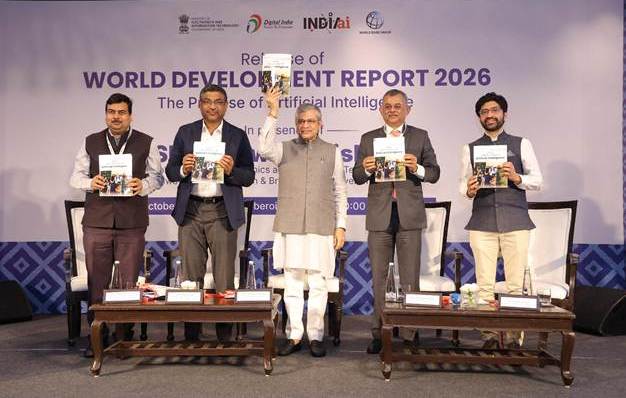
Electronics and Information Technology Ashwini Vaishnaw on Thursday launched
the World Bank Group’s World Development
Report 2026: The Promise of Artificial Intelligence, calling for wider
democratisation of technology to ensure its benefits reach citizens,
enterprises and institutions across the country.
The report, launched
at an event organised jointly by the IndiaAI Mission, Ministry of Electronics
and Information Technology (MeitY) and the World Bank Group in New Delhi,
examines the opportunities and challenges AI presents for developing economies
and outlines a framework centred on adoption, adaptation and advancement.
“AI is changing the lives of ordinary people,”
Vaishnaw said, citing an initiative in Baramati where sugarcane yields rose 40
per cent with 30 per cent less water and fertiliser through voice-based
technology. He also highlighted a 35 per cent increase in TB detection through
AI-enabled healthcare applications.
The minister said the
Baramati initiative uses satellite, IoT and weather data and has also reduced
labour costs. In Gujarat, AgriStack is being used by five lakh farmers, while
AI-based animal health services through Sarlaben are benefiting three crore
cattle and their farmers.
The World Bank report
notes that AI can expand access to expertise, improve productivity and
strengthen service delivery in developing economies. However, it stresses that
such gains depend on foundations including reliable electricity and
connectivity, computing infrastructure, quality data, skills, education systems
and capable institutions.
India is developing
its AI ecosystem through the IndiaAI Mission’s seven pillars, covering compute
capacity, indigenous foundation models, datasets, application development,
future skills, startup financing and safe and trusted AI.
World Bank Group
Chief Economist Michael Kremer said India’s progress in AI offers lessons for
the wider developing world. He highlighted AI-based weather advisories and
education solutions, stressing that successful scale-up requires a “full stack”
approach involving not just software but also human and institutional
capabilities.
The report’s
Director, Gaurav Nayyar, said developing countries should be “optimistic,
strategic and pragmatic” about AI, focusing on adapting existing tools to local
needs rather than spending heavily on building advanced systems from scratch.
A high-level panel
subsequently discussed AI adoption, local adaptation and risk management, with
participants emphasising the need to move beyond isolated pilots towards
evidence-based scale-up, while improving access to data and computing
infrastructure.
A State AI Showcase also featured solutions from Andhra Pradesh, Maharashtra, Meghalaya and other parts of India, demonstrating applications in child development screening, agriculture, education and healthcare.
The deliberations underscored the importance of public trust and ensuring AI develops in a safe, responsible and inclusive manner, while strengthening institutional and policy frameworks needed to translate technological advances into broad-based development outcomes.